
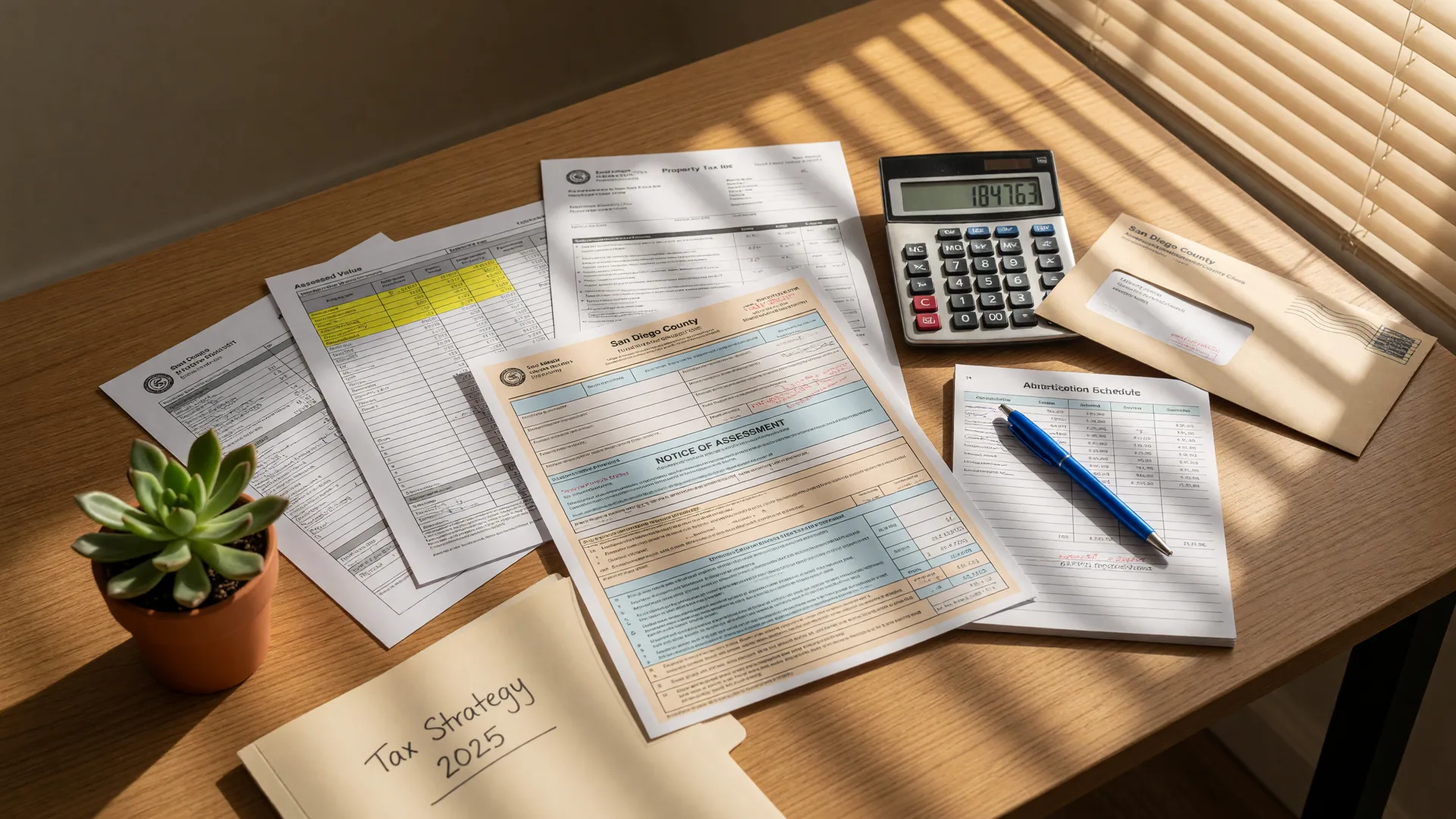
California property tax strategies for San Diego real estate investors.
A complete guide to Proposition 13, Proposition 8 decline-in-value reassessments, Proposition 19 inheritance rules, and the property tax appeal process for San Diego County real estate investors.
San Diego County's 2026 assessment roll, up $39 billion (4.86%) from 2025. Countywide assessed values continue to rise.
Prop 13's maximum annual assessed value increase. On a $750,000 property, that means a max increase of $15,000 per year regardless of market gains.
Deadline to file a formal 2026 assessment appeal. The window opened July 2. Property owners who act now can still file on time.
Average reduction on completed 2024 residential appeals in San Diego County. Properties bought at market peaks can achieve substantially larger savings.
California's property tax system is unlike any other state's. Understanding Prop 13, Prop 8, and Prop 19 is not optional for San Diego real estate investors — these rules directly determine your holding costs, your exit strategy, and the value you pass to the next generation.
San Diego County's 2026 assessment roll reached $845 billion, up 4.86% from $806 billion in 2025. That $39 billion increase in assessed value translates to roughly $390 million in additional property tax revenue. For investors, those rising assessments mean higher holding costs every year — unless you know how to use the tools California's tax system provides.
The three pillars of California property tax — Proposition 13 (1978), Proposition 8 (1978), and Proposition 19 (2020) — create a system that rewards long-term buy-and-hold investors, offers temporary relief during market downturns, and has recently tightened rules for transferring property within families. Each of these affects your investment returns in meaningful, quantifiable ways.
This guide covers every major property tax strategy available to San Diego real estate investors. We explain how Prop 13's 2% assessment cap creates a powerful long-term advantage for buy-and-hold investors, how to file a Prop 8 decline-in-value appeal (the filing window for the 2026 assessment year is open now through November 30), what Prop 19 means for inherited investment properties, and how the formal assessment appeal process works.
We also include four real investor scenarios — from the 2022 peak buyer to the inheritor of a family rental — with actionable strategies for each. Whether you are buying your first rental property or managing a portfolio of a dozen units, understanding California property tax is essential to maximizing your after-tax returns.
San Diego County total assessed value, up 4.86% ($39B) from 2025.
Deadline to file a 2026 decline-in-value appeal with the Assessor.
Maximum annual increase on assessed value, regardless of market appreciation.
Residential appeals filed countywide. Only 1.8% average reduction on completed cases.
Prop 13, Prop 8, and Prop 19: how California's property tax system works.
California's property tax system is defined by three voter-approved propositions. Together they create a framework that is both predictable and, for informed investors, strategically manageable.
Prop 13: The Foundation
Passed in 1978, Proposition 13 is the cornerstone of California property tax. It limits the property tax rate to 1% of the assessed value (plus voter-approved bonds) and caps annual assessed value increases at 2%, regardless of how much the market appreciates. Upon purchase, the property is reassessed to its purchase price. This means two identical homes on the same block can have vastly different tax bills based on when they were last sold.
Tax rate = 1% of assessed value + local assessments. Max 2% annual increase.
Prop 8: Decline-in-Value Reassessment
Proposition 8 allows property owners to request a temporary reduction in assessed value when the current market value falls below the factored base year value. This is relevant for investors who bought at the market peak in 2021-2022 and have seen values moderate in certain segments. The reduction is temporary: the Assessor reviews the property annually, and once market value recovers above the factored base year value, the original assessment is reinstated (plus the 2% annual adjustments that would have applied).
File July 2 - November 30 for current year. Free informal review available.
Prop 19: Transfer & Inheritance Rules
Proposition 19, effective February 2021, dramatically changed property tax transfer rules. For investment properties, the most significant change is that the parent-child exclusion no longer applies to non-primary residences. A child inheriting a rental property, vacation home, or any investment property will have it reassessed to current market value. Only primary residences qualify for the base year value transfer, subject to a $1 million assessed value cap. For age 55+, severely disabled, or wildfire victims, base year value can be transferred to a replacement primary residence up to three times statewide.
Investment properties: no parent-child exclusion. Primary residences: up to $1M assessed value cap.
Assessment Appeals Process
Property owners who disagree with their assessed value can appeal to the San Diego County Assessment Appeals Board. The process begins with an informal review by the Assessor's Office (free, no deadline), followed by a formal appeal to the Assessment Appeals Board (filing fee, specific deadline). Evidence must include comparable sales near the January 1 lien date. In 2024, San Diego County completed 1,514 residential appeals with an average reduction of 1.80%. While the average reduction is modest, successful appeals for properties purchased near market peaks can yield substantially larger savings.
Step 1: Informal review. Step 2: Formal appeal. Deadline: November 30, 2026.
Five steps to file a property tax appeal in San Diego County.
The property tax appeal process is straightforward but requires preparation. The 2026 filing window is open now through November 30. Here is exactly how to pursue a reduction.
Check Your Assessed Value
Review your annual property tax bill or look up your property on the San Diego County Assessor's online portal. Compare the assessed value to the estimated current market value. If your assessed value (factored base year value) exceeds what the property would reasonably sell for on January 1, you may qualify for a Prop 8 reduction.
Gather Comparable Sales
Collect at least 3-5 comparable property sales from the months surrounding January 1 of the assessment year. Focus on properties similar in size, location, condition, and property type. The Assessor's Office provides online tools to research comparable sales data. Professional appraisals or broker price opinions can strengthen your case.
Request an Informal Review
Contact the San Diego County Assessor's Office to request an informal review. There is no fee and no formal deadline. Submit your comparable sales data and explain why the assessed value should be reduced. The Assessor may agree to adjust the value without requiring a formal hearing. This is the fastest and least burdensome path.
File a Formal Appeal (If Needed)
If the informal review does not produce the desired result, file a formal Assessment Appeal Application with the Assessment Appeals Board. The deadline for the 2026 regular roll is November 30, 2026. There is a filing fee (typically $30-$100 depending on assessed value). Include all supporting evidence and be prepared to present your case at a hearing.
Monitor and Renew Annually
If your Prop 8 reduction is granted, the Assessor will review the value annually. If market values remain below the factored base year value, the reduction continues. Once market values recover, the original base year value is reinstated with the 2% annual adjustments that would have applied. You do not need to reapply each year.
Key dates for 2026: The filing window opened July 2, 2026. The deadline to file a formal Assessment Appeal Application is November 30, 2026. An informal review can be requested at any time with no fee and no deadline. Start gathering comparable sales data now.

Property tax strategies are specific to each property's purchase date, value trajectory, and ownership structure. A plan that works for one investor may not apply to another.
How do these rules apply to real San Diego investors?
Every investor's property tax situation is different. Here are four common scenarios with specific strategies for each.
Bought at 2022 Peak
An investor purchased a 4-unit multifamily in City Heights for $1.2M in April 2022. Current market value is approximately $1.05M. Assessed value (with 2% annual increases) is about $1.27M. A Prop 8 appeal could reduce assessed value to $1.05M, saving approximately $2,200 in property taxes this year.
Inherited Rental Property
An investor inherited a rental home in Chula Vista from a parent who purchased in 1998 with a base year value of $220,000. Under Prop 19, this is now reassessed to current market value of $780,000. The annual tax bill jumps from $2,640 to approximately $9,360. No Prop 8 remedy here unless the market subsequently declines.
Adding Value Through Improvements
An investor adds an ADU to a primary residence with a low Prop 13 base. The ADU addition triggers reassessment of only the new construction value, not the entire property. The new assessed value is the existing base year value plus the cost of the ADU. This is significantly more favorable than selling and buying a new income property at current market prices.
Portfolio Tax Planning
An investor with 6 rental properties in San Diego County wants to consolidate into fewer, higher-value assets. A 1031 exchange defers capital gains but triggers reassessment of each replacement property to purchase price. The investor must weigh the federal tax deferral benefit against the California property tax increase on replacement assets.
How does property tax treatment differ across investment scenarios?
Quick-reference comparison of how California's property tax rules apply to different investment scenarios. Each scenario has a distinct tax strategy.
| Scenario | Tax Base Treatment | Effective Rate | Recommended Action |
|---|---|---|---|
| Buy-and-Hold (10yr hold) | Locked at purchase + 2%/yr | ~1.0% - 1.2% of purchase price | Use Prop 13 to your advantage. Avoid selling unless 1031 exchanging. |
| Market Peak Buyer (Prop 8) | Temporary reduction possible | Reduced to current market value | File Prop 8 appeal before Nov 30 deadline. Reapply annually if needed. |
| Inherited Investment (Prop 19) | Reassessed to FMV upon transfer | ~1.0% - 1.25% of current FMV | Plan for step-up in basis. Consider whether to convert to primary residence. |
| ADU Addition | Existing base + new construction cost | ~1.0% of new construction cost | Add value via improvements rather than selling and repurchasing. |
| 1031 Exchange Replacement | Reassessed to purchase price | ~1.0% - 1.25% of new purchase price | Model property tax increase vs. capital gains deferral benefit. |
Important note: Property tax strategies should always be developed in consultation with a qualified tax professional or CPA. This guide provides a framework for understanding California's rules, but individual circumstances vary. The San Diego County Assessor's Office provides free resources and informal review processes for property owners who want to explore their options.
What else should investors know about California property tax?
Supplemental Assessments
When you purchase a property, the county issues a supplemental assessment reflecting the difference between the old assessed value and your purchase price. You will receive a supplemental tax bill for the prorated remainder of the tax year. This is separate from your regular annual bill and can catch new investors off guard. Budget for supplemental taxes in your first year of ownership.
Property Tax as an Investment Metric
When evaluating a potential acquisition, always look up the current assessed value. A property with a low Prop 13 base (held by a long-term owner) will have a significantly lower tax bill than a recently purchased comparable. When you buy, the property is reassessed to your purchase price. Factor this into your pro forma — the tax bill will be higher than what the current owner pays.
Mello-Roos & Special Assessments
Many newer San Diego communities have Mello-Roos districts or Community Facilities Districts (CFDs) that levy additional property taxes above the 1% Prop 13 rate. These special taxes can add 0.5% - 1.5% to the effective tax rate. Always check if a property is in a CFD before making an offer — the difference between a 1.1% and a 2.2% effective tax rate on a $750,000 property is $8,250 per year.
1031 Exchange & Tax Reassessment
A 1031 exchange defers federal capital gains tax but does not prevent California property tax reassessment. The replacement property is reassessed at its purchase price. This means trading from a property with a low Prop 13 base (held for 15+ years) into a more expensive replacement property triggers a substantial property tax increase. The total cost of ownership increases even though the federal tax bill is deferred.
Homeowners' Exemption
Owner-occupied residential properties qualify for a $7,000 reduction in assessed value under the Homeowners' Exemption. This saves approximately $70-$80 per year. For investment properties, this exemption does not apply — but if you house-hack (live in one unit of a multifamily), you may qualify for the exemption on your owner-occupied unit. File the claim form with the Assessor's Office within one year of moving in.
Disabled Veteran & Other Exemptions
California offers several property tax exemptions beyond the Homeowners' Exemption, including the Disabled Veterans' Exemption (up to $100,000 - $150,000 off assessed value depending on income), Church Exemption, Welfare Exemption, and College Exemption. These primarily benefit owner-occupants and qualifying organizations rather than investment properties, but investors should be aware of them when evaluating properties owned by exempt entities.
Frequently asked questions.
What is the difference between Prop 13 and Prop 8?
What is the difference between Prop 13 and Prop 8?
Can I appeal my property tax assessment for an investment property?
Can I appeal my property tax assessment for an investment property?
What is the deadline to file a property tax appeal in San Diego County for 2026?
What is the deadline to file a property tax appeal in San Diego County for 2026?
How does Proposition 19 affect the inheritance of rental properties?
How does Proposition 19 affect the inheritance of rental properties?
Can I transfer my low property tax base to a new investment property?
Can I transfer my low property tax base to a new investment property?
What evidence do I need for a Prop 8 appeal?
What evidence do I need for a Prop 8 appeal?
What happens after a Prop 8 reduction is granted?
What happens after a Prop 8 reduction is granted?
Are property taxes or assessed values publicly available for San Diego County properties?
Are property taxes or assessed values publicly available for San Diego County properties?
Let's evaluate your
property tax strategy.
Whether you are considering a Prop 8 appeal, planning an inheritance strategy, or evaluating the property tax impact of a 1031 exchange, our team can help you understand your options and connect you with qualified tax professionals.