The Great Pause: How the Fed's rate strategy is reshaping San Diego real estate investment.
Zero office construction starts in 2025, stalled residential projects, and 64% of California developers pulling back. A comprehensive analysis of how the Fed's extended rate hold is reshaping San Diego's built environment and creating selective opportunities for informed investors.
The Federal Reserve held its target rate at 3.50%-3.75% at the July 29 FOMC meeting on a 9-3 vote, with three hawkish members dissenting in favor of a quarter-point hike. The 30-year fixed mortgage averaged 6.64%-6.70% nationally through mid-August, with California averaging 6.668%. CME FedWatch places ~55% odds on a September rate hike, though Goldman Sachs predicts the Fed will hold through year-end. San Diego's construction pipeline continues to contract: zero office starts in 2025, units under construction down 24% year-over-year, and at least one major residential project stalled with excavation complete but no vertical construction underway.
Fed funds target rate, held steady since July 29. Three dissenters favored a hike. September odds at ~32-55% depending on the forecaster.
Office construction starts in San Diego in 2025, a historic first since records began. No new office projects broke ground all year.
Year-over-year decline in units under construction countywide. The supply pipeline is contracting sharply heading into 2027.
Share of California developers now more cautious due to interest rates, per Allen Matkins/UCLA Anderson Summer 2026 survey.
The Federal Reserve's extended hold on interest rates has triggered what industry analysts are calling California's "Great Pause," a broad-based slowdown in real estate development that is reshaping San Diego's built environment and creating a unique set of conditions for real estate investors.
For the first time since records began in 1999, San Diego saw zero office construction starts in 2025. Major residential projects like the Palmer's Grantville development on Mission Gorge Road have stalled mid-construction, leaving excavated sites and incomplete foundations. Luxury apartment towers are pausing as developers wait for conditions to improve. And the Allen Matkins/UCLA Anderson Summer 2026 survey reports that 64% of California developers are now more cautious about new projects due to elevated interest rates.
This is not a market collapse. It is a selective realignment. The projects that do pencil at current rates are proceeding. Institutional capital with lower cost-of-capital is still active. And for individual real estate investors who can underwrite conservatively and act with patient capital, the Great Pause creates windows of opportunity that do not exist in a booming market.
The macro backdrop is clear: the Fed held its target rate at 3.50%-3.75% at the July 29 FOMC meeting on a 9-3 vote, with three hawkish members dissenting in favor of a quarter-point hike. The 30-year fixed mortgage rate averaged 6.64%-6.70% through mid-August, elevated but stable compared to the volatile swings of 2024. CME FedWatch places roughly 55% odds on a September rate hike, though Goldman Sachs predicts the Fed will hold through year-end.
What makes this moment particularly significant for San Diego investors is the intersection of macro policy with local supply dynamics. While current rate levels suppress transaction volume and compress returns in the near term, the sharp contraction in new construction means the supply pipeline is shrinking. Units under construction fell 24% year-over-year countywide. Nearly 40,000 affordable housing units are stalled statewide. Every delayed project today is a supply shortage tomorrow, and supply shortages have historically been the most powerful driver of real estate values.
From rate hikes to the Great Pause: the timeline.
The path from historic low rates to today's construction freeze was not a straight line. Understanding the sequence helps investors anticipate where the cycle goes next.
The Low-Rate Era
The Fed slashed rates to near zero in response to the pandemic. 30-year fixed mortgage rates fell below 3%. Construction boomed as developers rushed to capitalize on cheap debt. San Diego saw a wave of multifamily and mixed-use projects break ground, with nearly 7,000 apartments built in 2025 alone, the most in 25 years.
The Sharpest Rate Cycle in History
The Fed embarked on its most aggressive tightening cycle in four decades, raising rates from near zero to over 5%. Mortgage rates spiked from 3% to nearly 8%. Transaction volume collapsed. Developers who had started projects at low-rate assumptions found themselves completing them into a radically different financing environment. New project starts began to slow, but the pipeline of already-underway projects kept deliveries high through 2024-2025.
Deliveries Peak, Starts Stall
The projects started during the low-rate era reached completion, flooding San Diego with new supply: 10,200+ new units delivered across 2025-2026. Apartment vacancy hit 6.2%, the highest this century. Meanwhile, new construction starts fell off a cliff. Office construction starts hit zero. Single-family residential starts in California fell 11% year-over-year through early 2026. The pipeline was contracting even as deliveries peaked.
The Great Pause
The Fed held rates at 3.50%-3.75% through mid-2026, and the market adjusted expectations from "rates will come down soon" to "rates are staying here for a while." Developer sentiment shifted decisively: 64% of California developers now report being more cautious due to interest rates. Entitled but unstarted projects remain on the shelf. Stalled projects like the Palmer's Grantville sit as visible monuments to the financing gap. The construction industry describes the environment as "selective," requiring higher returns, lower costs, and stronger demand to justify new starts.
Six ways the Great Pause is reshaping San Diego's real estate landscape.
The construction slowdown is not a theoretical risk. These are the concrete, observable impacts across San Diego County.
Zero Office Construction Starts
San Diego saw no new office construction starts in 2025 for the first time since CoStar began tracking in 1999. Developers are not betting on office demand with current financing costs and post-pandemic work patterns. Existing office properties face rising vacancy and cap rate expansion, creating distress opportunities for well-capitalized investors willing to reposition assets for alternative uses.
Palmer's Grantville Project Stalled
One of San Diego's largest planned housing developments, the Palmer's Grantville project on Mission Gorge Road, stalled in mid-2026, leaving a large excavated site and foundation work incomplete. The project, which would have delivered hundreds of residential units, exemplifies how high rates and construction costs are freezing even entitled, shovel-ready developments. The site sits as a visible reminder of the market's current friction.
Luxury Apartment Slowdown
Multiple luxury apartment projects across San Diego have slowed or paused construction. Developers who broke ground during the low-rate era are now completing projects into a weaker rent-growth environment, while new projects fail to pencil at current interest rates. The San Diego Business Journal reported a "temporary slowdown" in luxury apartment construction, with developers waiting for more favorable conditions before starting new towers.
40,000 Affordable Units Stuck Statewide
Nearly 40,000 affordable housing units across California remain stalled in the development pipeline due to financing gaps. Despite state funding commitments, high construction costs and elevated interest rates have made projects financially unfeasible. For San Diego investors, this means continued pent-up demand for workforce housing, a structural tailwind for existing affordable and mid-market rental properties.
SANDAG Purple Line Delayed to 2050
The SANDAG Purple Line light rail project, connecting downtown San Diego to Kearny Mesa and beyond, has been delayed to 2050. While federal funding uncertainty is the primary cause, the rising cost environment contributed. The delay means transit-oriented development along the Purple Line corridor will not materialize for another generation, shifting near-term investment focus back to existing Blue and Orange Line corridors.
64% of Developers More Cautious
The Allen Matkins/UCLA Anderson Summer 2026 survey found 64% of California developers said current interest rates make them more cautious, reversing earlier optimism about expected rate cuts. This broad-based caution across developer sentiment signals that the supply pipeline will remain constrained for at least 12-18 months regardless of what the Fed does next.
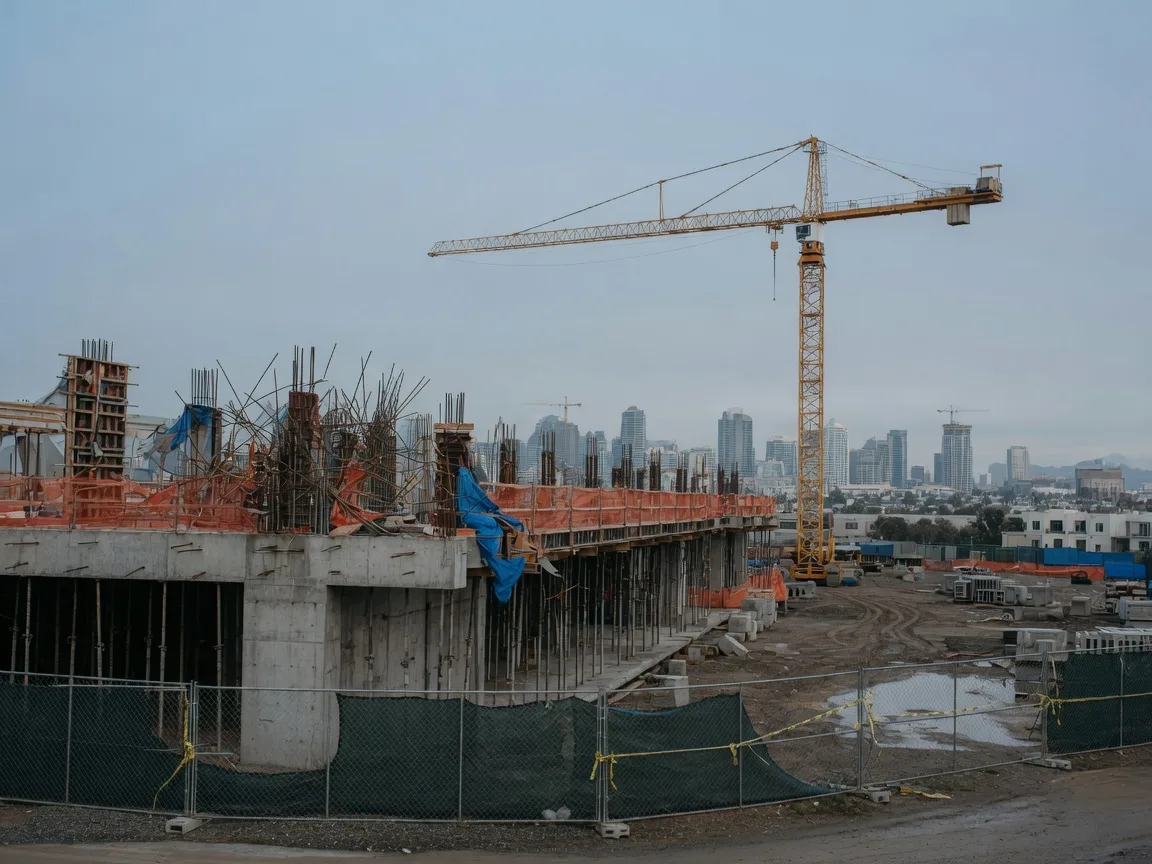
A stalled construction project in San Diego illustrates the financing gap that has frozen development across the county. Projects that penciled at 4% rates do not work at 6.5%.
Where are we in the cycle? A three-phase outlook.
Understanding where we are in the development cycle is essential for timing investment decisions. Here is our framework for the next 18-24 months.
Phase 1: The Pause (Mid-2026)
Max supply pressure from 10,200+ new units delivered 2025-2026. Zero office starts. Stalled residential projects. Highest caution among developers. Best time for selective acquisitions with patient capital.
Phase 2: Supply Absorption (Late 2026 - Mid 2027)
New deliveries slow as pipeline contracts. Existing properties begin regaining occupancy. Rent growth resumes in supply-constrained submarkets. Construction starts remain subdued but sentiment improves.
Phase 3: Tightening Market (2028+)
Construction pipeline substantially reduced. Supply-demand balance shifts in favor of property owners. Accelerating appreciation and rent growth. Development starts recover but take 2-3 years to deliver new units.
Six investment strategies for the Great Pause.
The current environment demands specific strategies. These six approaches are producing results for San Diego investors who understand the cycle.
Buy Before the Rebuild
With construction starts down sharply and units under construction falling 24% YoY, San Diego is heading into a period of tightening supply. Investors who acquire income-producing properties today, when competition from new construction is at its cyclical peak, position themselves to benefit as supply contracts through 2027-2028. Detached single-family rentals in supply-constrained coastal and central submarkets offer the strongest near-term appreciation potential.
Value-Add in a Low-Competition Environment
Elevated rates have reduced buyer competition for value-add properties. Investors who can execute renovations using conservative leverage face less bidding pressure than during the 2021-2023 period. Target properties with below-market rents in City Heights, National City, and older East County inventory, areas where cap rates of 5-6% still pencil at current financing costs.
Repositioning Distressed Office Assets
With zero office starts and rising office vacancy, well-located office properties are trading at discounted valuations. Investors with a conversion strategy (office-to-residential, office-to-medical, or office-to-flex-industrial) can acquire assets at favorable basis points. Downtown San Diego and Kearny Mesa office properties near transit corridors offer the strongest repositioning potential.
Seller Financing as a Rate Hedge
As conventional financing remains expensive, seller financing has become an increasingly attractive option. Sellers motivated to close can offer below-market interest rates, deferred payments, or hybrid structures that bridge the gap between buyer expectations and bank rates. In the current environment, sellers who carry paper often achieve higher net proceeds than those requiring all-cash or conventional-financed offers.
Workforce Housing Hold Strategy
The stalled affordable housing pipeline means pent-up demand for workforce housing will continue growing. Properties in the $400K-$700K range in inland submarkets (City Heights, National City, El Cajon, Chula Vista Eastlake) serve essential workers priced out of coastal neighborhoods. These properties offer the best rent-to-price ratios in the county, with stable demand that is largely independent of rate cycles.
Rate Buydowns and Creative Financing
Temporary and permanent rate buydowns have become standard tools for moving transactions in the current environment. Sellers willing to contribute 2-1 buydowns (reducing the rate by 2% in year one and 1% in year two) or permanent buydowns can expand the buyer pool significantly. Investors should evaluate buydown costs against projected holding period returns, as in many cases, a buydown is more cost-effective than a price reduction.
What could go wrong? Four risks to watch.
Continued Rate Hikes
CME FedWatch shows ~55% odds of a September 2026 rate hike, with three FOMC members already dissenting for a hike at the July 29 meeting. A return to tightening would further compress cap rates and slow transaction velocity. Lock in fixed-rate financing where possible and stress-test underwriting at 7-8% rates.
Extended Construction Timeline Risk
Already-started projects face completion delays as financing tightens and material costs fluctuate. Investors buying pre-construction or forward commitments should verify developer financing and build in timeline buffers. The Palmer Grantville stalling is a cautionary tale for anyone betting on delivery timelines.
Insurance Cost Escalation
California insurance premiums continue to rise 20-40% annually in some areas, driven by wildfire risk, reinsurance costs, and carrier pullbacks. These costs are a fixed operating expense that compresses NOI regardless of the interest rate environment. Budget for 3-5% annual insurance cost growth and explore the FAIR Plan as a backstop for high-risk properties.
Rent Growth Stagnation
San Diego apartment vacancy at 6.2% (the highest this century) has put downward pressure on rents, with six consecutive months of declines through late 2025. New supply still being absorbed will continue to suppress rent growth through late 2026. Underwrite rental income at flat to 2% growth for the next 12 months.
Frequently asked questions.
What is the "Great Pause" and how does it affect San Diego real estate investors?
What is the "Great Pause" and how does it affect San Diego real estate investors?
How long will the construction slowdown last in San Diego?
How long will the construction slowdown last in San Diego?
What types of investment property perform best during the Great Pause?
What types of investment property perform best during the Great Pause?
How should investors adjust their underwriting for the current rate environment?
How should investors adjust their underwriting for the current rate environment?
Is now a good time to buy investment property in San Diego?
Is now a good time to buy investment property in San Diego?
How does stalled affordable housing impact market dynamics?
How does stalled affordable housing impact market dynamics?
What are the signs that the Great Pause is ending?
What are the signs that the Great Pause is ending?
Navigate the Great Pause
with data-driven conviction.
The Great Pause creates opportunities for investors who understand the cycle and act with discipline. Whether you are evaluating a specific acquisition, repositioning an existing asset, or building a long-term strategy for San Diego's shifting supply landscape, our team can help you make informed decisions grounded in current market data.