
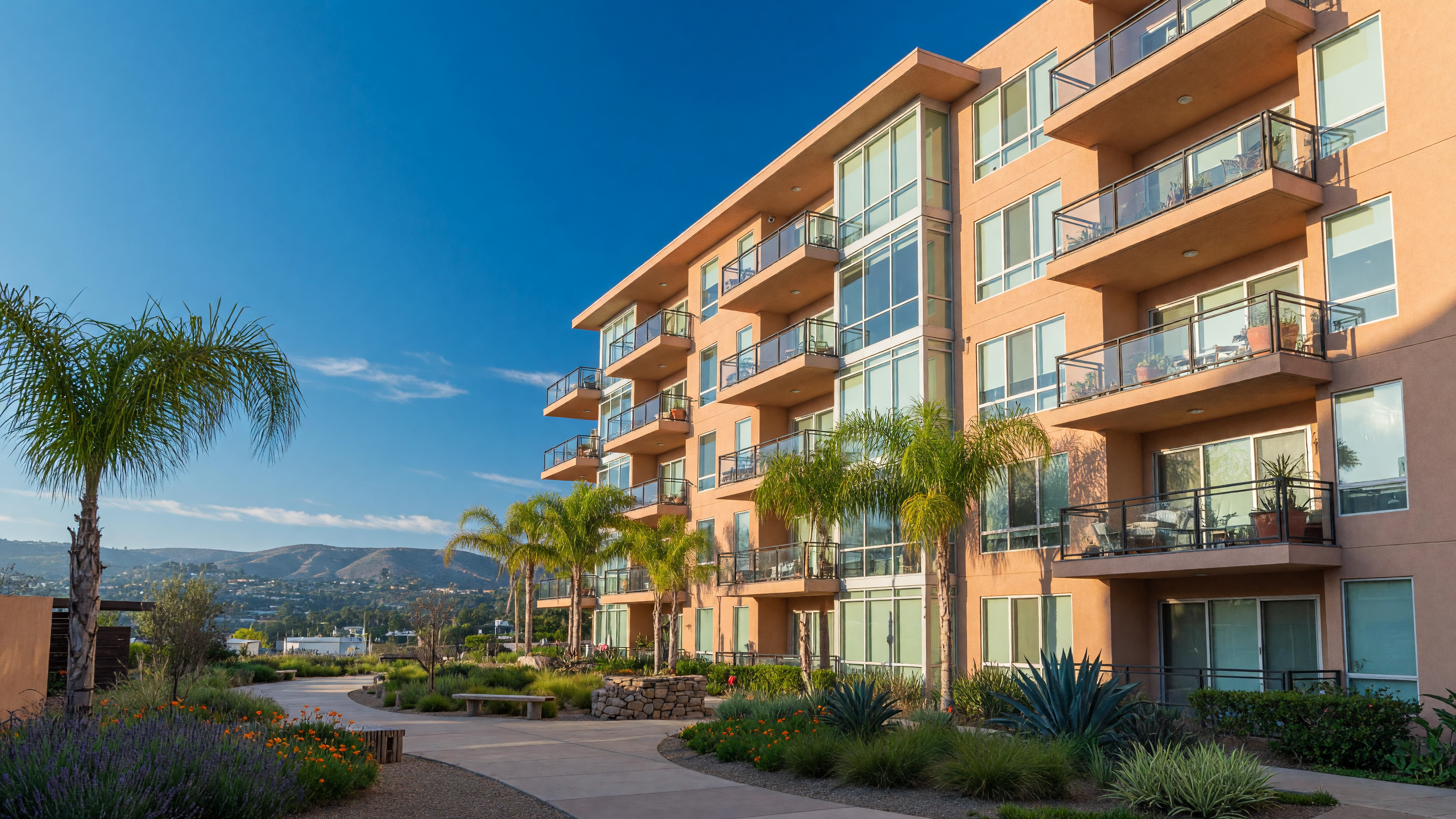
Multifamily & commercial investment opportunities in San Diego.
A data-driven guide to multifamily, mixed-use, and commercial real estate investment in San Diego County — submarket analysis, cap rate benchmarks, value-add strategies, and market outlook for 2026.
This article was originally published June 17, 2026 and meaningfully updated August 3, 2026 with the latest Q2 2026 multifamily cap rate data from Kidder Mathews and Northmarq, submarket-level cap rate benchmarks, the downtown office vacancy picture (33%), new construction pipeline slowdown data, and fresh Q3 2026 projections for the San Diego commercial and multifamily investment landscape.
Q2 2026 average multifamily cap rate (Kidder Mathews), steady YoY. Value-add submarkets reach 5.2%–6.3%.
Year-over-year increase in first-half multifamily sales volume, signaling a recovering transaction market.
Median per-unit pricing for mid-size multifamily assets — below replacement cost in most submarkets.
Estimated 2026 San Diego multifamily transaction volume, as both institutional and private capital returns.
San Diego's multifamily and commercial real estate markets are entering a new phase — one where temporary supply pressures create acquisition opportunities for patient, well-capitalized investors.
After a construction boom that delivered thousands of new multifamily units between 2023 and 2025, San Diego's market is stabilizing. Vacancy rates have settled in the 4.5%–5.4% range, rent growth has moderated to 2%–4%, and per-unit pricing has come down from peak levels — creating a more favorable entry point for buyers.
For investors, the current market presents a compelling thesis: acquire workforce housing and value-add multifamily assets at prices below replacement cost, improve operations and rents, and benefit from San Diego's long-term supply constraints and population growth.
The commercial landscape is equally dynamic. Industrial properties in Otay Mesa are navigating temporary oversupply while awaiting major infrastructure investments. Mixed-use developments in Mission Valley, Downtown, and the Chula Vista Bayfront are creating new investment nodes. And deal volume has tripled year-over-year, signaling that institutional and private capital are returning to the market.
This guide breaks down San Diego's multifamily and commercial investment landscape — from submarket-level analysis to investment models, value-add strategies, and the macro trends shaping returns in 2026 and beyond.
San Diego multifamily market snapshot.
Held steady YoY per Kidder Mathews. Inland/value-add submarkets reach 5.2%–6.3%. Coast submarkets trade below 4%.
Multifamily vacancy stabilizing after construction peak. City of San Diego proper lower at 4.22% per SoCal Rental Housing Association.
Average per-unit pricing for larger multifamily assets — below replacement cost in most submarkets.
Office CRE faces headwinds. Industrial demand remains strong. Retail stable at 5.5% vacancy.
Fresh Q2/Q3 2026 cap rate & market data.
Since this article was first published in June, new Q2 2026 data from Kidder Mathews, Northmarq, and the SoCal Rental Housing Association has given investors a clearer picture of where the multifamily and commercial markets stand heading into the second half of the year.
Held steady year-over-year per Kidder Mathews. Coast assets trade sub-4%; inland value-add reaches 5.2%–6.3%. Northmarq projects Q3 2026 activity uptick in Downtown, Balboa Park, Chula Vista, Imperial Beach, and East County.
Downtown office vacancy remains elevated at approximately 33%. Zero new office construction starts in early 2026. The only major project under construction is the Campus at Horton (243K SF). Repositioning and office-to-residential conversion is a growing trend.
Per the SoCal Rental Housing Association's 2026 annual survey. The countywide figure was higher at 6.36%, but vacancy within the city proper is tightening. New construction deliveries peaked in 2025 and are now declining.
City Heights offers the highest cap rates in the city at approximately 6.3%. Barrio Logan follows at 5.8%, National City at 5.2%, and El Cajon in the 5.0%–5.5% range. These submarkets are where cash-flow-focused investors find the strongest returns.
Retail real estate remains stable at 5.5% vacancy. Neighborhood-serving and grocery-anchored centers outperform. Retail is the most stable CRE sector in San Diego in 2026, with consistent demand and moderate rent growth.
Multifamily deliveries are cooling from the 2025 peak. Units under construction fell 24% year-over-year. Northmarq projects inventory growth will decline further through 2027, which should tighten fundamentals and support rent growth for existing properties.
Data compiled from Kidder Mathews Q2 2026 San Diego Multifamily Market Report, Northmarq Q2 2026 report, SoCal Rental Housing Association 2026 survey, and CommercialBrokerNow 2026 cap rate benchmarks. All figures reflect Q2/Q3 2026 conditions unless otherwise noted.
Where to invest: San Diego's key multifamily submarkets.
Each submarket offers a distinct risk-return profile. Choose based on your capital, risk tolerance, and whether you prioritize immediate cash flow or long-term appreciation.
Downtown / East Village
- Highest concentration of new multifamily deliveries in the county
- Average rent of approximately $3,146/month — among the highest in San Diego
- Strong demand from young professionals, biotech workers, and military personnel
- Transit-oriented location with trolley access and walkability to Gaslamp Quarter
- Office vacancy at approximately 33% downtown — conversion and repositioning opportunity growing
- New construction completions have temporarily elevated vacancy in Class A buildings
- Higher per-unit costs reduce near-term cash flow potential
- HOA and Mello-Roos assessments in newer buildings can compress NOI
- Office-to-residential conversion potential is gaining interest as office CRE remains soft
Value-add play on older Class B buildings with unit renovations. Target properties built before 2000 that trade below replacement cost — recent renovations of comparable buildings have pushed rents 15%–25% higher.
Mission Valley
- Average rent of approximately $3,149/month — competitive with Downtown
- Major mixed-use redevelopment underway, including Riverwalk San Diego
- Trolley-accessible submarket with proximity to SDSU and Qualcomm
- Strong institutional investment interest driving transaction volume
- Significant new pipeline may pressure rents in near term
- Mixed-use zoning adds complexity to underwriting
- Retail components require active management
Target well-located multifamily within walking distance of trolley stations. The Riverwalk San Diego redevelopment and SDSU expansion are creating long-term demand drivers. Existing buildings with under-market rents offer compelling value-add opportunity.
Chula Vista
- San Diego County's second-largest city with population exceeding 290,000
- Strong workforce housing demand driven by South Bay employment base
- New multifamily deliveries totaling 278+ units in 2025
- Median price per unit at approximately $409,500 — below county average
- High concentration of new inventory has pushed vacancy up 10 basis points
- Rent growth has moderated as new supply hits the market
- Cross-border economic dynamics create a unique tenant profile
Chula Vista rewards patient investors who buy during temporary supply-driven softness. The long-term demand trajectory is supported by population growth, infrastructure investment, and the Chula Vista Bayfront project. Focus on 5–20 unit properties with below-market rents.
Kearny Mesa / Clairemont
- Centrally located between major employment corridors
- Older housing stock presents significant value-add potential
- Consistent demand from healthcare and defense-sector employees
- Lower vacancy than newer submarkets due to limited new construction
- Older buildings may require deferred maintenance investment
- Rent control considerations under California's AB 1482 for pre-1995 buildings
- Commercial corridors offer mixed-use conversion potential
Among the strongest value-add opportunities in San Diego. Target 1960s–1980s-era buildings with original interiors. Interior renovations of $30K–$50K per unit can push rents 20%–30% higher. The central location provides access to the entire county's employment base.
Otay Mesa / South Bay Industrial
- Primary San Diego industrial hub with 50M+ SF of inventory
- Upcoming new truck port of entry to Otay Mesa crossing
- Major projects: Otay Business Park, Britannia Technology Park
- Strong demand from defense, automotive manufacturing, and logistics
- Vacancy exceeding 9% in Q1 2026 — highest in recent memory
- New supply deliveries outpacing net absorption
- Cross-border logistics create unique regulatory and tenant dynamics
Industrial is in a temporary buyer's market due to oversupply. Investors with a 3–5 year horizon can acquire assets at favorable cap rates while waiting for the new port of entry and infrastructure projects to absorb excess inventory. NNN lease structures provide downside protection.
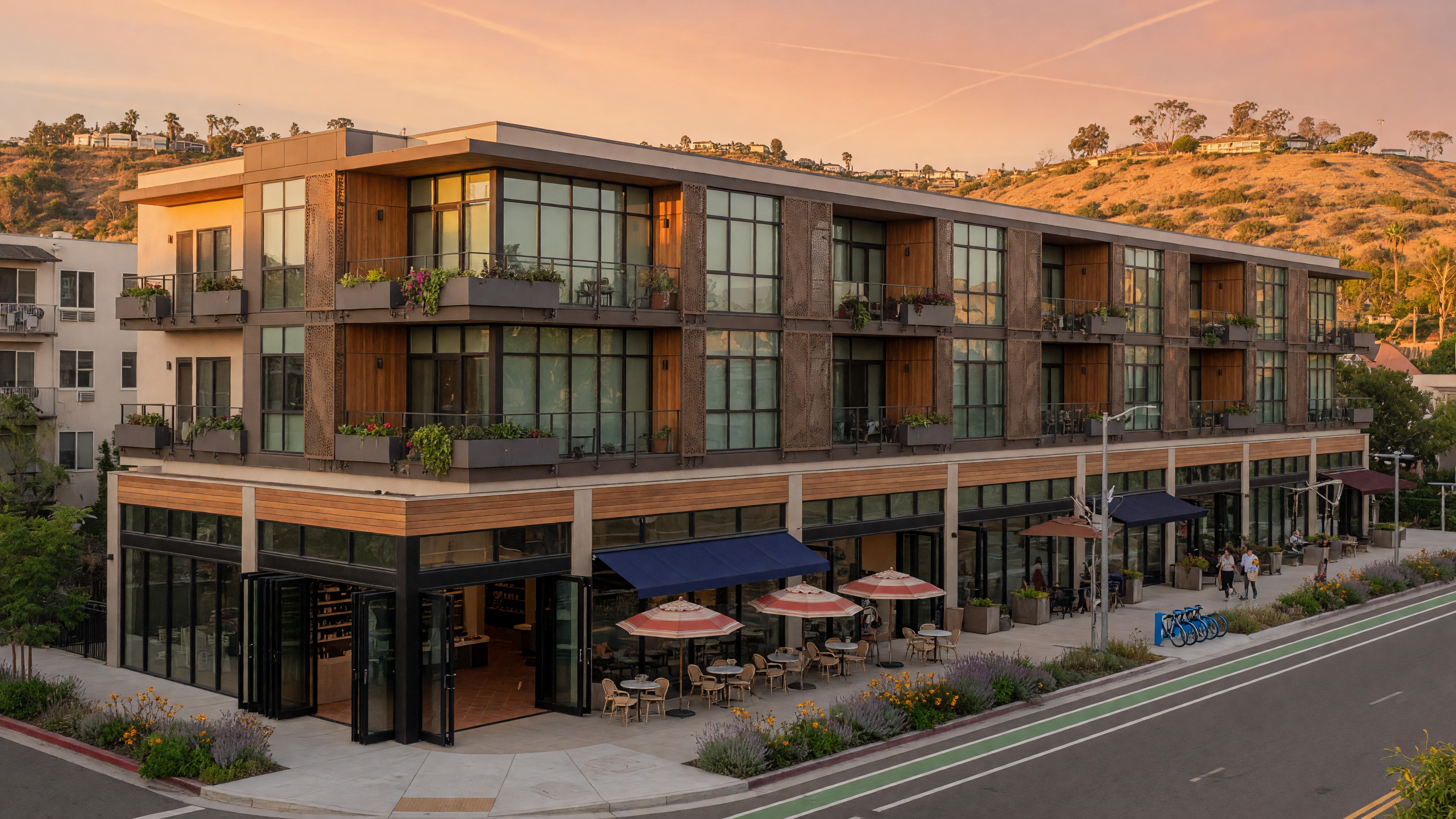
Mixed-use developments in Mission Valley, Downtown, and Chula Vista are reshaping San Diego's investment landscape.
How do investors participate in San Diego multifamily?
There are multiple pathways to multifamily investment, each with different capital requirements, management intensity, and return profiles.
Direct Acquisition — Small Multifamily (2–4 Units)
The most accessible entry point for individual investors. Financing available through conventional, FHA, or portfolio loans. Properties in San Diego typically trade between $525,000 and $1.5M for 2–4 unit buildings.
- Conventional and FHA financing available
- Residential loan terms (lower rates)
- Manageable scale for hands-on investors
- Strong cash flow in inland submarkets (5.0%–6.3% cap rates)
Direct Acquisition — Mid-Size (5–20 Units)
The sweet spot for many value-add investors. Properties require commercial financing but offer significantly better per-unit pricing than smaller buildings. Median per-unit pricing of $350K–$450K in 2025.
- Commercial loan terms with 20–25 year amortizations
- Professional property management justified by scale
- Significant value-add potential through rent optimization
- Lower competition from institutional buyers
Passive Investment — Syndications & Funds
Pool capital with other investors through a sponsor-led syndication or real estate fund. Investors receive proportional ownership, cash flow distributions, and tax benefits without day-to-day management responsibility.
- No active management required
- Access to institutional-quality assets
- Diversification across multiple properties
- Quarterly or monthly cash flow distributions
Joint Ventures & Equity Partnerships
Partner with other investors or operators to combine capital, expertise, and deal access. Common structures include 50/50 splits, preferred return + promote structures, and operating agreement-based partnerships.
- Combine resources for larger acquisitions
- Share operational expertise and risk
- Customizable deal structures
- Build relationships with experienced operators
The San Diego value-add multifamily playbook.
Value-add investing — acquiring underperforming properties, renovating units, and optimizing operations — is the most common strategy for generating outsized returns in San Diego's multifamily market.
Acquire Below Market Value
Identify properties with deferred maintenance, below-market rents, or operational inefficiencies. In San Diego, target buildings built before 1990 in improving submarkets like Kearny Mesa, City Heights, or Chula Vista.
Underwrite the Renovation
Plan unit-by-unit renovations with a focus on kitchen and bath upgrades, flooring, fixtures, and energy-efficient appliances. Budget $30,000–$60,000 per unit depending on condition and submarket rent ceiling.
Execute Phased Renovations
Renovate units as they turn over to minimize vacancy. Most value-add investors achieve 60%–80% renovation completion within 18–24 months of acquisition, balancing renovation costs against lost rental income.
Stabilize & Re-Position
After renovation, units should command 20%–30% higher rents. In San Diego, a well-executed value-add on a 10-unit building can increase NOI by $80,000–$120,000 annually — creating substantial equity uplift.
Real-world example: A 12-unit apartment building in Kearny Mesa acquired at $380,000/unit ($4.56M total) with 1980s-era interiors. After $420,000 in unit renovations ($35K/unit) completed over 20 months, projected rents increase from $2,200/month to $2,800/month — boosting NOI by approximately $86,000 annually and increasing the property's value by an estimated $1.1M–$1.4M.
What's shaping San Diego's multifamily and commercial markets in 2026?
Workforce Housing Outperforms Luxury
Class B and C workforce housing continues to outperform luxury Class A buildings in occupancy and rent growth. With San Diego's affordability challenges, properties priced for working families see consistent demand regardless of broader market cycles.
ADU Regulations Expand Multifamily Value
California's SB 1211 (2025) allows multifamily properties to add up to eight detached ADUs per lot. For San Diego investors, this means additional density without land acquisition — a game-changer for properties with large parking lots or underutilized outdoor space.
Mixed-Use Redevelopment Driving Growth
Mission Valley (Riverwalk San Diego), Downtown (Manchester Pacific Gateway), and the Chula Vista Bayfront are creating new mixed-use districts that will reshape property values in adjacent multifamily assets.
Industrial Recovery on the Horizon
San Diego's industrial sector is experiencing temporary oversupply (vacancy >9%), but the new Otay Mesa truck port of entry and defense manufacturing demand suggest a strong recovery for investors with a 3–5 year hold period.
Deal Volume Recovering
First-half 2025 multifamily sales activity tripled year-over-year in San Diego. As interest rates stabilize and sellers adjust expectations, transaction velocity is returning — creating opportunities for well-capitalized buyers.
Transit-Oriented Premium
Properties near trolley stations and major transit corridors command 10%–20% rent premiums and maintain lower vacancy. San Diego's continued trolley expansion creates new transit-oriented investment zones each year.
What risks should multifamily investors watch?
Supply Pressure
New multifamily deliveries peaked in 2024–2025. While the pipeline is declining, absorbed units must be backfilled before rent growth accelerates. Focus on submarkets with limited new construction.
Rent Regulation
California's AB 1482 caps annual rent increases at 5% plus CPI or 10%, whichever is lower. This limits revenue growth potential, particularly for properties with already market-rate rents.
Operating Cost Escalation
Insurance premiums, property taxes, and maintenance costs continue to rise in California. Investors must underwrite conservatively and build adequate reserves for operating expense growth of 3%–5% annually.
Interest Rate Sensitivity
Commercial multifamily loan rates of 6.0%–7.5% compress cash-on-cash returns. Rate caps and fixed-rate structures are essential — especially for investors acquiring at current cap rates.
Industrial Oversupply
Otay Mesa industrial vacancy has exceeded 9% as deliveries outpace absorption. Investors in this sector need a 3–5 year horizon and conviction in the port of entry infrastructure project.
Deferred Maintenance Risk
Older value-add properties often carry hidden deferred maintenance costs. Thorough physical inspections and capital expenditure budgeting are critical before acquisition — especially for pre-1980 buildings.
Frequently asked questions.
What cap rates are San Diego multifamily properties trading at in 2026?
What cap rates are San Diego multifamily properties trading at in 2026?
Is now a good time to invest in San Diego multifamily properties?
Is now a good time to invest in San Diego multifamily properties?
What is the difference between investing in 2–4 unit and 5+ unit multifamily in San Diego?
What is the difference between investing in 2–4 unit and 5+ unit multifamily in San Diego?
How do ADUs affect the value of multifamily properties in San Diego?
How do ADUs affect the value of multifamily properties in San Diego?
What financing options are available for commercial multifamily investments in San Diego?
What financing options are available for commercial multifamily investments in San Diego?
What are the biggest risks of investing in San Diego commercial real estate right now?
What are the biggest risks of investing in San Diego commercial real estate right now?
Let's find your
multifamily opportunity.
Whether you're acquiring your first duplex, evaluating a value-add 20-unit, or exploring passive syndication opportunities — our team understands the San Diego multifamily landscape and can help you build a strategy that aligns with your goals.