
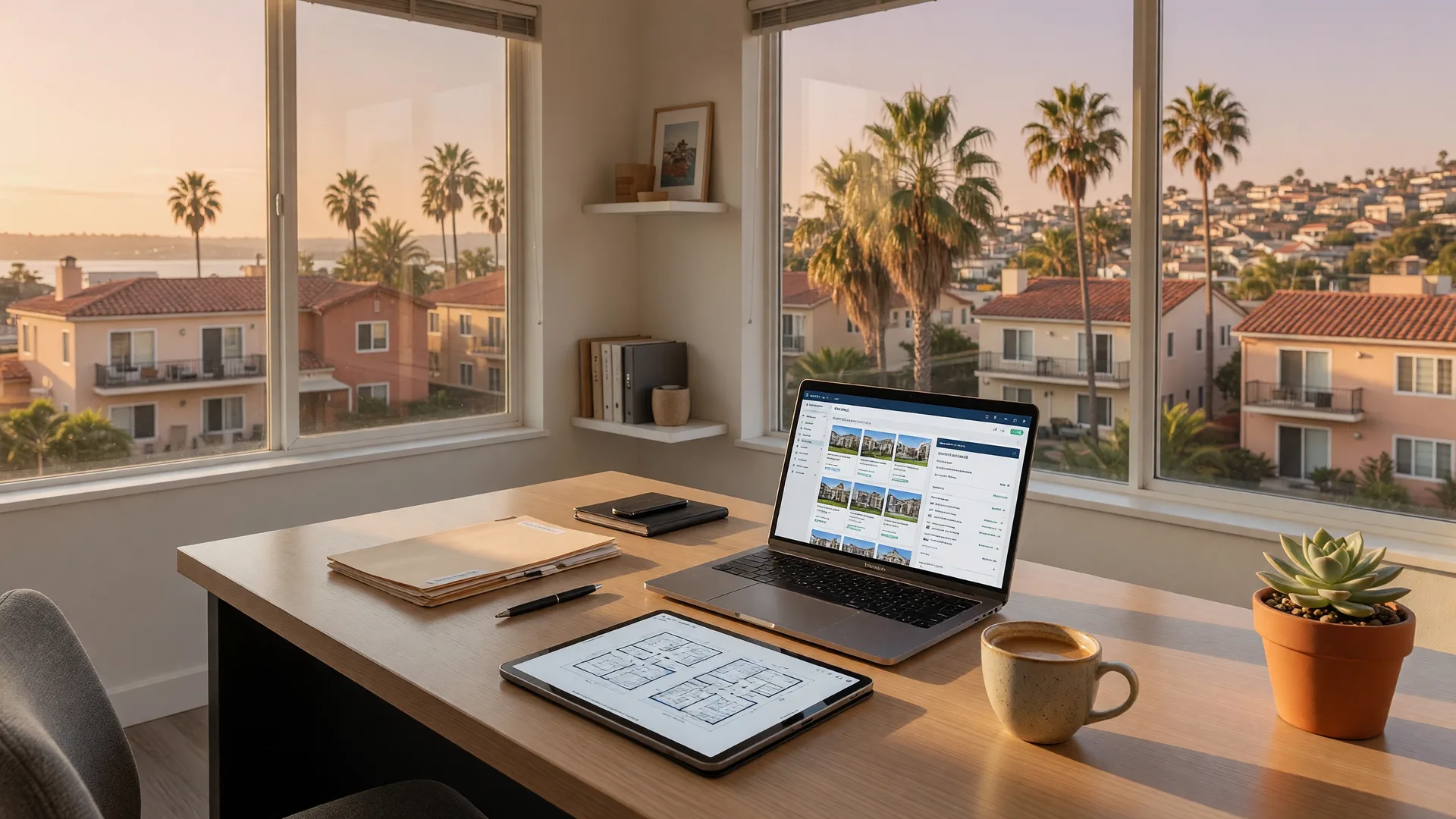
Property management best practices for San Diego investors.
A practical guide to tenant screening, California compliance, maintenance planning, and fee structures — everything San Diego landlords need to know to protect their investment and maximize returns. Updated August 2026 with fresh market data and new 2026 California landlord-tenant laws.
Last updated August 24, 2026
San Diego's multifamily vacancy rate reached 5.5% in Q2 2026 — up 60 bps year-over-year — with 11,800 units still under construction.
Maximum allowable rent increase under AB 1482 for San Diego County from August 1, 2026 through July 31, 2027 (5% + 3.2% CPI), down from 8.8%.
California landlord-tenant laws took effect in 2026 — AB 628 (mandatory appliances), AB 414 (deposit returns), AB 747 (fee transparency), SB 610 (disaster duties), and more.
Effective property management is the difference between a rental property that builds wealth and one that slowly drains it. In San Diego's shifting 2026 market — with rising vacancy, new legislation, and evolving tenant expectations — landlords who master the fundamentals will outperform.
San Diego's rental market is entering a new phase. Vacancy rates climbed to 5.5% in Q2 2026 — up 60 basis points from 4.9% a year earlier — as nearly 5,900 new multifamily units are expected to be delivered in 2026, following a 20-year high of approximately 6,100 units completed in 2025. With 11,800 units still under construction, this combined delivery wave represents approximately 6.3% inventory growth since 2023.
What new California landlord laws took effect in 2026?
Multiple new laws took effect on January 1, 2026, significantly reshaping landlord obligations, fee transparency, and tenant protections. San Diego property managers and landlords must understand and implement these changes to remain compliant.
AB 628 — Mandatory Appliances
Working stoves and refrigerators are now added to California's statutory habitability requirements under Civil Code Section 1941.1. For any lease entered into, amended, or extended on or after January 1, 2026, landlords must provide and maintain these appliances. Recalled appliances must be replaced or repaired within 30 days. Tenants retain the option to provide their own appliances if both parties agree in writing.
AB 414 — Deposit Return Modernization
Modernizes security deposit return rules. If rent or deposits were paid electronically, landlords may now return deposits electronically. For multi-tenant households, deposits must be returned via check payable to all adult tenants unless a written agreement specifies otherwise. Crucially, landlords must now maintain before-and-after photo documentation to justify deductions — raising the bar for proving damage beyond normal wear and tear.
AB 747 — Fee Transparency
All mandatory fees must now be disclosed upfront in rental advertising and pricing quotes. Trash, sewer, parking, utility connectivity, and administrative fees that apply to every tenant as a condition of renting must be included in the advertised rental price — not buried in the application process. This eliminates the practice of advertising a low base rent and adding mandatory fees later.
SB 610 — Landlord Disaster Duties
When a declared disaster impacts rental property, landlords must remove debris and remediate hazards (mold, smoke, ash, water damage) within a reasonable time. Rent and fees must halt during mandatory evacuations. Prepaid rent and security deposits must be returned if units become uninhabitable. Tenants also gain the right to return after remediation, preventing landlords from using disasters as grounds for permanent displacement.
AB 1414 — Internet Opt-Out
Tenants can no longer be forced to pay mandatory internet or bundled subscription fees as part of their lease. Landlords must allow tenants to opt out of bundled internet service fees they do not want. This law targets the common practice of including internet/cable fees in base rent or as a non-negotiable add-on.
AB 325 and SB 763 — Rent Pricing Oversight
These laws amend California's Cartwright Act to restrict coordinated rent pricing practices using shared competitor data via common pricing algorithms. Property managers and landlords using revenue management software that aggregates competitor data face increased scrutiny. Landlords should review any pricing tools for compliance with these new anti-coordination rules.
AB 1529 — Housing Omnibus
Allows the required just-cause termination notice to be included directly inside the lease or rental agreement, rather than only as a standalone addendum. Also updates rules for assisted housing and affordable rent provisions. Streamlines documentation requirements for landlords while maintaining strong tenant protections.
Compliance bottom line: These seven new laws add significant operational requirements for San Diego landlords in 2026. The most impactful changes are AB 628 (you must now provide stoves and refrigerators), AB 414 (photo documentation required for deposit deductions), and AB 747 (all mandatory fees must be in advertised rent). Review your lease templates, advertising practices, and property condition documentation now to avoid penalties.
This guide covers the core disciplines of effective property management in San Diego: tenant screening that minimizes risk, compliance with California's landlord-tenant laws, maintenance strategies that protect asset value, and the economic case for professional management versus self-management.
Whether you own a single rental in North Park or a portfolio spanning Chula Vista and Escondido, these best practices will help you operate more efficiently, reduce costly mistakes, and position your investment for long-term performance in a competitive market.
What is the current state of San Diego's rental market?
Vacancy Rate (Q2 2026)
Up 60 bps year-over-year from 4.9%. Still below the national multifamily average of 6.8%. 11,800 units remain under construction.
New Units (2026)
Expected multifamily deliveries this year, following ~6,100 units in 2025 — the highest level of new apartment construction in roughly 20 years.
AB 1482 Rent Cap 2026–2027
Effective August 1, 2026 through July 31, 2027. Down from 8.8% in the prior period. Calculated as 5% plus 3.2% local CPI.
Management Fees
Typical monthly management fee range for single-family rentals in San Diego, plus placement and renewal fees. Multifamily portfolios command 4%–8%.
How do you screen tenants effectively in San Diego?
In a market with rising vacancy, the temptation to accept the first qualified applicant is strong. Resist it. A thorough screening process costs $30–$75 per applicant but can save $5,000–$15,000 in eviction costs and lost rent. California law requires written authorization before pulling credit or background checks — and fair housing rules apply at every step.
Credit Report & Score Analysis
Pull full credit reports through TransUnion, Equifax, or Experian. Look for score thresholds (typically 620+ for conventional rentals), payment history, outstanding debts, and collection accounts. In California, you must obtain written authorization before running credit.
Income Verification
Verify monthly income is at least 2.5×–3× the monthly rent. Require recent pay stubs (2–3 months), bank statements, or tax returns. For self-employed applicants, request two years of tax returns and a current profit-and-loss statement.
Rental History & References
Contact the two most recent landlords (not just the current one, who may give a positive reference to get rid of a bad tenant). Ask about payment timeliness, property condition at move-out, lease compliance, and whether they would re-rent to the applicant.
Eviction & Criminal Background
California law requires careful application of criminal history screening. AB 1482 and fair housing rules limit blanket denial policies. Evaluate criminal records on a case-by-case basis, considering nature, severity, and time elapsed. Eviction history is a strong indicator of future tenancy risk.
Fair housing compliance: California's Fair Employment and Housing Act (FEHA) and federal fair housing laws prohibit discrimination based on race, color, religion, sex, gender, sexual orientation, marital status, national origin, ancestry, familial status, source of income, disability, or genetic information. San Diego landlords must apply screening criteria consistently to every applicant — inconsistent standards create legal liability.
How much does professional property management cost in San Diego?
Understanding the full cost structure is essential for evaluating whether professional management pencils out for your investment. The headline percentage is just the start — placement fees, renewal fees, maintenance markups, and eviction coordination fees all factor into the total cost of ownership.
| Property Type | Monthly Fee | Placement Fee | Renewal Fee |
|---|---|---|---|
| Single-Family Rental | 8%–12% | 50%–100% of one month's rent | $150–$300 |
| Multifamily (2–4 Units) | 6%–10% | 50%–75% of one month's rent per unit | $100–$250 |
| Multifamily (5+ Units) | 4%–8% | Negotiated — often capped per unit | Negotiated |
| Short-Term Rental | 20%–30% | N/A — dynamic listing management | N/A |
Single-Family Rental: Most common for individual investors. Fees vary based on property condition, rent level, and market competitiveness. Higher-end properties may negotiate flat monthly rates.
Multifamily (2–4 Units): Slightly lower percentage due to economies of scale. Multiple units in one location reduce per-unit management costs.
Multifamily (5+ Units): Larger portfolios command the lowest management fees. Commercial-style management agreements with flat fees or tiered structures are common.
Short-Term Rental: STR management involves significantly more work — guest communication, turnover cleaning, dynamic pricing, platform management, and compliance tracking.
Fees compiled from San Diego property management firms and industry surveys, 2025–2026. Actual fees vary by company, property condition, and lease terms. Always request a complete fee schedule in writing before signing a management agreement.
How do California's tenant protection laws affect San Diego landlords?
Applicability
AB 1482 applies to most residential rental properties in California, including apartments, condominiums, and single-family homes rented by corporate entities or individual investors with more than one rental property.
Rent Increase Cap
Annual rent increases are capped at 5% plus the local Consumer Price Index percentage change, with an absolute maximum of 10%. For San Diego County, the maximum allowable increase from August 1, 2026 to July 31, 2027 is 8.2% (5% + 3.2% CPI), down from 8.8% in the prior year. This annual recalculation is based on April 2026 CPI data and applies to all covered rental units statewide.
Key Exemptions
Single-family homes and condominiums owned by individual natural persons (not LLCs or corporations) are exempt if the owner does not own more than one single-family property and the lease is a separate written agreement. New construction occupied within the last 15 years is also exempt.
Just Cause Eviction
AB 1482 requires just cause for evictions after 12 months of occupancy. Qualifying reasons include nonpayment of rent, lease violations, nuisance, and owner move-in. This protection is a critical consideration for landlords managing tenant relations.
AB 12 — Security Deposit Cap
Effective July 1, 2024, California caps security deposits at one month's rent for all residential properties — down from two months' (unfurnished) or three months' (furnished). Military members are also capped at one month's rent.
No Local Rent Control
San Diego does not have a local rent control ordinance. Renters rely solely on California's statewide AB 1482 protections. However, the city's habitability and building codes apply in addition to state requirements.
How do you build a maintenance strategy that protects your investment?
Deferred maintenance is the silent wealth killer in rental properties. A $200 plumbing leak ignored becomes a $5,000 mold remediation. California's implied warranty of habitability means tenants can legally withhold rent for unaddressed habitability issues — and the cost of reactive emergency repairs runs roughly five times that of planned preventive maintenance.
Seasonal Inspections
Conduct quarterly or semi-annual property inspections to catch small issues before they become expensive problems. Check HVAC systems before summer and winter, inspect plumbing for leaks, test smoke and CO detectors, and assess exterior drainage and roofing.
Preventive Maintenance Schedule
Build a maintenance calendar: HVAC filter changes every 3 months, gutter cleaning twice yearly, water heater flush annually, appliance servicing on manufacturer intervals. Preventive maintenance costs 1/5th of emergency repairs on average.
Vendor Management & Pricing
Maintain a network of licensed, insured vendors for plumbing, electrical, HVAC, general handyman, and landscaping. Negotiate volume pricing for multi-property owners. Always verify contractor licenses through the California CSLB.
Emergency Response Protocol
Establish a 24/7 maintenance hotline and response protocol. Tenants should have a single point of contact for emergencies. For non-emergency repairs, maintain a 48–72 hour response window. Document everything for insurance and compliance.
Capital Improvement Planning
Budget for major replacements — roofing (20–30 year cycles), HVAC (15–20 years), appliances (10–15 years), and flooring (7–10 years). Track depreciation schedules for tax benefits and plan replacements to avoid emergency expenditures.
What are the most common landlord mistakes in San Diego?
Inadequate Tenant Screening
Skipping or rushing the screening process is the #1 cause of costly evictions. A thorough screening process costs $30–$75 per applicant but can save $5,000–$15,000 in eviction costs and lost rent.
Deferred Maintenance
Delaying repairs leads to compounding damage. A $200 plumbing leak ignored becomes a $5,000 mold remediation. California's implied warranty of habitability means tenants can withhold rent for unaddressed habitability issues.
Non-Compliance with AB 1482
Failing to comply with rent increase caps, just cause eviction requirements, or proper notice procedures can result in penalties equal to one month's rent per violation plus actual damages.
Incomplete Lease Agreements
Generic leases miss critical California-specific provisions: pet policies, subletting restrictions, guest policies, late fee limits (max 10% of monthly rent), and required disclosures. Always use California-compliant lease templates.
Should you self-manage or hire a professional property manager?
Eliminates management fees (8%–12% of monthly rent) and placement fees
Direct control over tenant selection, pricing, and vendor choices
Works well for a single property with a nearby, long-term tenant
Requires 10–20+ hours/month per property for operations, tenant issues, and compliance
California's evolving landlord-tenant law creates ongoing compliance risk without professional expertise
Professionally managed properties average 15%–25% fewer vacancy days
Market-level rent optimization based on real-time comparable data
Regulatory compliance handled by professionals familiar with California law
Essential for out-of-state investors, multi-property portfolios, or busy professionals
Management fees reduce gross returns by 8%–12% (single-family) or 4%–8% (multifamily)
Frequently asked questions.
What are the most important new California landlord laws taking effect in 2026?
What are the most important new California landlord laws taking effect in 2026?
What is the typical property management fee structure in San Diego in 2026?
What is the typical property management fee structure in San Diego in 2026?
How does AB 1482 affect San Diego landlords in 2026?
How does AB 1482 affect San Diego landlords in 2026?
What are the current vacancy rates in San Diego, and how should landlords respond?
What are the current vacancy rates in San Diego, and how should landlords respond?
What are the security deposit rules in California as of 2026?
What are the security deposit rules in California as of 2026?
How do I choose between self-management and professional property management?
How do I choose between self-management and professional property management?
What landlord disclosures are required in California rental agreements?
What landlord disclosures are required in California rental agreements?
Let us manage your
San Diego investment.
Whether you have a single rental property or a growing portfolio, our team handles tenant screening, placement, maintenance, compliance, and financial reporting — so your investment performs without consuming your time.