
San Diego ADU investment guide: costs, ROI & regulations.
Accessory Dwelling Units are San Diego's fastest-growing investment strategy — 480% growth in completions since 2022, new California legislation removing zoning barriers, and ROI that outperforms most traditional rental investments.
Growth in ADU completions since 2022
Construction cost range by ADU type
Typical property value increase
City-level reforms adopted June 2025
Accessory Dwelling Units have emerged as one of the most compelling real estate investment strategies in San Diego — combining strong rental yields, significant property value appreciation, and favorable state legislation that has removed most traditional barriers to entry.
San Diego faces a structural housing deficit estimated at over 100,000 units, creating persistent rental demand that ADUs directly address. Since 2022, ADU completions in San Diego have grown by 480% — reflecting both investor demand and a regulatory environment that has become increasingly supportive of accessory housing.
For real estate investors, ADUs offer a unique advantage: the ability to generate multifamily-level income on a single-family property. Whether you convert an existing garage, build a detached unit in your backyard, or add multiple ADUs to a multifamily lot under SB 1211, the economics are compelling.
California's progressive legislation — including SB 1211, AB 1332, AB 2533, and AB 462 — has removed zoning barriers, streamlined permitting to 60-day review timelines, and created pre-approved plan programs that reduce design costs by 15%–25%. San Diego went further in June 2025, implementing 25 city-level reforms that made it one of the most ADU-friendly markets in the state.
This guide covers everything an investor needs to evaluate ADU opportunities: construction costs by unit type, rental income projections, ROI analysis, the legislative landscape, and a step-by-step process from feasibility assessment to lease signing.
What types of ADUs can you invest in?
San Diego investors have four primary ADU pathways, each with different cost profiles, timelines, and return characteristics. The right choice depends on your property, budget, and investment goals.
Detached ADU
A standalone structure built in the backyard of an existing property. Offers maximum privacy for both the homeowner and tenant, and functions as a fully independent residence with its own entrance, kitchen, and bathroom.
Attached ADU
Built as an addition to or conversion of a portion of the existing home. More cost-effective than detached units due to shared structural elements, though privacy is slightly reduced.
Garage Conversion
Converting an existing garage into a livable unit. The most affordable ADU option since the structure already exists. Ideal for investors seeking the fastest path to additional rental income.
Junior ADU (JADU)
A smaller unit created within the existing footprint of a single-family home (e.g., converting a bedroom or bonus room). Requires only a half-bath and shares the primary kitchen, but provides an affordable entry point for new investors.
What ROI can San Diego ADUs deliver?
ROI analysis for four common ADU investment scenarios, based on 2025–2026 San Diego market data. These projections assume professional management, standard occupancy rates, and long-term rental leases.
| Scenario | Total Cost | Monthly Rent | Annual Income | Cap Rate | Payback |
|---|---|---|---|---|---|
| Garage Conversion | $120,000 | $1,600 | $19,200 | 16.0% | 6.3 years |
| Detached 1-Bedroom | $250,000 | $2,200 | $26,400 | 10.6% | 9.5 years |
| Detached 2-Bedroom | $350,000 | $2,800 | $33,600 | 9.6% | 10.4 years |
| Multifamily (4 ADUs via SB 1211) | $1,200,000 | $9,200 | $110,400 | 9.2% | 10.9 years |
Beyond rental income: These projections do not include the 25%–50% property value appreciation that ADUs typically generate. A detached ADU costing $250,000 that adds $175,000 in property value delivers a blended first-year return of approximately 80% when combining rental income and equity gain. Actual returns vary by location, construction quality, and market conditions.
Why ADUs make sense for San Diego investors right now.
Increase Property Value by 25%–50%
ADUs consistently increase property values in San Diego. A well-designed detached ADU can add $150,000–$300,000 to a property's market value — often exceeding the cost of construction. This equity boost is realized whether you sell or refinance.
Generate Consistent Monthly Cash Flow
With San Diego's chronic housing shortage and strong rental demand, ADUs are typically occupied within 2–4 weeks of listing. Long-term leases provide predictable income, while short-term rental zoning (in eligible areas) can increase yields by 30%–50%.
Meet San Diego's Housing Demand
San Diego County faces a structural housing deficit estimated at 100,000+ units. ADUs address this gap at the individual property level, providing affordable housing options that are in constant demand from young professionals, seniors, and families.
Leverage Favorable State Legislation
California's progressive ADU legislation — including SB 1211, AB 1332, and AB 2533 — has removed most zoning barriers and streamlined the permitting process. Cities must now approve ADU applications within 60 days in many cases, reducing the timeline from idea to income.
Low-Risk Entry into Multifamily
For investors who want multifamily income without purchasing an apartment building, adding multiple ADUs to an existing property creates a small-scale multifamily portfolio on a single lot — with lower acquisition costs, simpler management, and favorable financing.
Portfolio Diversification
ADUs add a new income stream to an existing property, reducing vacancy risk and increasing total return. Properties with ADUs typically sell for 20%–35% more than comparable properties without them, creating both immediate cash flow and long-term equity.
What legislation is driving the ADU boom?
A wave of state and local legislation between 2023 and 2025 has transformed ADUs from a niche investment into one of the most accessible wealth-building tools in California real estate. Here are the key laws every investor should understand.
Up to 8 Detached ADUs on Multifamily Properties
Dramatically expands ADU capacity on multifamily lots by allowing up to eight detached ADUs on properties zoned for multifamily use — a significant increase from previous limits. This opens major opportunities for investors with duplexes, triplexes, or apartment buildings.
Pre-Approved Plan Programs
Requires cities to establish pre-approved ADU plan programs, reducing design and permitting costs by 15%–25%. Investors can select from pre-approved designs, accelerating the construction timeline and reducing architectural fees.
Legalizing Unpermitted ADUs
Provides a pathway for homeowners to bring existing unpermitted ADUs into compliance without full demolition. This is significant for investors who discover unpermitted units during due diligence — rather than tearing them down, they can now legalize them.
60-Day Permit Timelines for Coastal Zone
Establishes mandatory 60-day review periods for ADU permits in California's Coastal Zone, including much of San Diego County. Cities must approve or deny ADU applications within 60 days or they are automatically approved.
City-Level ADU Overhaul (June 2025)
San Diego implemented 25 ADU-related reforms in June 2025, including streamlined permitting, community enhancement fees, reduced setback requirements, and enhanced oversight mechanisms. These changes made San Diego one of the most ADU-friendly cities in California.
Investor takeaway: The combination of state preemption (limiting local zoning restrictions) and San Diego's 25 city-level reforms creates an environment where ADU permits are typically approved within 60–90 days. This is a dramatic improvement from the 12–18 month timelines that characterized the ADU process just a few years ago.
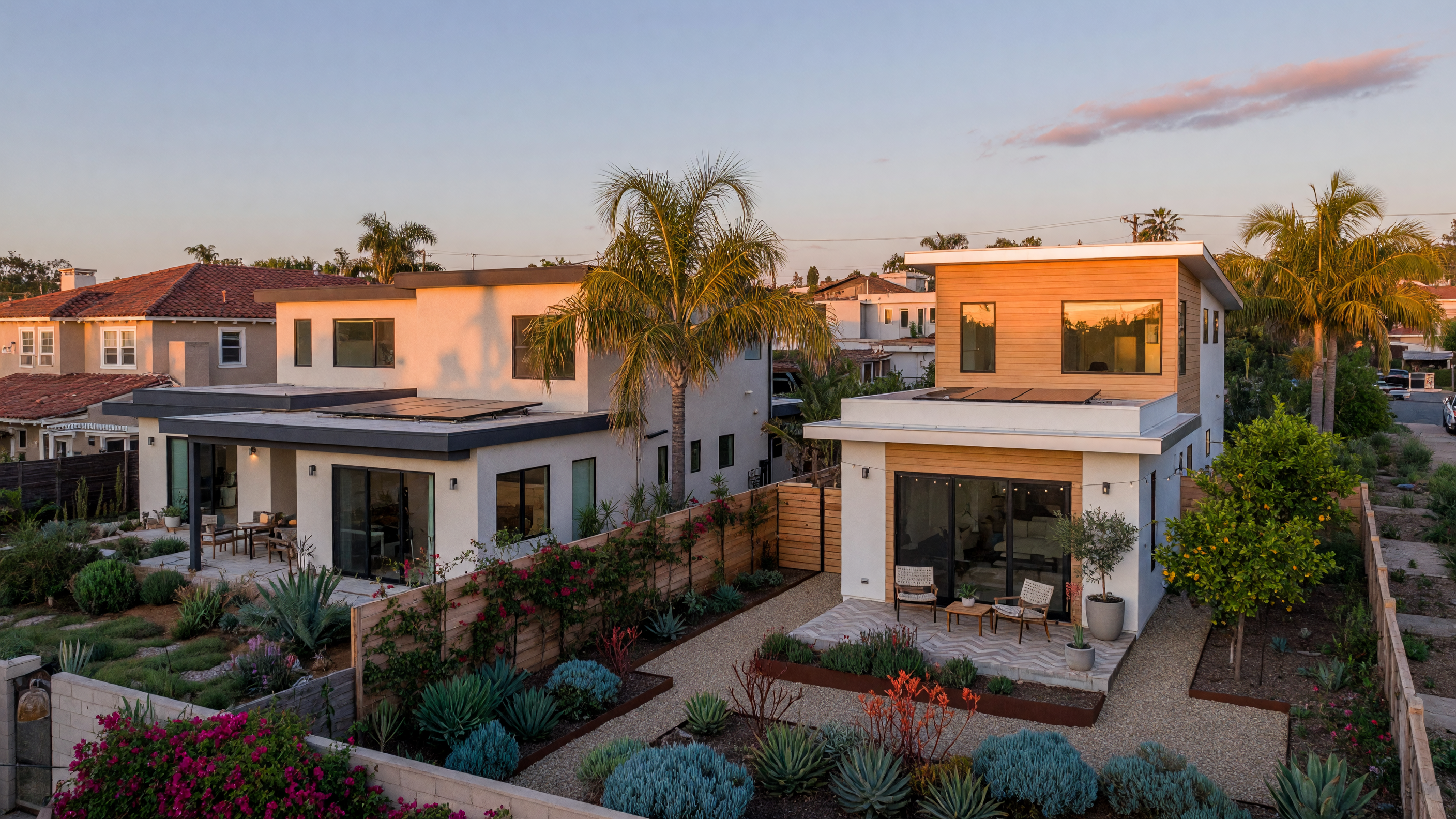
A well-designed detached ADU blends with existing architecture while generating $26,000–$34,000+ in annual rental income.
How do I build an ADU as an investment?
Feasibility Assessment
Evaluate your property's ADU potential: lot size, zoning designation, existing setbacks, utility access, and soil conditions. Verify that local regulations permit the ADU type you're considering. A site assessment costs $500–$1,500 but prevents costly surprises.
Design & Permitting
Choose from pre-approved city plans (reducing costs 15%–25%) or work with a designer on a custom unit. Submit plans to the city for review. Under AB 462 and San Diego's streamlined process, permits must be approved within 60–90 days. Architectural and engineering fees: $8,000–$25,000.
Construction
Typical construction timelines range from 3 months (garage conversion) to 18 months (detached unit). Obtain competitive bids from at least three licensed contractors. Budget 10%–15% contingency for unforeseen conditions. Construction costs represent 70%–80% of total project cost.
Lease & Management
Stage the unit professionally and list on high-traffic platforms. Set rents based on comparable units in your submarket. Consider professional property management for tenant screening, maintenance, and compliance — typically 8%–10% of gross rent for long-term rentals.
How do ADU returns compare to buying a rental property?
Lower entry cost: $80,000–$350,000 for most projects, compared to $800,000+ for a San Diego rental property
Cap rates of 8%–16%, significantly higher than traditional rental property cap rates of 3%–5%
No additional land acquisition cost — you're building on property you already own
25%–50% property value appreciation on your existing lot — equity you can refinance or realize at sale
Chronic housing shortage provides structural demand protection — San Diego needs 100,000+ units
High entry cost: San Diego median home price near $985,000, with investment properties often higher
Compressed cap rates of 3%–5% in coastal markets, requiring significant appreciation to generate returns
Requires full down payment (typically 20%–25% for investment properties) — $160,000–$250,000 minimum
Higher transaction costs: closing costs, property transfer taxes, and agent commissions at acquisition
Market-dependent returns — 2%–4% projected appreciation in San Diego may not offset high entry costs
Frequently asked questions.
How much does it cost to build an ADU in San Diego in 2026?
How much does it cost to build an ADU in San Diego in 2026?
What is the return on investment for an ADU in San Diego?
What is the return on investment for an ADU in San Diego?
Do I need a permit to build an ADU in San Diego?
Do I need a permit to build an ADU in San Diego?
Can I build multiple ADUs on my property?
Can I build multiple ADUs on my property?
What are the rental income expectations for ADUs in San Diego?
What are the rental income expectations for ADUs in San Diego?
How do San Diego's June 2025 ADU reforms affect investors?
How do San Diego's June 2025 ADU reforms affect investors?
Can I convert my garage into a rental unit?
Can I convert my garage into a rental unit?
Build equity and income
with an ADU strategy.
Whether you're evaluating your property's ADU potential, comparing construction approaches, or exploring multifamily ADU development under SB 1211 — our team can help you build a data-driven investment plan.