
This article was originally published July 10, 2026 and meaningfully updated August 19, 2026 with fresh neighborhood-level data from mid-August 2026 — including City Heights SFH median at $703K (down 4.5% YoY), North Park surging to $1.31M (up 13.9% YoY with just 12 days on market), Chula Vista Eastlake median at $977K, National City median at $625K with 6%–7% cap rates, and updated countywide medians of $1.09M for detached and $660K for attached homes. Neighborhood market dynamics have shifted meaningfully since July, particularly the widening two-track market and North Park's accelerated appreciation. For the second edition of this series, covering North County and East County markets (Oceanside, Escondido, Vista, San Marcos, La Mesa, and Santee), see the September 2026 companion guide.
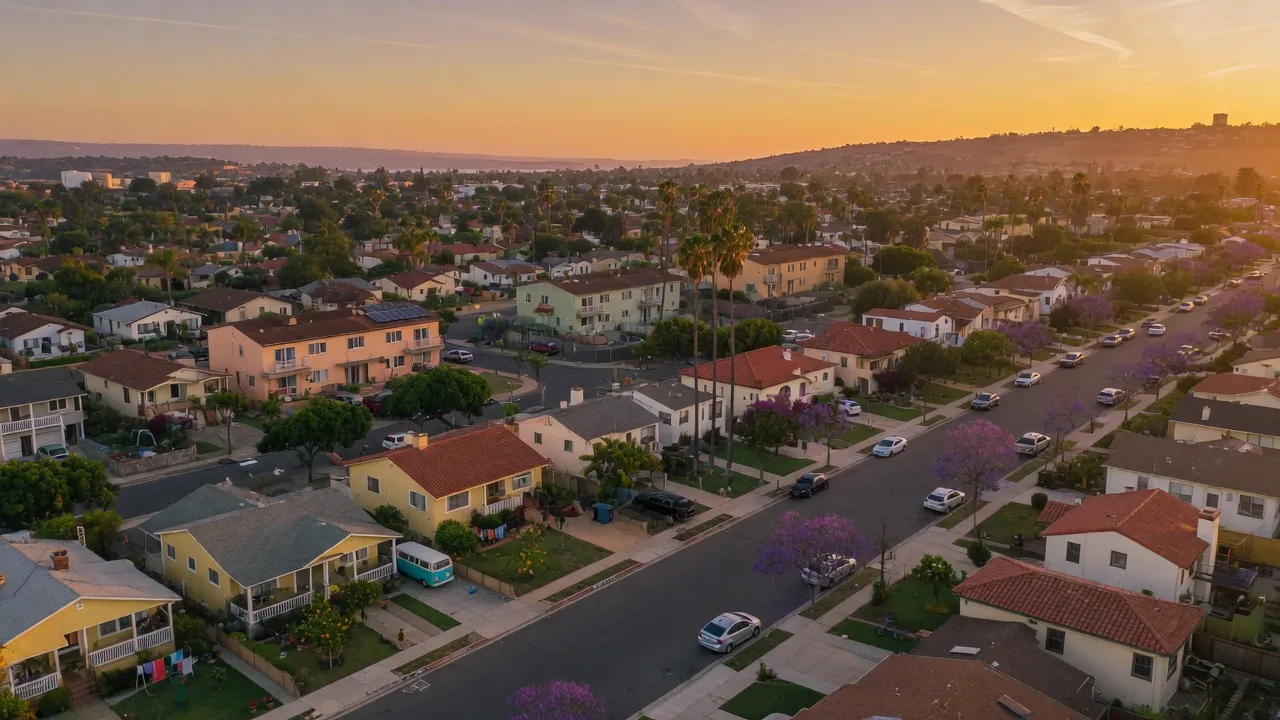
San Diego neighborhood investment spotlights.
A data-driven guide to the neighborhoods where San Diego real estate investors can find the strongest cash flow, appreciation potential, and ADU opportunities in 2026.
City Heights delivers the highest cap rates in San Diego County, outperforming most out-of-state markets when combined with local appreciation.
Entry point for investment properties in National City at $485 per sq foot — the lowest median price in San Diego County.
Potential property value increase from well-executed ADU additions under California's expanded ADU framework.
San Diego County's housing market is defined by constrained supply, persistent demand, and a widening gap between coastal and inland valuations — creating distinct opportunities for investors who know where to look.
With a countywide median home price near $1.09M for detached and $660K for attached homes, and a population approaching 3.35 million, San Diego's housing market continues to reward investors who understand micro-market dynamics. Not every neighborhood behaves the same way — and that's exactly where the opportunity lies.
This guide breaks down five San Diego neighborhoods that offer distinct investment profiles, from high-cash-flow inland corridors to appreciation-focused urban core properties. Each profile includes current median prices, rental benchmarks, cap rates, and a recommended investment strategy. Data reflects mid-August 2026 market conditions.
The county's employment base continues to grow, anchored by healthcare, biotech, defense, and higher education. Major employers including the U.S. Navy, UC San Diego, Sharp HealthCare, Scripps Health, and Qualcomm maintain strong rental demand across the region. The multifamily vacancy rate has risen to 6.2% after a surge in new deliveries in 2025-2026, though construction starts are already down 24% year-over-year.
Meanwhile, California's ADU reforms — including SB 1211 (allowing up to 8 ADUs on multifamily), new 2026 laws like AB 462 (streamlined coastal permits) and AB 2533 (legalizing pre-2020 unpermitted units) — have created powerful value-creation pathways. Combined with San Diego's ADU Home Density Bonus Program and financing options up to $250,000 through the San Diego Housing Commission, ADUs represent one of the most compelling investment strategies in the market today.
San Diego investment market snapshot.
County-wide median across all property types — detached homes at $1.09M, attached at $660K
Typical range for 2–11 unit investment properties
Gross Rent Multiplier for larger multifamily assets
San Diego County as of mid-2026, with steady annual growth
What's changed since July?
Neighborhood-level metrics have shifted meaningfully since this guide was first published in July. Here are the key changes every San Diego investor should know.
Detached homes at $1.09M, attached at $660K reflecting the two-track market. County median across all types trended down from $1.05M in June to $1.02M in July.
Highest cap rates in the county remain in City Heights, though the SFH median dropped to $703K (down 4.5% YoY), improving entry points for cash-flow investors.
North Park SFH median surged to $1.31M with just 12 days on market. The strongest appreciation in our spotlight group, driven by walkability and constrained supply.
Eastlake median corrected to $977K (down 11.2% YoY). Bayfront sub-area at $685K offers a more accessible entry. Overall price correction opening selective opportunities.
At $625K median and $485 per sq ft, National City remains the lowest-priced entry point in the county with cap rates of 6%–7%. Undervalued transit-corridor potential.
Data compiled from SDAR, PropertyShark, Redfin, Zillow, local MLS, and team analysis. All figures reflect mid-August 2026 conditions unless otherwise noted. Individual properties vary based on location, condition, and market dynamics.
Understanding cash flow vs. appreciation zones in San Diego.
Inland & South Bay
City Heights, National City, El Cajon, parts of Chula Vista, Encanto, Paradise Hills, and Southeast San Diego. These neighborhoods offer cap rates of 5.0%–6.3%, lower entry prices, and strong rent-to-price ratios driven by workforce housing demand.
Coastal & Urban Core
North Park, Hillcrest, La Mesa, Carlsbad, Encinitas, and coastal communities. These areas command premium rents ($2,400–$3,500+) but require higher entry capital and longer hold periods. Appreciation-focused investors benefit from constrained coastal supply and lifestyle-driven demand.
Five San Diego neighborhoods worth watching.
Each neighborhood profiled below represents a distinct investment thesis. Choose based on your capital, risk tolerance, and whether you prioritize immediate cash flow or long-term appreciation.
City Heights
The Cash-Flow Champion
- Highest cap rates in the city at 5.0%–6.3% for well-located 2–4 unit properties
- Median SFH price dropped to $703K (down 4.5% YoY) — more accessible entry points for cash-focused investors
- Condos and townhomes at $460K median offer the lowest entry in our spotlight group
- Active redevelopment corridor along El Cajon Boulevard with new retail and mixed-use projects
- Excellent transit access via the City Heights trolley stop; 29 days on market, 2.1 months of supply
- Older housing stock may require deferred maintenance investment — budget $20K–$40K for renovations
- Property management is essential — tenant turnover can be higher in this submarket
- Condominium median dropped 4.5% YoY — run numbers carefully and favor single-family or small multifamily
Best for investors seeking immediate cash flow over appreciation. City Heights offers the highest cap rates in the county at 5.0%–6.3%, and the recent price dip to a $703K SFH median (down 4.5% YoY) has improved entry points for cash-focused buyers. Look for duplexes and triplexes on streets bordering Normal Heights or Talmadge, where proximity to better-rated amenities lifts rents without inflating purchase prices proportionally.
Chula Vista
South County Growth Engine
- San Diego County's second-largest city and one of its fastest-growing metro areas
- Eastlake median at $977K (down 11.2% YoY) — price correction opening entry points
- Bayfront sub-area median at $685K offers more accessible investment pricing
- Major master-planned developments (Millenia, Eastern Urban) delivering completed units
- Strong workforce housing demand with a median age of 34 — below county average
- ZIP codes 91910 and 91911 remain top cash-flow zones for rental investors
- Eastlake prices have corrected 11.2% year-over-year — check if stabilization continues
- Newer construction commands premium rents but requires higher upfront capital
- South Bay market dynamics differ from coastal North County; understand the local tenant profile
Chula Vista rewards investors who buy in the eastern growth corridors before infrastructure fully catches up. New multifamily developments here command $2,100–$3,200/month in rent, and the pipeline of new residents continues to grow. Consider 2–4 unit properties near the Millenia development for a blend of cash flow and appreciation.
El Cajon
East County's Affordable Entry Point
- Consistent rental demand driven by healthcare, education, and service-sector employment
- Median purchase prices well below the countywide median — strong affordability
- Average apartment rent of ~$2,095/month as of mid-2026 — rising steadily
- Proximity to Grossmont College and Sharp Grossmont Hospital — two major employment anchors
- Active city programs supporting housing development and infrastructure investment
- Some sub-areas have higher crime rates; research micro-neighborhoods carefully
- East County experiences higher temperature extremes — factor into maintenance planning
- Appreciation trajectory is slower than coastal or South Bay markets
El Cajon is ideal for investors who want a lower entry point into San Diego County with stable, predictable cash flow. Target properties near major employers (Sharp Grossmont, Grossmont College) for consistently occupied rentals. The 5.5%–6.5% cap rate range makes it one of the strongest cash-flow neighborhoods in the county while retaining long-term appreciation potential.
North Park
Urban Core with ADU Upside
- SFH median surged 13.9% YoY to $1.31M — strongest appreciation in our spotlight group
- Strong ADU development potential under California's expanded ADU framework — SB 1211 and new 2026 state laws
- Premium rental rates ($2,400–$3,500/month) with just 12 days on market average
- Young professional tenant demographic with low vacancy rates
- Redevelopment corridor with active investor interest and improving infrastructure
- Higher entry prices reduce immediate cash-flow potential
- Cap rates among the lowest in our spotlight neighborhoods (3.5%–4.5%)
- Competition for well-located properties is intense — be prepared to act quickly
North Park rewards a buy-and-hold approach with an ADU strategy. California's SB 1211 allows multifamily properties to add up to eight detached ADUs, and new 2026 laws (AB 462, AB 2533) have further streamlined ADU permitting and legalized pre-2020 unpermitted units. San Diego's ADU Home Density Bonus Program provides additional financial incentives. Adding an ADU to a North Park property can increase value by 20%–30% while generating an additional $1,200–$1,800/month in rent.
National City
Workforce Housing with Undervalued Potential
- One of the lowest median home prices in the county at $625K — strong rent-to-price ratio
- Identified as a top cash-flow zone alongside Chula Vista and City Heights
- Proximity to the San Diego Bay waterfront and Chula Vista Marina
- Essential workforce housing for the South Bay labor market
- Transit-oriented development plans progressing — potential appreciation catalyst
- Smaller city with limited inventory — fewer deals on the market at any time
- Neighborhood quality varies significantly block-by-block
- Limited retail and amenity infrastructure compared to larger cities
National City is the stealth pick for investors who want strong cash flow at the lowest entry point in the San Diego metro. With the lowest median prices in the county ($625K at $485/sq ft) and 6%–7% cap rates, it offers the strongest rent-to-price ratios in the region. Look for properties near the waterfront transit corridor, where planned development could unlock appreciation on top of already-strong cash flow.
San Diego County's inland neighborhoods offer compelling investment profiles for investors seeking cash flow and long-term appreciation.
How ADUs supercharge San Diego investment returns.
California's ADU reforms — including SB 1211 and new 2026 state legislation — have made accessory dwelling units one of the most powerful tools in a San Diego investor's toolkit. Here's how to evaluate and execute an ADU strategy.
Why ADUs matter for investors
An ADU transforms a single-family property into a dual-income asset. In San Diego's rental market, a well-designed ADU generates $1,200–$2,200/month depending on size and location — often enough to cover a significant portion of the property's mortgage payment.
Beyond cash flow, ADUs increase property values by an estimated 20%–30%. A $600,000 property with a new ADU could be worth $720,000–$780,000 upon completion — creating equity that exceeds the cost of construction in many cases.
California's SB 1211 allows multifamily properties to add up to eight detached ADUs and eliminates parking replacement requirements for most ADU types. New 2026 laws including AB 462 (streamlined coastal ADU permits) and AB 2533 (legalizing pre-2020 unpermitted units) further strengthen the ADU framework. San Diego's ADU Home Density Bonus Program provides additional incentives for qualifying projects.
Building an ADU: Step by step
Assess Your Property
Evaluate your lot size, setbacks, and existing structures. California's SB 1211 allows up to 8 detached ADUs on multifamily properties and eliminates parking replacement requirements for most ADU types. New 2026 legislation has further streamlined the process.
Secure Financing
The San Diego Housing Commission's ADU Finance Program provides up to $250,000 for qualifying homeowners. Additional options include HELOCs, construction loans, and cash-out refinancing. Many investors use the ADU's projected rental income to qualify for favorable terms.
Design & Permit
Work with a designer experienced in San Diego's ADU permitting process. The city implemented ADU reforms in 2025 that capped the number of ADUs on single-family lots, while state laws have streamlined approvals. San Diego's 2026 Land Development Code update is expected to further streamline ADU permitting. Expect 3–6 months for design and permitting.
Build & Lease
Construction timelines for detached ADUs typically run 6–12 months. Once complete, a well-designed 1-bed ADU in San Diego rents for $1,200–$1,800/month, with 2-bed units commanding $1,600–$2,200/month depending on location.
How do you evaluate a San Diego investment neighborhood?
The difference between a good deal and a great deal often comes down to location fundamentals. Use these six factors to evaluate any San Diego neighborhood before you invest.
Rent-to-Price Ratio
Target areas where monthly rent is at least 0.7% of the purchase price. In San Diego, this typically points to inland neighborhoods like City Heights, El Cajon, and National City.
Employment Anchors
Properties near hospitals, universities, military bases, and major employers maintain lower vacancy rates. San Diego's anchors include UC San Diego, Sharp HealthCare, Scripps Health, and Naval Base San Diego.
Infrastructure Investment
Track where the city is investing in transit, roads, and utilities. New trolley extensions, freeway interchanges, and commercial developments often signal which neighborhoods will appreciate next.
Cap Rate vs. Appreciation
San Diego County averages 4.2%–5.5% cap rates for multifamily. Higher cap rates in inland areas balance lower appreciation, while coastal and urban core areas offer appreciation upside at the expense of cash flow.
Regulatory Environment
San Diego's ADU-friendly policies, rent stabilization framework, and zoning reforms all affect investment returns. Stay current with California state legislation that impacts landlords and tenants.
Neighborhood Trajectory
Look for leading indicators: new coffee shops and restaurants, building permits, improved streetscaping, and declining vacancy rates. These signal a neighborhood in transition before prices fully reflect the change.
Frequently asked questions.
What is the best neighborhood in San Diego for a first-time real estate investor?
For first-time investors focused on cash flow, National City ($625K, 6%–7% cap rates) and El Cajon ($650K–$800K, 5.5%–6.5%) offer the strongest entry points. City Heights cap rates of 5.0%–6.3% remain among the highest in the county at a $703K SFH median. If you prefer a more established suburban environment, El Cajon provides stable rental demand near major employers (Sharp Grossmont Hospital, Grossmont College) with below-county-median prices.
Are San Diego investment properties cash-flow positive in 2026?
It depends on the neighborhood and financing structure. In high cap-rate areas like City Heights (5.0%–6.3%), National City (6.0%–7.0%), and El Cajon (5.5%–6.5%), investors can achieve positive cash flow with conventional financing at current interest rates. Coastal and urban core neighborhoods like North Park and La Jolla are more appreciation-focused and typically require higher down payments or ADU strategies to achieve cash flow.
How do ADUs impact investment returns in San Diego?
Accessory Dwelling Units can increase a property's value by 20%–30% while generating $1,200–$2,200/month in additional rental income. California's SB 1211 allows up to 8 detached ADUs on multifamily properties and eliminates parking replacement requirements. New 2026 laws including AB 462 (streamlined coastal permits) and AB 2533 (legalizing pre-2020 unpermitted units) have further strengthened the ADU framework. The San Diego Housing Commission's ADU Finance Program provides up to $250,000 in financing. In neighborhoods like North Park and City Heights, an ADU strategy can turn a marginal cash-flow property into a strong performer.
Should I invest in San Diego or look at out-of-state markets?
San Diego offers a unique combination of stable tenant demand, long-term appreciation potential, and limited housing supply that out-of-state markets often cannot match. While cap rates are lower than Midwest or Southeast markets (typically 4.2%–5.5% vs. 7%–10%), San Diego properties have historically appreciated at 4%–7% annually. Over a 10-year hold, total returns (cash flow plus appreciation) in San Diego often outperform higher-cash-flow markets with weaker appreciation trajectories.
What should I know about rent stabilization in San Diego?
California's Tenant Protection Act (AB 1482) limits annual rent increases to 5% plus local CPI or 10%, whichever is lower. The law applies to most residential properties built after 1995 or with more than one unit. San Diego does not have a local rent control ordinance beyond the state framework, but investors should monitor legislative developments. Properties exempt from AB 1482 include single-family homes owned by individuals (not corporations) and properties newer than 15 years.
Let's find your
San Diego investment property.
Whether you're looking for cash-flow rentals in City Heights, ADU opportunities in North Park, or growth plays in Chula Vista, our team understands the San Diego investment landscape and can help you identify properties that match your strategy.