San Diego office-to-residential conversions & the adaptive reuse investment opportunity.
Downtown San Diego's office vacancy has reached 33%–36%, creating a once-in-a-generation opportunity for adaptive reuse. With California's AB 507 streamlining approvals and the city allocating $400 million in conversion incentives, office-to-residential conversions are emerging as one of the most compelling investment themes in San Diego commercial real estate.
This article introduces a new investment topic to the San Diego Investor Guide: office-to-residential adaptive reuse conversions. With the July 2026 enactment of AB 507 (California's streamlined adaptive reuse law), the city's $400 million conversion incentive program, and downtown office vacancy above 33%, this sector represents a distinct investment opportunity for San Diego commercial real estate investors. We cover the key projects, regulatory framework, economics, risk factors, and practical pathways for investor participation.
Downtown office vacancy rate (Q2/Q3 2026). Zero new office construction starts in 2026. The highest vacancy crisis in modern San Diego history.
City conversion incentive fund targeting East Village, Little Italy, and the Broadway corridor for commercial-to-residential conversion.
Apartment units currently in San Diego's office-to-residential conversion pipeline. National momentum is +28% YoY.
AB 507 streamlined adaptive reuse law took effect — fee waivers, ministerial approvals, reduced CEQA review for qualifying conversions.
The convergence of record-high office vacancy, new state legislation, and significant public incentive funding has created a rare window for adaptive reuse investment in San Diego.
Downtown San Diego has not recovered from the pandemic-driven shift to remote and hybrid work. Office vacancy has climbed to 33%–36% — the highest in the county and among the highest of any major U.S. downtown. With zero new office construction starts in 2026 and only one major project (the Campus at Horton, 243K SF) under construction, the market cannot absorb its way back to health through traditional leasing.
The most viable solution is conversion. The same buildings that are struggling to attract office tenants can be transformed into housing, hospitality, or medical uses — serving entirely different demand drivers. And for the first time in recent memory, California state law and the City of San Diego are actively working to make those conversions economically viable.
Assembly Bill 507, effective July 1, 2026, removes key regulatory barriers to adaptive reuse — eliminating discretionary review for qualifying projects, waiving Development Impact Fees for smaller residential units, and streamlining CEQA requirements. The city has backed this with a $400 million conversion incentive fund targeting East Village, Little Italy, and the Broadway corridor.
For investors, this creates multiple pathways: acquiring distressed office buildings at $150–$300 per square foot and converting them to residential units worth $600–$900 per square foot; investing passively in conversion-focused syndications; land banking near conversion corridors; or targeting specialty plays in medical and hospitality conversions. This guide covers the data, the strategy, and the risks.
San Diego adaptive reuse market snapshot.
Per Voit Co. August 2026. The citywide office vacancy leader since the pandemic-driven flight from downtown workspaces.
City program targeting East Village, Little Italy, and the Broadway corridor for commercial-to-residential conversion.
Per RentCafe March 2026 — San Diego metro has 489 units being converted from offices, trailing LA but above many peer metros.
Per Voit Co. — 90,300 apartments in conversion nationally at start of 2026, a 28% year-over-year increase.
Why are office-to-residential conversions happening now?
Four converging factors have created an unusually favorable environment for adaptive reuse investment in San Diego.
AB 507 Streamlined Approvals (Effective July 2026)
California Assembly Bill 507, which took effect July 1, 2026, removed procedural hurdles for adaptive reuse conversions. This includes Development Impact Fee waivers for residential units under 500 square feet and streamlined permitting for change-of-use applications. For the first time, converting an old office building into housing is faster and cheaper than building new.
Downtown Vacancy Crisis Creates Opportunity
Downtown San Diego has the highest office vacancy in the county at 33%–36%. With zero new office construction starts in early 2026 and only the Campus at Horton (243K SF) under construction, the market is not going to absorb its way out. The most viable solution is conversion — turning vacant space into housing, hospitality, and medical uses.
$400M in Incentive Funding
The City of San Diego has allocated $400 million for a commercial-to-residential conversion incentive program targeting East Village, Little Italy, and the Broadway corridor. This fund reduces the capital gap that has historically made conversions uneconomical compared to ground-up development.
National Conversion Momentum
Nationally, 11.8 million square feet of office space was converted or under conversion in 2025, with 90,300 apartment units in process at the start of 2026 — a 28% year-over-year increase. Major markets like Washington DC (6,600+ units), Dallas, and Chicago lead the trend. San Diego is well-positioned to accelerate given its favorable climate, dense downtown core, and improving regulatory environment.
What office-to-residential conversions are underway in San Diego?
Several significant conversion projects are already in motion. Together, they represent a tangible shift in how downtown San Diego's built environment is being repurposed.
707 Broadway
Affordable Housing142 one-bedroom + 58 two-bedroom units. Construction began March 2025 under Vintage Housing.
Office tower (1962)
Construction underway; completion TBD
101 Ash St.
Affordable Housing100% affordable housing conversion advancing through city planning. City is actively moving the project forward.
Office building
Planning/entitlement phase
Tower 180 / 180 Broadway
HospitalityHyatt Place + Hyatt House. $250M project by developer J Street. Construction began early 2026.
25-story office tower
Completion expected H1 2028
R B Medical Plaza
Medical / Office CondoAcquired April 2026 by Compass Capital Investments. Conversion to medical and office condos.
Two-building office complex
Acquired; conversion underway
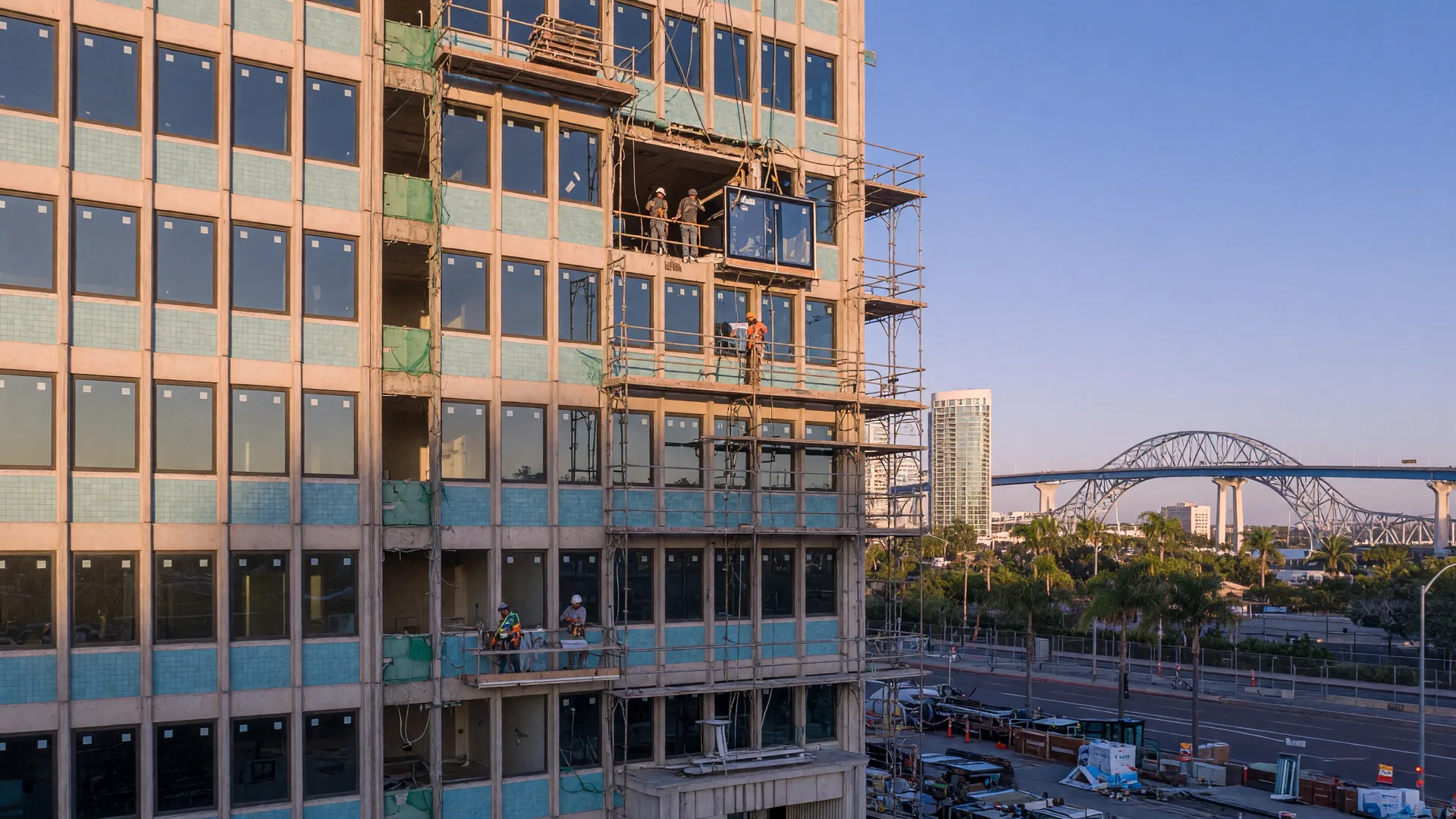
The conversion momentum is building. These four projects represent a diverse cross-section of conversion outcomes — affordable housing (707 Broadway, 101 Ash St.), hospitality (Tower 180), and medical/office condominiums (R B Medical Plaza). Together they demonstrate that adaptive reuse in San Diego is not a theoretical concept: it is already reshaping the downtown built environment. As AB 507 and the $400M incentive fund accelerate more projects, the conversion pipeline is expected to grow significantly through 2027.
San Diego conversion market by the numbers.
| Metric | Current Value | Context |
|---|---|---|
| Downtown Office Vacancy | 33%–36% | Highest in county |
| Conversion Incentive Fund | $400M | Targeting East Village, Little Italy, Broadway |
| San Diego Pipeline Units | 489 | Offices converting to apartments |
| National Conversion Units | 90,300 | +28% YoY |
| AB 507 Effective Date | July 1, 2026 | Streamlined approvals + fee waivers |
| Conversion Costs/SF | $200–$600 | Varies by building condition |
| Commercial-to-Residential RVT | 18–36 mo. | Acquisition to stabilized occupancy |
| Office-to-Hotel Pipeline | 560 rooms | Tower 180 Hyatt conversion in progress |
Data compiled from Voit Co. August 2026 San Diego Office Market Report, City of San Diego, Pacific Beach Builder, RentCafe, SoCal CRE Pros, CalHardMoneyLenders, and the San Diego Union-Tribune. All figures reflect Q2/Q3 2026 conditions.
How does an office-to-residential conversion work?
Adaptive reuse is neither ground-up development nor simple renovation. It occupies a middle ground that requires specialized expertise across entitlement, design, construction, and financing.
Acquisition & Feasibility
Identify and acquire a conversion-candidate building. Evaluate floor plate width (target under 60 feet), ceiling heights (minimum 9 feet), window-to-wall ratio, existing plumbing infrastructure, seismic condition, zoning compatibility, and location within incentive zones. Commission a Phase I environmental assessment and structural engineering review.
Entitlement & Permitting
Under AB 507 (effective July 2026), qualifying conversions follow a ministerial (by-right) approval process, reducing entitlement timelines from 12–24 months to 3–6 months. Submit change-of-use permit, building permit plans, and affordability compliance documentation. If applicable, apply for city incentive funding.
Design & Construction
Architectural and engineering design transforms the office floor plate into residential units. Key work includes: new plumbing risers and bathroom cores; upgraded electrical panels and HVAC systems; kitchen installation; unit partitioning (typically drywall); window modifications where needed; common area and amenity space design. Construction typically spans 12–24 months.
Lease-Up & Stabilization
After certificate of occupancy, begin marketing and lease-up. Downtown San Diego's residential market has strong demand for well-located, transit-accessible units. Stabilization (90%+ occupancy) typically takes 3–6 months. The property is then refinanced or sold to a permanent capital buyer.
How can investors participate in San Diego's conversion market?
There are multiple pathways to participate in the adaptive reuse opportunity, each with different capital requirements, risk profiles, and return expectations.
Direct Acquisition of Conversion-Candidate Buildings
Acquire underperforming office or commercial buildings at distressed valuations and partner with an experienced conversion developer. Target buildings with good bones — 1960s–1980s construction, adequate floor plates, strong natural light, and location in designated incentive zones near transit.
Investment in Conversion-Sponsored Syndications
Participate as a passive investor in conversion-focused real estate syndications or funds. Sponsors with experience in adaptive reuse are raising capital to convert Class B and C office buildings. Returns are typically structured as preferred return plus profit split, with hold periods of 3–5 years.
Land Banking Near Conversion Zones
Acquire land or underutilized parcels near designated conversion corridors (East Village, Broadway, Little Italy). As conversions drive population density and retail demand, adjacent properties appreciate in value. This is a lower-risk play that captures the spillover benefits of conversion activity.
Specialty Conversion Plays (Medical/Hospitality)
Not every conversion target is suitable for residential. The R B Medical Plaza conversion shows that office-to-medical and office-to-hotel conversions are also viable. These alternative uses often require less renovation per square foot and serve growing demand sectors.
Important note: Office-to-residential conversion is a specialized investment that requires experienced operators, thorough due diligence, and realistic timelines. Most individual investors access this opportunity through passive syndications or joint ventures rather than direct acquisition and development. Our team can help qualified investors evaluate conversion opportunities and connect with reputable sponsors active in the San Diego market.
What risks should conversion investors watch?
Conversion Cost Uncertainty
Conversions cost $200–$600 per square foot. Older buildings may require entirely new plumbing, electrical, and HVAC systems. Seismic retrofits can add $50–$100 per square foot. Always commission thorough engineering studies before acquisition.
Regulatory & Permitting Risk
Despite AB 507 streamlining, CEQA review, local discretionary approvals, and building code compliance remain significant. Conversions can trigger affordable housing obligations and parking requirements that shift project economics.
Layout & Physical Constraints
Deep floor plates (70+ feet) require expensive atrium cutouts for natural light. Low ceiling heights under 9 feet create unappealing residential spaces. Buildings with poor window-to-wall ratios are difficult to convert to residential use affordably.
Market Absorption Risk
With 489 units already in the conversion pipeline and the $400M incentive fund accelerating more, there is risk of oversupply in downtown residential. Underwrite absorption timelines conservatively and differentiate your project's location and amenity offering.
Financing & Capital Stack
Construction loan rates at 7%–9% compress returns. Lenders require 30%–40% sponsor equity. Gap funding from incentive programs can bridge the viability gap but adds compliance layers. Complex capital stacks increase execution risk.
Property Tax Reassessment
A change of use or significant renovation under Prop 13 can trigger reassessment, potentially increasing property taxes by 100%–300% on the converted value. This is manageable when underwritten upfront but can be a surprise if not budgeted for properly.
Frequently asked questions.
What is an office-to-residential conversion, and why is it happening in San Diego now?
What is an office-to-residential conversion, and why is it happening in San Diego now?
Which San Diego neighborhoods are best positioned for office-to-residential conversions?
Which San Diego neighborhoods are best positioned for office-to-residential conversions?
What are the economics of an office-to-residential conversion in San Diego?
What are the economics of an office-to-residential conversion in San Diego?
What types of office buildings make the best conversion candidates?
What types of office buildings make the best conversion candidates?
How does AB 507 (effective July 2026) change the conversion landscape?
How does AB 507 (effective July 2026) change the conversion landscape?
Can individual investors participate in San Diego conversion projects?
Can individual investors participate in San Diego conversion projects?
What is the $400 million conversion incentive program, and who qualifies?
What is the $400 million conversion incentive program, and who qualifies?
How long does an office-to-residential conversion take from acquisition to occupancy?
How long does an office-to-residential conversion take from acquisition to occupancy?
Navigate San Diego's adaptive reuse market with confidence.
Whether you are evaluating a specific office building for conversion potential, exploring syndication and fund opportunities, or looking to understand how AB 507 and the city incentive programs affect your portfolio — our team can help you make data-driven decisions in this emerging investment sector.