
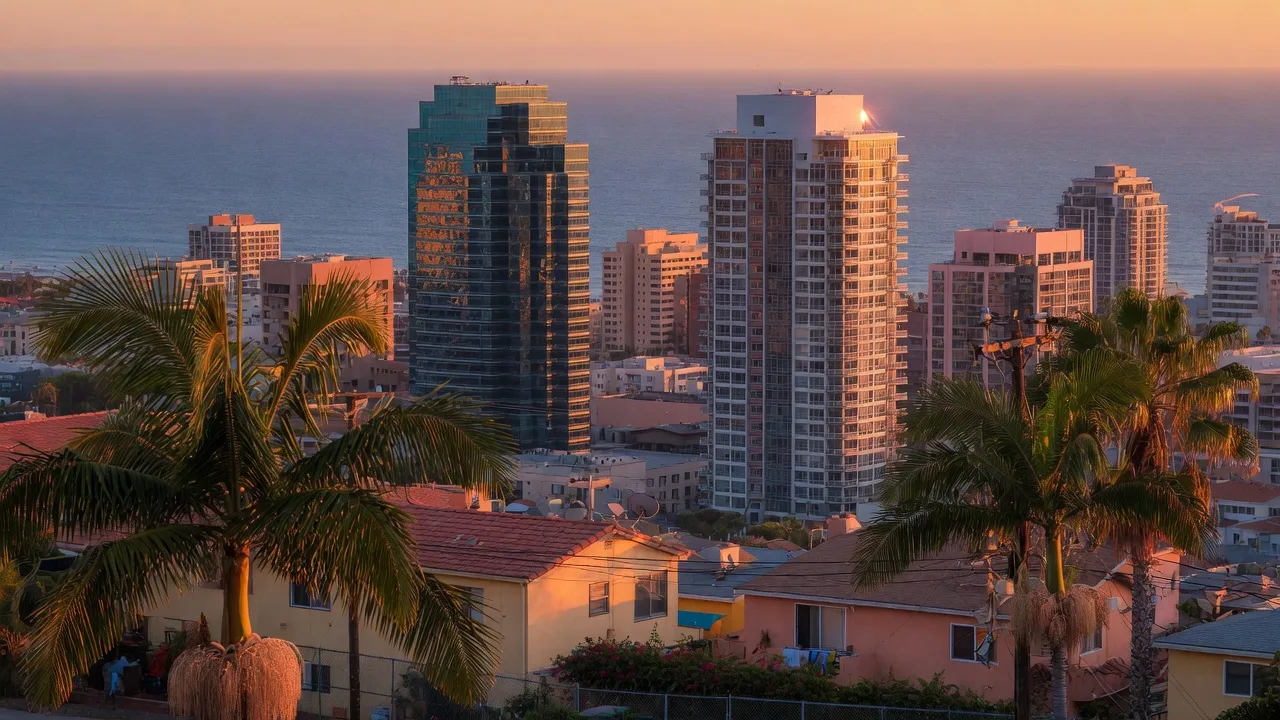
San Diego real estate market trends & investment outlook.
An updated mid-summer 2026 look at San Diego County's real estate market u2014 median prices, mortgage rates at 6.67%, the two-track market, record vacancy, shrinking construction pipeline, and actionable strategies for investors.
This article was originally published June 24, 2026 and last updated July 27, 2026. We have refreshed it with mid-August 2026 data: the 30-year fixed mortgage averaged 6.67% per Freddie Mac PMMS (week of August 13, down from 6.69%), the 10-year Treasury yield stands at 4.63%-4.68%, the Fed held rates at 3.50%-3.75% at its July 29 FOMC meeting (9-3 vote with three hawkish dissenters), and a weaker-than-expected July jobs report has pushed September rate hike odds down to ~32% with Goldman Sachs calling a hike "very unlikely." The mid-year San Diego housing market review confirmed a "normalization" year: detached homes appreciating 5.1% YoY with active inventory at 2.8 months of supply, total closed sales up 3.9% YoY in July, and new listings down 2.3% year-over-year countywide.
County median home price in July 2026, down from June's $1.05M. Detached homes rose 5.1% YoY; attached homes appreciated 1.1%.
Apartment vacancy hit a century high. New supply surged with 10,200+ units delivered 2025\u20132026. Downtown vacancy exceeds 10%.
Detached homes appreciate and sell fast; condos/attached have growing inventory and more buyer negotiating room. Property selection is critical.
New units under construction fell year-over-year. The supply pipeline is already shrinking heading into 2027\u20132028, setting up tighter conditions.
San Diego's real estate market in mid-summer 2026 is defined by a split personality \u2014 detached single-family homes are appreciating 5% year-over-year and selling quickly, while the rental sector faces record vacancy and condos have growing inventory.
The San Diego Association of Realtors (SDAR) reported a countywide median detached home price of $1,125,000 in June 2026 \u2014 up 5.1% year-over-year \u2014 with total closed sales jumping 9.5% compared to June 2025. Detached home closings increased 10.9%, while attached closings rose 6.7%. New detached listings, however, fell 17.8% year-over-year, meaning inventory remains extremely tight for single-family homes with only 3,047 detached homes available at the end of June.
Yet the rental market tells a different story. The apartment vacancy rate has surged to 6.2% \u2014 the highest level this century and more than double the historic low of 2.64% in 2021 \u2014 driven by a flood of new supply: nearly 7,000 apartments built in 2025 (the most in 25 years), with 10,200 new units delivered between 2025 and 2026 combined. Downtown San Diego has the county's highest vacancy at over 10%.
The most significant structural dynamic remains San Diego's chronic housing undersupply for for-sale homes. Population growth of 0.32% annually (reaching 3.34 million countywide) is modest, but the gap between housing production and demand for single-family homes continues to grow. The two-track market \u2014 appreciating detached homes alongside softening condos and rental apartments \u2014 means investors must be highly selective about property type and submarket.
Three major employment sectors \u2014 military and defense (Naval Base San Diego), biotech and healthcare (UC San Diego, Sharp HealthCare, Scripps Health), and tourism \u2014 provide diversified, recession-resistant demand. The county added 4,700 jobs in 2025, with healthcare and social assistance leading gains. Meanwhile, units under construction fell 24% year-over-year, signaling that the supply pipeline is already shrinking heading into 2027\u20132028 \u2014 a positive sign for existing property owners and investors with a medium-term horizon.
Fresh data: mid-August 2026.
The numbers have shifted meaningfully since our mid-year analysis. Here are the key metrics San Diego investors should be tracking right now.
County median home price dipped $30K from June’s $1.05M — detached homes still up 5.1% YoY
Highest level this century. Downtown San Diego vacancy exceeds 10%. Six consecutive months of rent declines through late 2025
Single-family homes appreciate and sell fast. Condos have growing inventory and more buyer negotiating room
Units under construction fell 24% YoY — supply is shrinking heading into 2027–2028
30-year fixed averaged 6.67% per Freddie Mac PMMS, down from 6.69%. 10-year Treasury at 4.63%-4.68%. Fed holding at 3.50%-3.75% with September hike odds at ~32%.
| Metric | Current Value | Trend |
|---|---|---|
| Median Detached Home (SDAR) | $1,125,000 | +5.1% YoY |
| Median Attached Home (SDAR) | $670,000 | +1.1% YoY |
| County Median (Jun/Jul) | $1.02M–$1.05M | Moderating from peak |
| Apartment Vacancy Rate | 6.2% | Highest this century |
| Multifamily Cap Rate (Avg) | ~4.5% | Range: 3%–6% |
| Median Days on Market | 18–43 days | Well-priced homes: ~2 weeks |
| Mortgage Rate (Residential) | ~6.0%–6.5% | Stabilizing |
| New Listings (Detached) | 1,789 (Jun) | −17.8% YoY |
Data compiled from SDAR, Freddie Mac PMMS, Federal Reserve, San Diego Union-Tribune, Zillow, Redfin, and team analysis. Individual properties may vary based on location, condition, and market dynamics. All figures reflect mid-August 2026 conditions unless otherwise noted.
Why detached and attached homes are behaving like two different markets in 2026.
The single most important structural dynamic for San Diego investors in mid-summer 2026 is the growing divergence between the detached home market and the condo/attached market. They are moving in opposite directions.
The detached side: The median detached home price hit $1,125,000 in June, up 5.1% year-over-year. Only 3,047 detached homes were available for sale \u2014 down 26.1% from a year earlier. New detached listings fell 17.8% YoY. Well-priced homes go pending in approximately 18 days. The luxury segment ($5M+) is even stronger, with pending sales up 21.8% year-over-year and only 3.7 months of supply (a firm seller's market).
The attached side: Condos and townhomes tell a different story. The median attached home price was $670,000, up just 1.1% YoY \u2014 essentially flat when adjusted for inflation. Condo inventory is rising significantly, giving buyers more negotiating room and softening pricing power. The contrast is stark: a detached home in Carlsbad or Encinitas sees multiple offers within two weeks, while a comparable condominium in the same area may sit for 30\u201345 days with price adjustments.
For investors, this means property selection has never been more critical. Detached single-family rentals in supply-constrained neighborhoods offer the strongest appreciation and rent growth potential. Condos in HOA communities with new-construction competition require careful underwriting and a longer hold period to work.
Nine trends shaping San Diego real estate investment in 2026.
Moderate Appreciation Replaces Rapid Gains
San Diego has shifted from the double-digit appreciation of 2021–2022 to a more sustainable 2%–4% annual growth rate in 2026. This moderation is actually healthy for investors — it reduces bubble risk while still building equity faster than inflation. Properties bought at today's prices are projected to appreciate steadily over the next 3–5 years.
New Construction Pipeline Slowing
After a surge of multifamily deliveries in 2024–2025, the construction pipeline is declining. Units under construction fell 24% year-over-year. This is significant for investors: new supply was the primary factor behind rent softening and elevated vacancy in certain submarkets. As deliveries slow through 2027, existing properties should benefit from reduced competition and improving occupancy.
Interest Rates Creating Selective Opportunity
With mortgage rates hovering around 6%–6.5% and stabilizing, the financing environment is creating selective opportunities. Properties that pencil out at current rates are strong investments — and many sellers who listed at peak prices are now adjusting expectations, creating better entry points for well-capitalized buyers. DSCR loans at 25% down remain the go-to for buy-and-hold investors.
ADU Legislation Transforming Property Values
California's SB 1211 (2025) allows multifamily properties to add up to 8 detached ADUs per lot, and San Diego's ADU Home Density Bonus Program provides financing up to $250,000 through the Housing Commission. For investors, this means adding $1,200–$2,200/month per unit in rental income while increasing property values by an estimated 20%–30%.
Workforce Housing Outperforming Luxury
Class B and C workforce housing continues to outperform luxury Class A properties in occupancy and rent stability. With San Diego's affordability challenges, properties priced for working families see consistent demand regardless of broader market cycles. Inland neighborhoods like City Heights, Chula Vista, and National City are the primary beneficiaries.
Institutional Capital Returning to Market
After a pullback in 2023–2024, institutional and private capital is flowing back into San Diego real estate. Apartment complexes are drawing increased buyer interest expected to carry through 2026 into 2027. Closed sales rose 9.5% in June 2026 vs. a year earlier. This increased buyer competition is supporting property values while also creating exit opportunities for holders.
Recovery Housing and Specialty Sectors Growing
The sober living and recovery housing sector is emerging as a compelling investment niche. San Diego's concentration of behavioral health providers, treatment facilities, and recovery programs creates demand for specialized residential properties. Operators seeking compliant housing can offer property owners stable, long-term tenancies with strong occupancy rates.
Industrial Sector in Temporary Buyer's Market
San Diego's industrial vacancy has exceeded 9% — the highest in recent memory — due to deliveries outpacing absorption. However, the new Otay Mesa truck port of entry and defense manufacturing demand suggest strong recovery potential. Investors with a 3–5 year horizon can acquire assets at favorable cap rates during this temporary oversupply window.
Employment Anchors Sustaining Rental Demand
San Diego's economy is anchored by three recession-resistant sectors: military and defense (Naval Base San Diego), biotech and healthcare (UC San Diego, Sharp HealthCare, Scripps Health), and tourism. The county added 4,700 jobs in 2025, with healthcare and social assistance leading gains. These employment bases create consistent, diversified rental demand.

Data-driven analysis is essential for making informed investment decisions in San Diego's complex, neighborhood-specific market.
How do San Diego's submarkets compare in 2026?
San Diego is not one market \u2014 it's a collection of distinct micro-markets, each with different dynamics. Understanding submarket-level trends is essential for targeted investment decisions.
| Submarket | Current Trend | 2026\u20132027 Outlook | Key Driver |
|---|---|---|---|
| Downtown / East Village | Stabilizing | Moderate | New deliveries absorbed gradually; vacancy above 10% in downtown — transit-oriented demand remains strong but supply overhang is the highest in the county |
| Mission Valley | Growing | Strong | Riverwalk redevelopment and SDSU expansion driving long-term value |
| Chula Vista | Growing | Strong | Bayfront project and population growth support sustained demand |
| Kearny Mesa / Clairemont | Stable | Strong | Limited new construction; value-add opportunities on aging stock |
| City Heights | Improving | Strong | Highest cap rates in the city; El Cajon Blvd corridor redevelopment |
| North Park | Stable | Moderate | ADU-driven value creation; premium rents with low vacancy |
| El Cajon | Stable | Moderate | Healthcare and education employment anchors; below-median pricing |
| National City | Improving | Moderate | Lowest entry point in county; transit-oriented development planned |
| Otay Mesa Industrial | Softening | Recovery | Temporary oversupply; 3–5 year recovery horizon with port of entry |
| Oceanside | Growing | Moderate | North County expansion; military and tourism demand dual anchors |
Which investment strategies are producing results in 2026?
Value-Add Acquisitions
Acquire underperforming properties with below-market rents, invest $30K–$60K per unit in renovations, and push rents 20%–30% higher. Kearny Mesa, City Heights, and Chula Vista offer the best value-add opportunities with older housing stock below replacement cost.
ADU Development
Add accessory dwelling units to existing properties under California's SB 1211 reforms. Each ADU generates $1,200–$2,200/month in rent and increases property value by 20%–30%. San Diego Housing Commission financing up to $250,000 is available for qualifying projects.
Workforce Housing Hold
Acquire and hold workforce housing in cash-flow zones (City Heights, National City, El Cajon) for stable 5%–6.3% cap rates. These properties offer the strongest rent-to-price ratios and consistent demand from San Diego's essential workforce.
Specialty Housing
Recovery housing, sober living, and behavioral health residential properties offer operators long-term leases and stable occupancy. Property owners benefit from professional operators who maintain the property and pay reliable, structured rent.
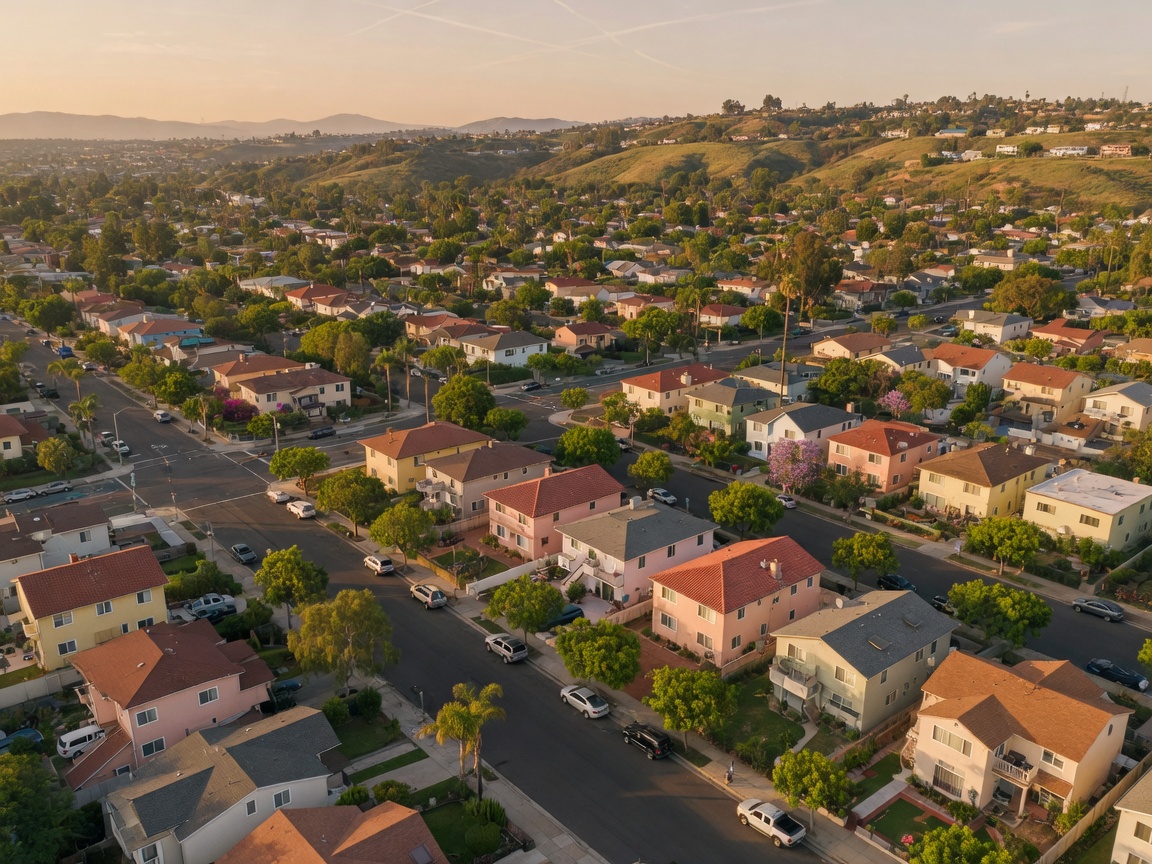
San Diego's inland neighborhoods continue to offer compelling investment profiles for investors seeking cash flow and long-term appreciation.
What risks should San Diego investors watch in 2026?
Record Apartment Vacancy
Apartment vacancy at 6.2% is the highest this century. Downtown vacancy exceeds 10%. Rents declined for six consecutive months through late 2025 \u2014 the longest sustained drop since 2010. Multifamily investors should underwrite conservatively and expect flat-to-negative rent growth through 2026.
Regulatory Environment
California's AB 1482 rent cap (5% plus CPI or 10%, whichever is lower) limits revenue growth on market-rate properties. The cap drops to 8.2% on August 1, 2026. Eviction procedures are complex and time-consuming. Staying current with state and local legislation is essential for compliance.
Financing Costs
Residential mortgage rates have stabilized at 6%\u20136.5%, which is an improvement over 2024 but still compresses cash-on-cash returns. Commercial loan rates of 6.0%\u20137.5% affect multifamily acquisitions. Rate locks, fixed-rate structures, and conservative LTV ratios are essential risk management tools.
Two-Track Market Risk
Condo and attached home inventory is rising while detached inventory shrinks. Investing in the wrong property type could mean extended holding periods and weaker appreciation. Buyers targeting condos or HOA communities should verify association financials and be conservative with rent growth projections.
Industrial Oversupply
Otay Mesa industrial vacancy exceeding 9% signals a temporary buyer's market. Investors in this sector need a 3\u20135 year horizon and conviction in the port of entry infrastructure project driving future demand.
Deferred Maintenance Risk
Older value-add properties carry hidden costs. Thorough physical inspections and capital expenditure budgeting are critical before acquisition \u2014 especially for pre-1980 buildings in City Heights, Kearny Mesa, and National City.
Frequently asked questions.
Is now a good time to invest in San Diego real estate in 2026?
Is now a good time to invest in San Diego real estate in 2026?
Which San Diego neighborhoods are appreciating the fastest in 2026?
Which San Diego neighborhoods are appreciating the fastest in 2026?
How are rising insurance costs affecting San Diego investment properties?
How are rising insurance costs affecting San Diego investment properties?
What financing options are available for San Diego investment properties in 2026?
What financing options are available for San Diego investment properties in 2026?
How does California's AB 1482 rent cap affect investment returns?
How does California's AB 1482 rent cap affect investment returns?
What are the biggest risks for San Diego real estate investors in 2026?
What are the biggest risks for San Diego real estate investors in 2026?
Why is the San Diego apartment vacancy at 6.2% — the highest this century — and what does it mean for investors?
Why is the San Diego apartment vacancy at 6.2% — the highest this century — and what does it mean for investors?
Navigate San Diego's market
with data-driven confidence.
Whether you're evaluating a specific property, comparing submarkets, or building an investment strategy from the ground up \u2014 our team can help you make informed decisions backed by local market expertise.