
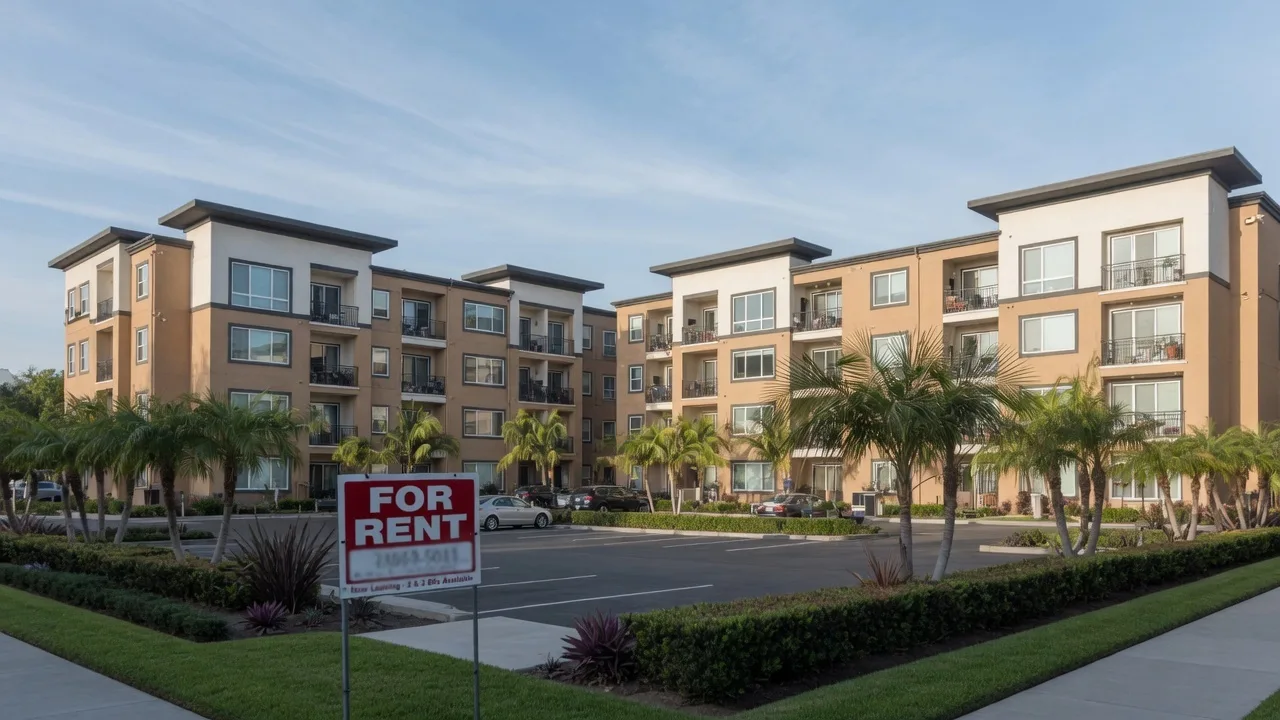
San Diego's rental market is shifting. Here's what investors need to know.
Record vacancy, a proposed fee crackdown by the City Council, and a new AB 1482 rent cap taking effect August 1 — mid-2026 is a defining moment for San Diego rental property investors. Data-driven analysis and actionable strategies for navigating the shift.
Record apartment vacancy — highest this century, surpassing the 2009 Great Recession peak of 5.7%.
New apartment units delivered in 2025–2026, driving the supply glut. 4,000+ more expected by year-end.
New AB 1482 rent cap effective August 1 — down from 8.8%. Plan your rent increases accordingly.
Proposed City Council ordinance would cap monthly fees at 5% of rent and ban pet rent. Under active consideration.
San Diego's rental market is undergoing its most significant shift in a generation. Record-high vacancy, a proposed fee crackdown from the City Council, and a new AB 1482 rent cap are converging to reshape the landscape for property owners and investors.
The apartment vacancy rate in San Diego County has reached 6.1% — the highest level this century, surpassing even the 5.7% peak recorded during the 2009 Great Recession. Downtown San Diego has been hit especially hard, with vacancy exceeding 10%. The primary driver is an unprecedented wave of new construction: more than 10,200 apartment units were delivered between 2025 and mid-2026, with an additional 4,000+ units expected by the end of the year.
For investors, this means a market that has shifted decisively from a landlord's market to a tenant's market — at least in the short term. Rents have flattened or declined modestly year-over-year, and landlords are competing aggressively for qualified tenants with concessions, reduced deposits, and waived fees.
At the same time, the City Council is considering a new ordinance that would significantly limit how landlords charge fees — capping monthly recurring fees at 5% of rent, capping late fees at 2%, banning monthly pet rent, and prohibiting fees for habitability services. While the ordinance is still under consideration as of July 2026, it signals a growing regulatory focus on landlord fee practices.
And starting August 1, 2026, the AB 1482 rent cap drops from 8.8% to 8.2% (5% base + 3.2% CPI) — a modest but meaningful reduction that affects how much rent increase landlords can implement in the coming year.
These three developments — record vacancy, fee regulation, and a lower rent cap — create a challenging but navigable environment for informed investors. The strategies that work in this market are different from the ones that worked in 2021–2024. This guide breaks down what's happening and what to do about it.
What does the data say about San Diego's rental market?
The numbers paint a clear picture of a market in transition. Here are the key metrics every rental property investor should be tracking.
Highest apartment vacancy this century, surpassing the 5.7% peak during the 2009 Great Recession.
Apartment construction boom has flooded the market with new supply, particularly in Downtown and Mission Valley.
AB 1482 rent cap drops from 8.8% to 8.2% (5% base + 3.2% CPI) starting August 1, 2026.
City Council considering ordinance to cap monthly recurring fees (parking, trash) at 5% of monthly rent.
| Metric | Current Value | Trend |
|---|---|---|
| Countywide Apartment Vacancy | 6.1% | Highest this century |
| Downtown / East Village Vacancy | 10%+ | Most affected submarket |
| Average Monthly Rent | $2,333–$3,100 | Flat to slightly declining YoY |
| New Units Delivered (2025–2026) | 10,200+ | 4,000+ more expected by end of 2026 |
| Rent Cap (Aug 2026–Jul 2027) | 8.2% | Down from 8.8% |
| Proposed Fee Cap | 5% of monthly rent | Under City Council consideration |
| Residential Mortgage Rate | ~6.35% | Down 45 bps from 2025 |
| Active Inventory Change | +24% YoY | Days on market 4–13 days longer |
Data compiled from U.S. Census Bureau, CoStar, San Diego Union-Tribune, KPBS, and industry reports as of July 2026. Individual submarkets may vary significantly from countywide averages.
What's driving San Diego's record vacancy rate?
Unprecedented New Supply
San Diego absorbed 10,200+ new apartment units between 2025 and mid-2026, with an additional 4,000+ units expected by year-end. This is the largest wave of new construction the city has seen in decades. Downtown San Diego alone has vacancy exceeding 10%, driven primarily by new Class A high-rises competing for a limited pool of renters willing to pay premium prices.
Rent Growth Has Stalled
After years of steady increases, San Diego rents have flattened or declined modestly year-over-year. Average rents now range from approximately $2,333 to $3,100 depending on property type and location. Monthly rent growth is averaging just 0.4%, and some submarkets are seeing slight declines as landlords compete for tenants with concessions like one month free or reduced security deposits.
Downtown Oversupply Crisis
Downtown San Diego and East Village are the epicenters of the vacancy surge, with rates exceeding 10%. The concentration of new luxury high-rises has created a buyer's market for renters in the urban core. Investors with Downtown properties face the most pressure to offer concessions, reduce rents, or reposition their assets to compete.
Workforce Housing Remains Resilient
While Class A luxury properties struggle with absorption, workforce housing (Class B and C) in neighborhoods like City Heights, Chula Vista, National City, and El Cajon continues to perform well. These properties serve essential demand from San Diego's working families and healthcare/defense employees — tenants who are less mobile and less likely to chase concessions at luxury buildings.
The big picture: The construction pipeline is already slowing. Fewer new projects broke ground in 2026 than in 2024–2025, which means the supply wave is front-loaded. Existing investors who can weather 12–18 months of elevated vacancy should see conditions improve as new deliveries taper off. The key is having sufficient reserves and a strategy to compete effectively in the interim.
San Diego City Council is considering a landlord fee crackdown.
In July 2026, the San Diego City Council began considering a proposed ordinance that would significantly limit the fees landlords can charge tenants. While the ordinance has not yet been passed, it represents a meaningful regulatory development that investors should understand and prepare for.
Monthly Fee Cap (5% of Rent)
The proposed ordinance would cap recurring monthly fees — including parking, storage, trash, and valet waste — at 5% of the monthly rent. This directly impacts investors who use fees to boost effective rent without increasing base rent, a common strategy in California's cap-regulated environment.
Late Fee Cap (2% of Rent)
Late payment fees would be capped at 2% of monthly rent. Currently, many landlords charge flat late fees of $50–$100 or up to 5%–6% of rent. The proposed cap would reduce late fee revenue significantly for properties with frequent payment issues.
Ban on Monthly Pet Rent
The ordinance would prohibit monthly pet rent charges, though a one-time non-refundable pet deposit would still be allowed. This is a significant change for pet-friendly properties that generate $25–$75/month in additional pet rent per unit.
Ban on Fees for Habitability Services
Charges for services necessary to keep a unit habitable — such as trash collection, water, and sewer — would be prohibited as separate fees. These costs must be included in the base rent, reducing the ability to unbundle expenses.
What this means for investors: The proposed ordinance is still under consideration and could change before passage. However, the trend is clear — San Diego is following cities like Los Angeles and Oakland in regulating landlord fee practices. Investors should review their current fee structures now and model the financial impact of these restrictions. Properties that rely on unbundled fees for a significant portion of effective rent will need to adjust their operating models.
The AB 1482 rent cap drops to 8.2% on August 1, 2026.
California's Tenant Protection Act (AB 1482) caps annual rent increases at 5% plus the local Consumer Price Index percentage change, or 10% — whichever is lower. The cap is recalculated annually based on the CPI for the region.
For the period August 1, 2025 through July 31, 2026, the maximum allowable increase has been 8.8% (5% + 3.8% CPI). Starting August 1, 2026, the cap drops to 8.2% (5% + 3.2% CPI) for the period through July 31, 2027.
The 0.6 percentage point reduction is significant in context. With vacancy at record highs, the practical ability to increase rents by 8.2% is limited in many submarkets — the market, not the cap, will be the binding constraint for most landlords in 2026–2027.
However, for properties with below-market rents, the 8.2% cap still provides meaningful room to push rents toward market levels. Investors pursuing value-add strategies should plan their rent increases carefully to maximize the allowable adjustment within the cap framework.
Exemptions to AB 1482: Single-family homes and condominiums owned by individual natural persons (not LLCs or corporations) are exempt if the owner does not own more than one single-family property. Properties built within the last 15 years are also exempt. Verify your property's exemption status before assuming the cap applies.

Strategic financial planning is essential for navigating San Diego's shifting rental market. Conservative underwriting and proactive management separate successful investors from those caught off guard.
Six strategies for navigating San Diego's rental market shift.
The strategies that worked in 2021–2024 won't work in mid-2026. Here are the approaches that are producing results for San Diego rental property investors in this new environment.
Reposition for Workforce Housing Demand
With luxury Class A vacancy at elevated levels, investors should consider repositioning assets to serve the workforce housing segment. Properties in B- and C-class neighborhoods continue to see stable occupancy and consistent rent collection. Value-add improvements that upgrade units without pushing them into luxury pricing tiers offer the best risk-adjusted returns in this environment.
Offer Strategic Concessions Instead of Rent Reductions
When vacancy pressures require tenant incentives, offer one-time concessions (one month free on a 12-month lease, reduced security deposit, waived application fees) rather than lowering base rent. Base rent reductions compound over time under AB 1482's cap framework — a lower base rent means lower future increases. Concessions protect your long-term rent trajectory.
Prepare for the Fee Ordinance
If passed, the proposed fee ordinance will reduce effective rent by 5%–10% for properties that currently rely on unbundled fees. Review your current fee structure now. Consider whether to absorb the impact by adjusting base rent (where AB 1482 allows), or by reducing operating costs to maintain NOI. Properties with minimal fee reliance will be less affected.
Target Mid-Term Rentals for Vacant Units
With short-term rental regulations tightening and long-term leases facing vacancy pressure, mid-term rentals (30–360 nights) offer a compelling bridge strategy. Corporate housing, travel nurses, and remote workers provide stable occupancy at premium rates. The hybrid model avoids STRO license requirements while maintaining higher per-night revenue than traditional leases.
Lock in Long-Term Fixed-Rate Financing
With commercial loan rates stabilizing in the 6.0%–7.5% range and potential rate cuts on the horizon later in 2026, securing fixed-rate financing now protects against uncertainty. Refinance floating-rate debt into fixed-rate products where possible. The spread between cap rates and financing costs remains tight — every basis point of rate stability matters.
Strengthen Tenant Retention Programs
In a high-vacancy environment, retaining existing tenants is significantly cheaper than finding new ones. Implement renewal incentives (small rent concessions, unit upgrades, referral bonuses), improve maintenance responsiveness, and conduct stay interviews with good tenants. A 5% reduction in turnover can save $2,000–$5,000 per unit annually in turnover costs.
Frequently asked questions.
Why is San Diego's apartment vacancy rate at a record high in 2026?
Why is San Diego's apartment vacancy rate at a record high in 2026?
What is the proposed landlord fee ordinance in San Diego?
What is the proposed landlord fee ordinance in San Diego?
How does the AB 1482 rent cap change in August 2026?
How does the AB 1482 rent cap change in August 2026?
Which San Diego neighborhoods are most affected by the vacancy surge?
Which San Diego neighborhoods are most affected by the vacancy surge?
Is now a good time to buy a rental property in San Diego?
Is now a good time to buy a rental property in San Diego?
How should I adjust my property management strategy for the high-vacancy market?
How should I adjust my property management strategy for the high-vacancy market?
What happens to property values if vacancy stays high?
What happens to property values if vacancy stays high?
How does the new ADU legislation affect the rental market?
How does the new ADU legislation affect the rental market?
Navigate San Diego's shifting
rental market with confidence.
Whether you're adjusting your portfolio strategy, evaluating a new acquisition, or navigating regulatory changes — our team can help you make informed decisions backed by current market data and local expertise.