
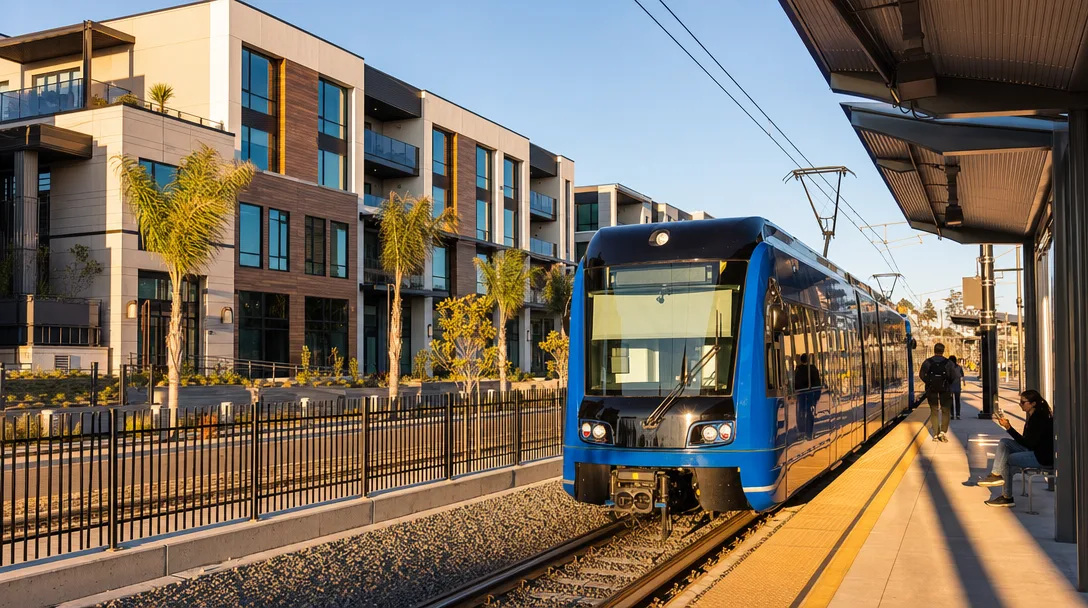
SB 79 transit-oriented development: a new play for San Diego investors.
California's transit density law took effect July 1, 2026, overriding local zoning limits near qualifying transit stops. For investors, it opens a new map of redevelopment opportunity across San Diego County.
SB 79 effective date -- California's Abundant and Affordable Homes Near Transit Act took effect, overriding local zoning limits near qualifying transit stops.
Qualifying San Diego stops -- All 47 MTS Trolley stations plus 21 SANDAG-qualified bus stops fall under the new density standards.
Height allowance near Tier 2 stops -- Buildings up to 65 feet and 100 units per acre within a quarter mile of a qualifying light rail station.
Affordability requirement -- A share of new units must be affordable to lower-income households, varying by project and location.
California's SB 79, the Abundant and Affordable Homes Near Transit Act, is the most significant state-level zoning change to touch San Diego in years. It lets developers build taller and denser near qualifying transit stops without a local rezoning process, and that change reshapes the value of land across the county.
Signed in October 2025, SB 79 took effect July 1, 2026 in eight urban transit counties across California, including San Diego. The law establishes state-level minimum zoning standards that override local height, density, and floor area ratio (FAR) limits for residential development near qualifying transit stops. In practical terms, a parcel that was previously limited to a handful of units can now support a mid-rise project by right.
For investors, this is not merely a regulatory headline. It is a re-pricing event for near-transit land. The highest and best use of a qualifying parcel changes, which changes what a buyer can build, what a lender will finance, and ultimately what the land is worth. Understanding which parcels qualify, and which do not, is the foundation of this opportunity.
San Diego's qualifying stops include all 47 MTS Trolley stations, which fall under Tier 2 standards, plus 21 SANDAG-qualified bus stops along the Park Boulevard, El Cajon Boulevard, University Avenue, and SR-15 corridors. The City Council voted in May 2026 to defer to SANDAG on bus stop qualifications and adopted a Transit Village Plan as an alternative compliance path.
This guide walks through the density tiers, the affected corridors, the due diligence checklist, and the common mistakes investors make when pricing near-transit land. As with any zoning-driven opportunity, the edge comes from precision: the parcels that qualify, the projects that pencil out, and the sites still burdened by fire severity or infrastructure constraints.
Two tiers, and San Diego sits in Tier 2.
SB 79 assigns development standards based on the type and frequency of transit at a stop. San Diego's Trolley network qualifies as Tier 2 light rail, which sets the density ceiling for every qualifying station in the county.
Tier 1
Not in San DiegoHeavy rail or 72+ trains daily
Within a quarter mile: 75 ft height, 120 units/acre, FAR 3.5
Quarter to half mile: 65 ft height, 100 units/acre, FAR 3.0
Applies to systems like BART and Caltrain. San Diego has no qualifying Tier 1 stops.
Tier 2
Applies to San DiegoLight rail, commuter rail, or qualifying BRT
Within a quarter mile: 65 ft height, 100 units/acre, FAR 3.0
Quarter to half mile: Minimum 30 units/acre
San Diego MTS Trolley stops (Blue, Orange, Green, and UC San Diego Blue Line extensions) qualify as Tier 2.
What this means in practice
Within a quarter mile of a qualifying trolley station, a developer can now build up to 65 feet tall at 100 units per acre with a floor area ratio of 3.0. Between a quarter and half mile, the floor drops to a minimum of 30 units per acre. Compare that to the underlying zoning on many near-transit parcels and the increase is substantial. The value gap is precisely where the investment opportunity lives.
Which San Diego stops qualify.
Coverage is determined by proximity to a qualifying stop, and the qualifying set is broader than many investors expect. Knowing the full list is the first step to finding eligible parcels.
Trolley Stations
All 47 MTS Trolley stations qualify as Tier 2 TOD stops, running the Blue, Orange, Green, and UC San Diego Blue Line extensions. These include stations from UTC and the VA Medical Center in the north to Barrio Logan, 24th Street, and San Ysidro in the South Bay, plus the line east to El Cajon and north to Santee and SDSU.
Bus Rapid Transit Stops
SANDAG's draft map expanded qualifying bus stops from the city's proposed 4 to 21, along routes meeting SB 79 frequency criteria. These run on four principal corridors: Park Boulevard, El Cajon Boulevard, University Avenue, and the SR-15 Centerline busway through City Heights.
Fire Severity Zones
Very High Fire Severity Zones, which cover much of Mission Valley, parts of University City, Old Town, Mid-City, and San Ysidro, may be exempted or delayed. Confirm the exact site status before underwriting any near-transit acquisition.
The corridors worth watching.
SB 79 does not touch every corner of San Diego. Its impact concentrates along the transit corridors. These are the areas where near-transit density and housing demand intersect most strongly.
Downtown & the Core
The densest, most mature transit corridor. Mid-rise infill near Park & Market, 12th & Imperial, and Barrio Logan benefits from existing infrastructure and strong rental demand.
Mid-City (City Heights, Normal Heights, North Park)
The SR-15 Centerline busway and University Avenue corridor host several of the newly qualified bus stops. Workforce housing here stays in sustained demand as affordability pressures push renters inland.
The UC San Diego Blue Line Extension
Stations from UTC through Clairemont and Pacific Beach unlock infill opportunity along a corridor where land was already highly valued. Expect the strongest price competition here.
The South Bay
Stations from Barrio Logan through National City, Chula Vista, and San Ysidro provide some of San Diego's most accessible near-transit land, with lower entry prices than the coastal corridors.
A due diligence checklist for near-transit land.
The density bonus only converts to value if the project is feasible, financeable, and buildable. Work through this checklist before you pay a premium for a near-transit parcel.
Confirm the site qualifies
Verify the property is within a quarter or half mile of a qualifying Tier 2 stop and confirm the SANDAG map status. Not every near-transit parcel qualifies, and fire severity zone exemptions can remove a site from coverage.
Underwrite the affordable requirement
SB 79 projects must set aside 7% to 13% of units for lower-income households. Model that commitment into your rent roll and projected yield before you commit.
Check local design standards still apply
While SB 79 overrides height, density, and FAR limits, cities retain control over design standards, fees, and procedures. Those costs vary by jurisdiction and materially affect the pro forma.
Confirm parking and entitlements
Transit-adjacent projects often qualify for reduced parking requirements. Confirm what has changed locally and what documentation a lender will require.
Verify the city alternative path
San Diego adopted a Transit Village Plan as an alternative compliance approach. A project that follows the city plan may access different density and affordability terms than the state default.
Common mistakes when pricing density.
Zoning changes invite speculation, and speculation invites mispricing. These are the recurring mistakes we see when investors chase transit density.
Assuming every near-transit parcel qualifies
SB 79 coverage is stop-specific and map-based. A parcel a few blocks from a station may fall outside the qualifying radius or inside a fire severity exemption. Verify the exact parcel before ascribing any density premium to it.
Ignoring the affordability set-aside in the yield
The 7% to 13% affordable requirement reduces achievable market-rate rent. Failing to model it overstates income and understates the part of the project that needs subsidies or longer lease-up.
Overpaying on speculation about future entitlement
The density bonus only has value if the project is feasible and financeable at current rates and construction costs. Buy based on a fully entitled, buildable pro forma, not on hope that a future upzone will rescue the price.
Underestimating fire severity and infrastructure risk
Very High Fire Severity Zones can delay or exempt projects entirely. Check fire zone status, utility capacity, and station planned improvements before underwriting a tight return.
Why a zoning change needs an investor-focused approach.
SB 79 is a land-value event, and land-value events favor buyers and sellers who move with accurate information. A generalist agent may not know the SANDAG map, the fire severity exemptions, or how the Transit Village Plan changes the math.
Accurate Parcel-Level Analysis
The opportunity is parcel-specific. The right team pulls the qualifying map, checks fire severity status, and confirms what the city's Transit Village Plan allows for each site. That precision tells you which near-transit parcels are genuinely re-priced and which are not.
We work with investors who want to understand the buildable envelope, the affordable requirement, and the realistic path to entitlement before they underwrite a single parcel.
A Connected Network for the Whole Deal
Transit-oriented projects bring together land, capital, and operators. Our network spans investors, funders, and development partners across San Diego County, from the UC San Diego corridor to the South Bay.
Whether you are acquiring near-transit land, structuring funding, or placing a workforce housing project, the team can help connect the pieces of the deal.
SB 79 is re-pricing near-transit land across San Diego. Is your parcel or acquisition target in the qualifying zone?
Contact the team for a parcel-level look at what SB 79 means for your property or your next acquisition. We can help you verify qualification, run the numbers, and connect funding or development partners.
Call or text 619-630-9618 or use the contact form to discuss a near-transit deal.