
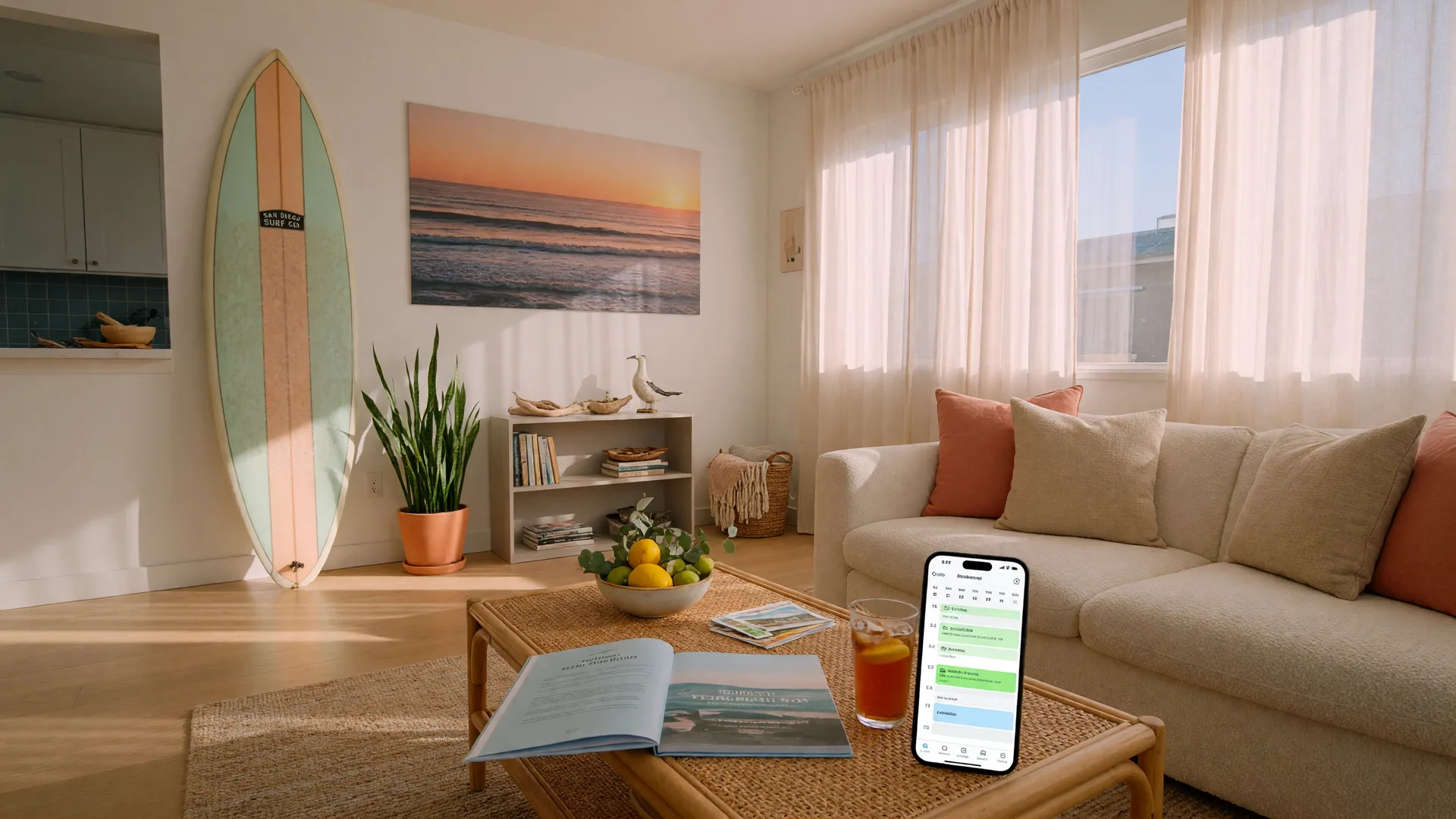
Self-managing a short-term rental in San Diego.
Short-term rentals can be a highly profitable investment, and self-managing them can dramatically cut your costs. But it takes organization, creativity, and consistency. Here's how to run your own short-term rental successfully in San Diego.
Property management fees you keep in your pocket when you self-manage. On a $50,000 annual revenue property, that's $10,000–$15,000 in savings.
Typical weekly time commitment for one well-run short-term rental — guest communication, turnover coordination, marketing, and maintenance oversight.
Number of platforms you should list on to maximize occupancy. Airbnb alone is not enough in a competitive market like San Diego.
Short-term rentals can be a highly profitable investment, and self-managing them can dramatically cut your costs. But it takes organization, creativity, and consistency. Here's how to run your own short-term rental successfully in San Diego.
As a San Diego real estate agent and investor who has worked with short-term rental owners across the county, I have seen the difference between a self-managed property that thrives and one that burns out the owner within six months. The gap almost always comes down to systems — not luck, not location, and not the size of the marketing budget.
Self-managing a short-term rental (STR) is more hands-on than a long-term lease, but the financial upside is significant. A well-run vacation rental in a desirable San Diego neighborhood can generate 2–3 times the gross revenue of a traditional annual rental. The trade-off is that you are effectively running a hospitality business, not just collecting rent.
This guide covers everything you need to know to self-manage a short-term rental in San Diego — from day-to-day operations and listings across multiple platforms to creative marketing strategies that drive bookings and the honest math on when to hire a professional instead.
Whether you are just getting started with your first STR or you have been hosting for a while and want to level up your approach, this guide will give you a practical framework to run your property like a pro — without paying a property manager 20–30% of your revenue.
Managing a self-managed short-term rental property.
The day-to-day of a self-managed STR is different from a long-term rental in almost every way. Instead of one tenant who handles most things on their own, you have a rotating cast of guests who expect hotel-level service in a home setting. Here is what that actually looks like.
Guest Communication and Check-In/Check-Out Coordination
Communication is the heartbeat of a successful short-term rental. Guests expect fast, clear responses from the moment they inquire through the moment they walk out the door. A delayed reply to a pre-booking question often means a lost reservation to a faster host.
Set up automated messaging templates on your platform for the key touchpoints: booking confirmation with a welcome message, check-in instructions sent 48 hours before arrival (including door code, Wi-Fi password, parking details, and your contact number), mid-stay check-in to see if the guest needs anything, and a check-out reminder with departure instructions.
For check-in, smart locks or electronic lockboxes eliminate the need to hand-deliver keys. You can change codes between guests for security and grant access remotely if a guest arrives early. For check-out, keep it simple: strip the beds, start a load of towels, take out the trash, lock up. The less you ask of guests at check-out, the better their reviews tend to be.
Keep your response time under one hour during peak booking hours (morning and evening). Airbnb and Vrbo both track response rates and prioritize hosts who reply quickly in search results — responsiveness directly affects your booking volume.
Housekeeping, Turnover, and Supplies Management
Turnover is the most physically demanding part of self-management. Between guests, every surface gets cleaned, linens get washed, supplies get restocked, and the property gets inspected. For same-day back-to-back bookings, you often have a 4–6 hour window between check-out and check-in.
Most self-managing hosts either do the cleaning themselves (saving $100–$200 per turnover but committing to several hours of physical work per booking) or hire a dedicated cleaner who knows the property and can work independently. If you hire out, build a relationship with one cleaner and pay them well — a reliable cleaner is worth more than almost any other vendor relationship you have.
Create a supplies checklist and keep a running inventory. Stock multiple sets of linens so you are never waiting on laundry. Keep backups of the most commonly lost or broken items: towels, bath mats, drinking glasses, wine glasses, coffee mugs, remote control batteries, light bulbs, and trash bags.
For starter supplies, provide enough for the guest's first 2–3 days: dish soap, dishwasher pods, laundry detergent, paper towels, toilet paper (at least one roll per bathroom plus extras), trash bags, coffee pods or ground coffee, salt, pepper, and cooking oil. Guests remember the small things — a well-stocked kitchen and soft towels generate more "exceeded expectations" reviews than the size of the TV.
Maintaining the Property and Keeping It in Great Shape
A short-term rental gets lived in harder than a long-term rental. Guests do not treat your property the same way a tenant with a lease and a security deposit would. Furniture takes more abuse, dishes get broken more often, walls get scuffed, and appliances get pushed harder. Plan for 2–3 times the maintenance budget of a comparable long-term rental.
Do a thorough walk-through of the property at least once a month, not just between guests. Check for leaking faucets, running toilets, HVAC filters that need changing, grout that needs resealing, and any furniture that is starting to show wear. Replace worn items before they break during a guest's stay. A broken coffee maker or a stuck closet door on a Saturday night when you cannot get a repair person is a one-star review waiting to happen.
Build relationships with a handyman, plumber, electrician, and HVAC technician who can respond on short notice. In San Diego's competitive STR market, same-day service is often the difference between a five-star stay and a guest who demands a refund.
Staying on Top of Reviews — Respond Quickly and Keep Your Rating High
Your rating is your most valuable marketing asset. A property with a 4.8–5.0 average rating commands higher nightly rates and higher occupancy than an identical property at 4.2. Airbnb's algorithm favors highly rated listings in search placement, and guests filter by minimum rating. Dropping below 4.5 can cut your booking volume by 30% or more.
Respond to every review — positive and negative — within 24 hours. A thoughtful, gracious response to a positive review reinforces the guest's good experience and tells future guests that you care. A professional, solution-oriented response to a negative review shows that you take feedback seriously. Never argue with a guest in public. Address the issue, apologize if appropriate, and describe what you have done or will do to improve.
To keep ratings high, underpromise and overdeliver. If your listing says "ocean views from the balcony," make sure those views are actually visible and not partially blocked. If you advertise a fully equipped kitchen, make sure every pot and pan is actually usable. The most common source of disappointing reviews is a disconnect between what the listing photos and description promise and what the guest finds when they arrive.
Send a post-check-out message thanking the guest and reminding them that you would love a review. Many guests leave reviews only when prompted, and a gentle reminder the day after check-out can significantly increase your review volume — which builds social proof and boosts your listing's algorithm ranking.
The Little Details That Drive Repeat Guests and 5-Star Reviews
Five-star reviews are rarely about granite countertops or high-end appliances. They are almost always about how the guest felt during their stay. The little details create that feeling. A welcome note handwritten and left on the kitchen counter. A small welcome basket with local San Diego snacks — maybe some Sea Salt Caramels from a Little Italy shop or a bag of locally roasted coffee. A printed guidebook with your personal restaurant recommendations, favorite beaches, and the best taco shops in the neighborhood.
Leave a spare phone charger in the living room. Provide beach towels and a cooler if you are near the coast. Stock basic toiletries guests might forget: shampoo, conditioner, body wash, lotion, a spare toothbrush, and toothpaste. These cost you a few dollars per stay but can turn a good review into a glowing one.
Repeat guests are the most profitable guests. They book with less negotiation, require less communication, and often stay longer. Encourage returns by leaving a small loyalty card in the unit — "Welcome back! Use code RETURN10 for 10% off your next direct booking." Keep a guest book or a digital list of past guests and send them a seasonal email when you update the property, decorate for the holidays, or have a last-minute cancellation.
The little things compound. One small thoughtful gesture per stay, multiplied by 30–60 bookings a year, builds a reputation that no amount of paid advertising can buy.
Changing Out Pictures for the Seasons
Your listing photos are the first and most powerful thing guests see. Most hosts take photos once and never update them. Fresh photos that reflect the current season, holidays, or special events keep your listing feeling current and drive bookings.
Summer should show bright, sunlit rooms with windows open, beach gear staged on the balcony or patio, and maybe a pitcher of lemonade or margarita glasses on the outdoor table. Winter and the holiday season should show warm lighting, cozy blankets on the sofa, holiday decorations, garlands, or a small tree. Fall can feature pumpkins on the doorstep and warm-toned throws. Spring calls for fresh flowers and bright, airy styling.
For San Diego specifically, seasonal updates are especially powerful because the city draws visitors year-round for different reasons. Summer beach travelers, fall and spring for Comic-Con and music festivals, winter for holiday visitors and "snowbirds." If your property has holiday decor in December, show it. If you are near Balboa Park during the December Nights festival, feature that in your listing description.
You do not need a professional photographer for every seasonal update if you have a good smartphone camera and decent natural light. But investing in one professional shoot per year — restaging the property with updated decor and getting fresh wide-angle shots — is well worth the $200–$500 cost. That refresh alone can increase click-through rates by 20–40%.
Sites to post to (in addition to Airbnb and Zillow).
Airbnb is the obvious starting point, but relying on a single platform is risky. Algorithm changes, policy updates, or a temporary account issue can dry up your bookings overnight. Diversifying across multiple listing sites is one of the smartest things a self-managing host can do.
Vrbo
Vrbo is Airbnb's biggest competitor and especially strong for whole-home vacation rentals and family travelers. Many guests who prefer whole-home privacy search Vrbo exclusively. Listing on Vrbo costs nothing upfront — they charge a commission per booking similar to Airbnb. If you own a coastal property or a larger home, Vrbo should be your second listing after Airbnb.
Booking.com
Booking.com has strong international reach and is particularly popular with European and Asian travelers who are accustomed to using it for hotels. It also attracts a solid segment of business travelers. The platform charges a commission (typically 10–18%) but gives you access to a massive global audience that overlaps very little with Airbnb's user base. The booking management dashboard takes some getting used to, but the extra exposure is worth it.
Google Vacation Rentals
Google Vacation Rentals pulls listings from partner platforms and displays them directly in Google search results. If you list on a partner platform (including many channel managers), your property appears when travelers search "vacation rentals in San Diego" on Google. Even without a direct listing, ensure your property is syndicated through a channel manager that feeds into Google, because the visibility from Google's search results is enormous and completely free.
Expedia and Hotels.com
Expedia Group owns a massive share of the online travel market. Listing your property on Expedia and Hotels.com gives you access to their loyalty program members and a broad travel audience that books hotels and vacation rentals interchangeably. Expedia connects to many property management software platforms, making it easier to manage alongside your other listings. Note that Expedia's commission structure is often higher than Airbnb's, but the incremental bookings from their audience can more than make up for it during peak seasons.
Direct Bookings
A simple website or booking link for direct reservations eliminates platform commissions entirely. Even a basic landing page with your calendar, rates, photos, and a contact form can capture direct bookings from repeat guests and word-of-mouth referrals. Services like Lodgify, OwnerRez, or even a simple Squarespace site can handle direct booking management and payment processing. Direct bookings are your highest-margin reservations — every dollar that would have gone to a platform's commission stays in your pocket.
Local San Diego Platforms and Facebook Marketplace
Do not overlook local channels. San Diego has active Facebook groups for vacation rentals, second homeowners, and short-term stays. Facebook Marketplace allows you to list your property directly. Local San Diego travel forums, university groups (SDSU, UCSD), and military relocation groups (Camp Pendleton, Naval Base San Diego) can be goldmines for midweek and off-season bookings. Post in local community groups when you have a last-minute cancellation or a shoulder-season discount. The local audience books shorter lead times and often pays cash or bank transfer, saving on processing fees.
Listing on Multiple Sites
Listing on multiple sites expands your reach and fills more nights. Use a channel manager or property management software to sync your calendar across platforms — otherwise you risk double bookings, which will get you suspended from every platform simultaneously. Tools like Guesty, Hostaway, or Lodgify automate calendar syncing, messaging, and reviews across all your listings from one dashboard. The cost of the software ($30–$100 per month) is easily justified by the increase in bookings and the peace of mind of never double-booking.
Ways to be creative in marketing.
San Diego has thousands of short-term rental listings. To stand out, you need more than clean rooms and a good location. Creative marketing turns your property from a commodity into a destination. Here are the strategies that work.
Professional, Seasonal Photography
Your photos are your storefront. Professional wide-angle photography that shows the property at its best in the current season is the single highest-ROI marketing investment you can make. Hire a photographer who specializes in STR or hospitality photography — they know how to stage a room, use natural light, and capture the shots that drive clicks. Update your hero photo seasonally to keep the listing feeling fresh. A listing with 20+ high-quality photos gets significantly more engagement than one with 8–10.
Highlighting Local San Diego Attractions
Guests do not book a room, they book an experience. Write a detailed neighborhood guide in your listing description — the best coffee shop within walking distance, which beach has the best sunset views, the taco shop that locals swear by, the best route to Balboa Park or the San Diego Zoo. Mention major events like Comic-Con, the San Diego County Fair, the Holiday Bowl, and the December Nights at Balboa Park. If your property is near a specific attraction, build your listing around it. "Walk to the Gaslamp Quarter" or "5 minutes from Petco Park" are more compelling than generic location descriptions.
Creating a Branded Name and Story
Give your property a name — something memorable that hints at the experience. "Casa del Sol" for a sunny Mission Beach cottage. "Ocean Breeze Haven" for a coastal listing. "The Mission Hills Retreat" for a quiet hillside property. A named property feels more established and curated than one identified only by its address. Write a short story about the property for your listing — what inspired you to set it up, what makes it special to you, and what you hope guests experience. Storytelling differentiates your listing from the dozens of others in the same neighborhood.
Email Marketing and Repeat-Guest Discounts
Collect guest email addresses (with their permission) during the booking process and build a mailing list. Send a quarterly email with seasonal updates, local events, and a special "returning guest" discount code. Offer 10–15% off for direct repeat bookings — the savings on platform commissions plus the reduced marketing effort make this profitable even with a significant discount. An email list of 100–200 past guests can fill 20–30 nights a year with no platform fees and no advertising spend.
Partnerships With Local Businesses
Build relationships with local businesses your guests will love. Partner with a surf school in Pacific Beach or La Jolla for a guest discount. Team up with a local restaurant for a welcome dinner credit. Connect with a bike rental shop, a kayak tour operator, or a wine tasting room. You get a unique offering for your guests, and the local business gets new customers. These partnerships often cost nothing to set up and create the kind of local, authentic experience that generates glowing reviews and word-of-mouth referrals.
Social Media — Instagram and TikTok
Visual platforms are a natural fit for short-term rentals. Post short video tours of the property, the neighborhood, the best nearby beach spots, or a local restaurant recommendation. A 30-second TikTok or Reel of the sunset from your balcony, the fully stocked kitchen, or the walk to the beach can get more views in an afternoon than a month of search engine impressions. Use location tags and hashtags like #SanDiegoVacationRental #PacificBeach #SanDiegoSTR. Social media is free, takes 15–30 minutes a week, and builds a following that fills bookings.
Offering Themed Packages
Stand out with themed stays that appeal to specific traveler segments. A "Date Night Package" with a bottle of local wine, chocolates, and a restaurant recommendation. A "Family Adventure Package" with beach toys, board games, and a guide to kid-friendly San Diego attractions. A "Workcation Package" with a dedicated desk, high-speed internet details, and a list of nearby coworking spaces. These packages do not cost much to assemble but they make your listing memorable and give guests a reason to pick you over 50 similar options in the same price range.
Collecting Guest Emails for Direct Booking
Every guest who stays at your property is a potential repeat direct booker. After a confirmed booking (but before their stay), ask for their email to send pre-arrival information. After their stay, ask for permission to send an occasional update. Build a simple email list in Mailchimp, Constant Contact, or even a Google Sheet. Send two or three emails per year: a spring break reminder, a summer booking push, and a holiday season announcement. Direct bookings from past guests are your highest-margin reservations — no commissions, no platform fees, no advertising cost.
The advantage of saving money on property management.
Property management fees for short-term rentals typically run 20–30% of booking revenue. That is significantly higher than the 8–12% charged for long-term rentals, because the work is more intensive. Self-managing keeps that money in your pocket, and over a year the savings add up fast.
Keep 20–30% More Revenue
A property manager for a short-term rental typically charges 20–30% of gross booking revenue. On a property generating $60,000 in annual bookings, that is $12,000–$18,000 in fees. Self-managing puts that entire amount back in your pocket. Over five years, the savings can be $60,000–$90,000 — enough to buy another property or fund a major renovation.
Full Control Over Guest Experience, Pricing, and Calendar
When you self-manage, every decision is yours. You set the nightly rate, decide when to offer last-minute discounts, block off personal use days, and adjust pricing for local events. You approve every booking personally. You choose which guests to accept. You decide when to invest in new furniture or amenities. No middleman means no delays in responding to guest issues and no missed opportunities to maximize revenue.
Reinvest Savings into the Property and Marketing
The $12,000–$18,000 you save on management fees each year can go directly back into the property. New furniture, upgraded linens, a better TV, fresh paint, landscaping improvements, a hot tub, professional photography, seasonal decor updates — every improvement makes your listing more competitive and justifies higher nightly rates. Reinvesting your management fee savings creates a virtuous cycle of better quality, better reviews, and higher revenue.
The Trade-Off: Time, Attention, and Responsiveness
The trade-off is real. Self-managing a short-term rental requires 5–8 hours of active work per week for a single property. More during turnover weeks and peak season. You need to be available for guest messages, maintenance issues, and emergencies. A midweek work call about a broken air conditioner on a 90-degree July afternoon requires immediate attention. You cannot ignore it until the weekend. For some owners, that trade is worth the money. For others, paying 20% to have someone else handle it is a bargain.
When to hire a property manager.
Self-managing a short-term rental is rewarding and profitable. But it is not the right move forever. Here are the clearest signals that it is time to hand off the day-to-day to a professional.
Converting to a Longer-Term Rental
When you are ready to convert your short-term rental to a long-term lease, the demands and tenant relationship change completely. A long-term tenant needs different screening criteria, different lease terms, different maintenance expectations, and a different communication style. If you built your systems around hospitality-style management, the transition to landlord-style management is significant. At that point, a property manager who specializes in long-term rentals can handle the transition smoothly while you focus on your next investment.
When Self-Managing Becomes Too Overwhelming
If you find yourself dreading guest messages, skipping turnover days, letting maintenance slip, or feeling burned out by the constant cycle of bookings and cleanings, it is time to bring in help. The stress of running a hospitality business while juggling a career, family, or other properties takes a real toll. There is no shame in handing it off. The best investors know when to delegate so they can focus on what they do best — finding and acquiring the next deal.
When You Prefer a Team to Handle Screening and Day-to-Day
Some hosts simply do not want to be the person who handles complaints at 10 PM, screens every inquiry, and coordinates cleaners between back-to-back bookings. Professional property management teams have systems for all of it: 24/7 guest communication lines, vetted cleaning crews, dynamic pricing tools, and automated review management. If you value your time more than the 20–30% management fee, a professional STR management company is worth every dollar.
When You Are Out of the Area or Travel Frequently
Self-managing a short-term rental from a distance is extremely difficult. If you are more than 30 minutes from the property, every emergency becomes a logistical nightmare. A toilet overflow on a Saturday at 4 PM means either someone drives 45 minutes to fix it or a guest sits with a flooded bathroom until you can find a plumber who will go there without you present. If you travel frequently or are considering a move, a professional local property manager is not an expense, it is a necessity.
A Professional Protects Your Investment
When you hand off to a professional property manager, you are not losing money — you are buying your time back and protecting your investment. A good manager keeps occupancy rates high, responds to issues immediately, maintains the property, manages compliance with San Diego's STR regulations including STRO licensing and Transient Occupancy Tax filings, and gives you the freedom to focus on your next investment or simply take a vacation without worrying about your vacation rental. The key is recognizing when the math — both financial and personal — favors delegation.
Whether you're starting your first short-term rental or deciding when to hand things off, I can help you think through the numbers and the strategy.
As a San Diego real estate agent and investor who understands short-term rentals from both sides, I can help you evaluate your property, run the revenue projections, and decide whether self-management or professional management makes more sense for your situation.
Call or text 619-630-9618 or reach out through the contact page to schedule a conversation.