
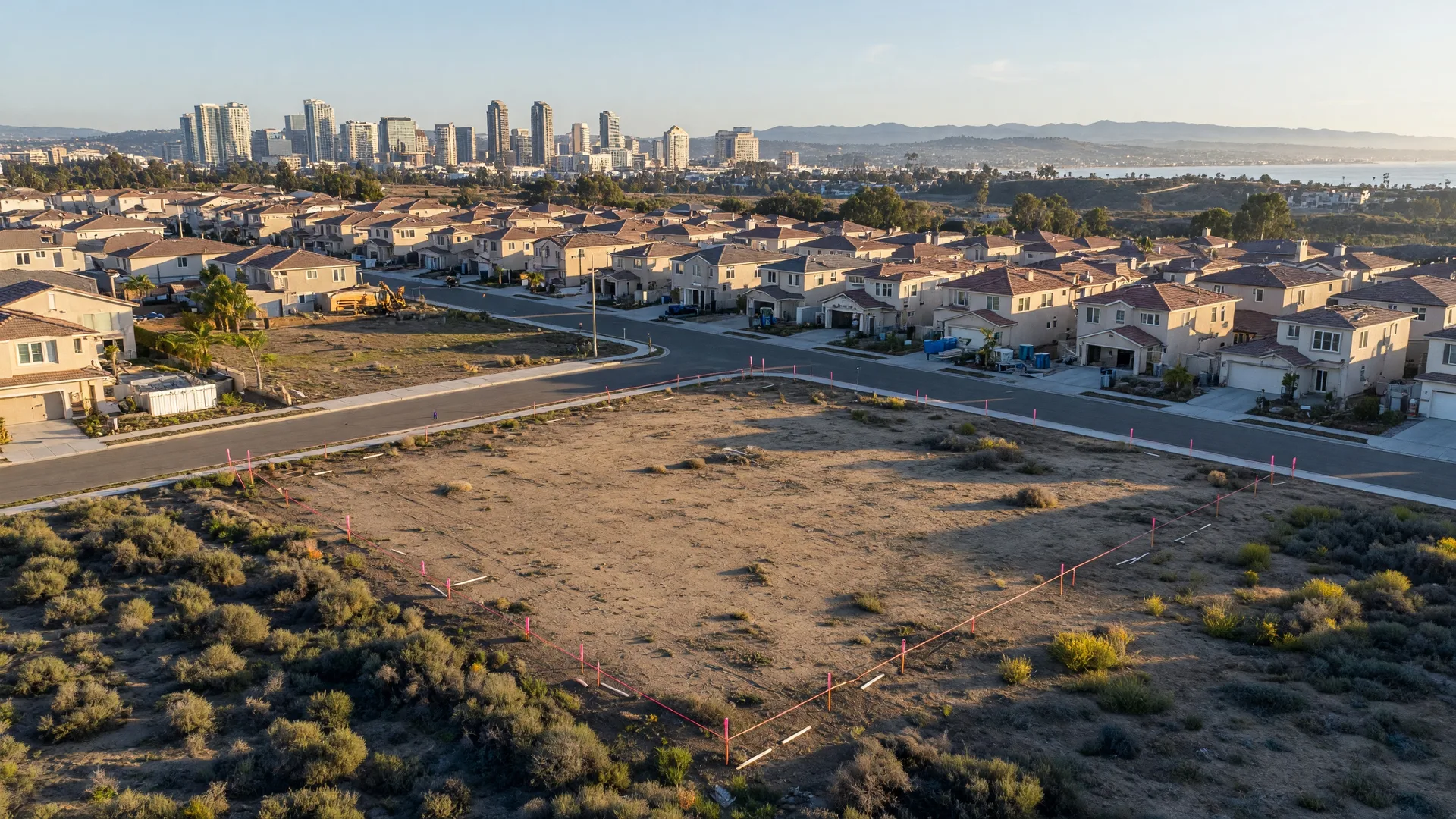
Selling vacant land in San Diego: what every owner & investor needs to know.
Selling land is fundamentally different from selling a house. Entitlements, zoning, environmental review, and the right buyer network all determine what your parcel is worth -- and who will pay that price.
Days typical due diligence period for land transactions in San Diego -- significantly longer than residential sales.
Value difference between raw unentitled land and a fully entitled parcel with approved permits and grading in place.
Months typical entitlement timeline in San Diego County, depending on project complexity and CEQA requirements.
Potential value increase from having a Phase I ESA, survey, and geotechnical report already completed and organized for buyers.
Selling vacant land is not a simple transaction. It requires specialized knowledge of zoning, entitlements, environmental regulations, and market dynamics -- and the difference between a well-prepared seller and one who lists raw land without documentation can be hundreds of thousands of dollars.
If you own vacant land in San Diego County, you own an asset with significant potential. Whether your parcel is in an established suburban neighborhood, a developing exurban area like Alpine or Jamul, or a transitional urban infill lot in City Heights or Southeast San Diego, the value of that land is determined by a complex set of factors that most residential real estate agents are not equipped to navigate.
The first and most important thing to understand: selling vacant land is not like selling a house. A home is priced by comparable sales, square footage, bedrooms, condition, and location. A vacant parcel is priced by its highest and best use under current zoning, its entitlement status, the work already invested in it, and what a developer or investor can reasonably build -- and profitably sell -- on that site.
As both a real estate agent and an investor in the San Diego market, I have seen sellers leave substantial money on the table simply because they did not understand what they were selling. I have also seen sellers overprice raw land based on what entitled parcels nearby sold for, then watch the property sit on the market for months while the carrying costs stack up.
This guide covers the key factors that determine land value, the documentation buyers will demand, the most common mistakes sellers make, and why working with an agent who understands San Diego's land market and investor community can make the difference between a successful sale and a frustrating experience.
Why selling land is not a simple process.
The residential real estate market has standardized processes, comparable data sets, and a large pool of buyer demand. The land market has none of those things. Every land sale is unique, and the agents who succeed in this space understand entitlements, development economics, and the investor mindset.
Buyers Are Investors, Not Homeowners
The pool of buyers for vacant land is small and specialized. Developers, builders, land investors, and syndicates evaluate parcels based on pro forma returns, not emotional appeal. A buyer is asking: can I build something profitable here? If the numbers don't work, they walk. The agent needs to know what those numbers look like to price and market the property effectively.
Pricing Requires Specialized Analysis
There is no MLS comp for raw land the way there is for a 3-bedroom home. Land valuation requires a highest and best use analysis, a residual land value calculation (what can be built times sale price minus all development costs), and a deep understanding of zoning and density allowances. An agent who cannot build a residual land value model cannot accurately price a vacant parcel.
Timelines Are Longer & More Complex
Typical due diligence periods for land transactions in San Diego range from 30 to 90 days. During that time, buyers investigate title, survey boundaries, assess environmental conditions, evaluate utility availability, and model development feasibility. Sellers who are organized and prepared with documentation can close faster -- but even the smoothest land transaction takes longer than a home sale.
Why entitlement status determines your land's value.
Entitlement is the single most important factor in land valuation. A fully entitled parcel can be worth 2 to 5 times what the same raw, unentitled parcel would sell for -- and understanding where your property stands in the entitlement process is essential to pricing it correctly.
What Is Entitlement?
Entitlement refers to the approvals, permits, and zoning permissions that determine what can be built on a piece of land. In San Diego County, the entitlement process includes zoning verification, general plan consistency, tentative map approval (for subdivisions), site plan review, use permits, grading permits, building permits, and often environmental review under CEQA. A fully entitled parcel has cleared most or all of these hurdles.
The Entitlement Premium
Buyers pay a significant premium for land where the entitlement work has already been done. Why? Because entitlements represent time, money, and risk that the seller has already absorbed. Navigating San Diego's planning and development approval process can take 6 to 18 months and cost tens of thousands of dollars in consultant fees, application fees, legal costs, and environmental studies. A buyer who does not have to repeat that process is willing to pay substantially more for the land.
Raw vs. Entitled: The Difference
A raw 5-acre parcel zoned for single-family residential in unincorporated San Diego County might sell for $200,000 per acre. The same parcel, after receiving tentative map approval for a 10-lot subdivision with grading permits issued and CEQA clearance completed, could be worth $500,000 per acre or more. The value difference is not in the dirt -- it is in the approvals. Every approval you have secured adds direct, measurable value to the property.
What to check before listing
Before you list your property, determine exactly where you stand in the entitlement process. Review your existing permits, any approved or pending applications, prior planning studies, and the property's full history with the county or city planning department. This information forms the basis of your marketing strategy and your pricing position. An agent experienced in land transactions will know how to verify this information and present it effectively to buyers.
Why being organized matters.
Organized sellers attract serious buyers and close faster. When a buyer's due diligence process takes 60 to 90 days, having every document ready and accessible from day one can shave weeks off the timeline and dramatically reduce buyer anxiety -- which translates directly into stronger offers and fewer renegotiations.
Current Preliminary Title Report
Reveals ownership, recorded easements, liens, deed restrictions, CC&Rs, and any encumbrances. A clean title report is the foundation of a smooth closing. If the report reveals issues, address them before listing rather than during escrow.
ALTA or Boundary Survey
A current survey confirms the property boundaries, identifies encroachments, and documents easements. Buyers and their lenders will require this. An older survey may still be usable if no improvements or boundary changes have occurred since it was completed.
Zoning Verification Letter
A written confirmation from the planning department stating the current zoning, allowed uses, and any overlay designations (coastal zone, airport influence area, habitat conservation area). This is basic due diligence that every buyer will request.
Geotechnical or Soils Report
If a geotechnical report was prepared for a previous development plan, it is valuable documentation. Soils conditions in San Diego County vary dramatically — expansive clay soils in inland areas, liquefaction zones near waterways, and landslide hazard areas in coastal canyons.
Environmental Site Assessment (Phase I ESA)
A Phase I Environmental Site Assessment documents whether the property has known or potential environmental contamination. While not always required, having one available signals thorough preparation and reduces buyer uncertainty.
Utility Availability Letters
Written confirmation from each utility provider stating that service is available and describing the connection requirements and estimated costs. In rural and semi-rural areas of San Diego County, utility extension costs can reach six figures.
Tax Records and Assessor Information
Current property tax bills, any special assessments (Mello-Roos, CFD, improvement bonds), and the assessor's parcel number and legal description. Buyers need to understand their ongoing tax obligation, especially for parcels in Community Facilities Districts.
Historical Documentation and Prior Studies
Any prior planning studies, biological surveys, archaeological reports, traffic studies, or previous development plans. Even if the prior plans were never executed, the documentation reduces the buyer's initial due diligence burden and adds tangible value to the sale.
Know the history of your property. Beyond the basic documentation, understand and document the full chain of ownership and any events that could affect the property's value: prior lease agreements that may still affect use, recorded or unrecorded easements, boundary disputes, prior environmental assessments, previous permit applications (approved or denied), and any communications with the county or city planning department. A thorough property file signals to buyers that the seller is professional and the transaction will be smooth.
Property value is what someone else will pay for location plus preparation.
This is the concept that separates successful land sellers from those who never close. Your land is worth what a willing buyer will pay for it -- no more, no less. And what a buyer will pay depends on two things: the location, and the work that has already been invested.
Location Determines the Ceiling
A five-acre parcel in La Jolla is worth more than a five-acre parcel in Jacumba Hot Springs, regardless of what improvements have been made. Location sets the upper boundary of value based on surrounding land prices, comparable sales, and the strength of the local real estate market. But within that ceiling, preparation determines where your property lands.
Preparation Determines the Price
Two identical parcels side by side in the same subdivision can have dramatically different values. The raw, unentitled lot might sell for $150,000. The neighboring lot with grading completed, tentative map approved, sewer connection paid, and building permits ready to issue might sell for $400,000. The buyer is paying for the location AND the work already done. Every hour of engineering, every permit fee paid, every study completed adds tangible value.
Highest and Best Use Drives Demand
The projected highest and best use of the property -- what the land is zoned and positioned for -- determines which buyers will be interested and what they will pay. A parcel zoned for multifamily development attracts different buyers than one zoned for single-family homes or commercial use. Understanding your property's highest and best use, and marketing it to the right buyer pool, is the agent's job. An agent who does not understand highest and best use analysis cannot effectively sell land.
Residual Land Valuation: How Developers Price Your Land
When a developer or investor evaluates your property, they are not comparing it to recent land sales alone. They are running a residual land value calculation: (total sale price of finished product) minus (all development costs, including construction, financing, marketing, carrying costs, and profit margin) equals (what they can pay for the land). This means the value of your land is directly tied to the economics of what can be built on it. If construction costs rise or sale prices for finished homes decline, the residual land value drops -- even if your property has not changed. Understanding this dynamic is essential to setting realistic expectations and pricing your land to sell.
What to check before listing your land.
Before you put your property on the market, work through this entitlement checklist with an experienced agent. Each item represents a value driver that will either support your asking price or reveal a gap that needs to be addressed.
Verify Current Zoning Designation
Confirm the property's zoning with the County of San Diego or applicable city planning department. Zoning determines what uses are permitted by right, what requires a conditional use permit, and what is prohibited. A parcel zoned for residential use has different value drivers than one zoned commercial or industrial.
Confirm General Plan Land Use Designation
The General Plan designation may allow more uses than the zoning code or fewer. Check whether your property's land use designation and zoning are consistent. Inconsistencies can create approval risk that buyers will discount from their offer price.
Check for Approved Tentative Maps or Vesting Maps
If the property was previously subdivided or a tentative tract map was approved, that approval carries value. A vested tentative map means the subdivision is essentially approved subject to final map conditions. This can dramatically increase the property's value to a developer.
Review Environmental Documentation (CEQA)
California Environmental Quality Act (CEQA) compliance is one of the largest hurdles for land development in San Diego. If previous environmental review was completed (an Initial Study, Mitigated Negative Declaration, or EIR), that documentation reduces buyer risk and timeline uncertainty.
Understand Permit Status and Grading Approvals
Has the property been graded? Are building permits already issued or pending? A parcel where grading has been completed and permits are in the pipeline is worth significantly more than raw land where every approval is still ahead. Buyers pay for progress, not potential.
Assess Utility Availability and Access
Confirm whether water, sewer, gas, and electricity are available at the property line or require extension. In unincorporated San Diego County, sewer and water availability can be a make-or-break factor. Also verify legal access — a landlocked parcel with no recorded easement has very limited value.
Common mistakes sellers make with land.
After working with dozens of land sellers in San Diego County, these are the most common mistakes I see -- and how to avoid them.
Pricing based on what the land could be worth after development
Price based on what the land is worth as-is, with its current entitlements. The value of what could be built is only realized after the buyer invests additional time, money, and risk. Rare exceptions exist for parcels with full, ready-to-pull building permits.
Ignoring the highest and best use analysis
An appraisal-based highest and best use analysis identifies the most profitable legal use of the property. A 5-acre parcel might support one single-family home (by right) or a 10-lot subdivision (with discretionary approvals). The HBU directly affects valuation.
Failing to disclose known issues
California law requires disclosure of material facts affecting the property's value. Known issues — drainage problems, access disputes, environmental conditions, past permit denials — must be disclosed upfront. Concealing them invites lawsuits and deal cancellations.
Not preparing for a longer timeline
Land transactions take longer than residential sales. Due diligence periods of 30–60 days are common. Buyers need time to review title, order surveys, conduct environmental studies, and confirm development feasibility. Unrealistic deadlines chase away serious buyers.
Marketing only to the obvious buyer type
The buyer for your land may be a developer, an investor, a builder, a neighboring property owner, or a syndicate. Each buyer type has different criteria and valuation models. A diverse marketing strategy reaches the full range of potential buyers.
Why working with the right agent matters for land sales.
A land sale is not a transaction for a generalist agent. It requires someone who understands the San Diego County land market, has relationships in the investor and developer community, and can accurately value properties based on entitlement status and highest and best use.
Access to the Investor Network
The right agent does not just list your property on the MLS and wait. They know who is actively buying land in San Diego County, what those buyers are looking for, and what they are willing to pay. They have relationships with developers, builders, land syndicators, and other investors who are constantly searching for parcels that meet their acquisition criteria. An agent with deep investor connections can match your property with a buyer who sees its potential before it ever hits the open market.
This is where my background as both an agent and an investor gives my clients an advantage. I understand what a developer's pro forma looks like, what return thresholds they need to meet, and what the local market conditions mean for their acquisition decisions. I can speak their language and position your property accordingly.
Market Expertise & Valuation Accuracy
Pricing land is the hardest part of the transaction. Price it too high based on an emotional attachment or an unrealistic view of its development potential, and it will sit on the market -- accumulating carrying costs, tax obligations, and the stigma of an overpriced listing. Price it too low, and you leave money on the table that a well-connected buyer will happily pocket.
An experienced agent understands the current market environment, the regulatory landscape, construction cost trends, and the projected highest and best use. They can price your land to attract serious offers while maximizing your net proceeds. They also know how to negotiate the unique terms of a land contract -- longer due diligence, smaller deposits, contingency structures -- and protect your interests throughout the process.
Selling vacant land in San Diego requires an agent who understands land values, entitlements, and the investor community.
Contact Hanna for a consultation on your land sale. Whether your parcel is raw, partially entitled, or ready to build, we can help you understand what it is worth, who the right buyers are, and how to position it for a successful sale.
Call or text 619-630-9618 or visit the contact page for a consultation.