

Prop 1 and Prop 37 pass. Prop 43 and Prop 45 fail. What the election means for San Diego investors.
The November 3, 2026 results are in for the measures that matter to real estate investors: a funded housing pipeline, new-home buyer assistance, a wealth tax firewall, and two local cliffhangers still counting. Here is what each outcome changes.
Early Secretary of State returns show Prop 1, the $11.25 billion housing bond, at roughly 59% yes statewide, and Prop 37, the $25 billion CalHFA down payment authority for newly built homes, near 61%.
The constitutional amendment passed with roughly 54% of the vote and outpolled Prop 40, the billionaires’ wealth tax, so its protections control under the higher-vote-to-prevail rule.
The two-thirds requirement for local special taxes drew only about 44.8% yes, and the CEQA fast-track measure about 45.7%. Both lost, leaving approval and revenue rules unchanged.
The $3.5 billion SDUSD bond cleared its 55% threshold with roughly 64.9% yes, extending the $32 per $100,000 assessed-value levy for about another ten years.
California voters funded the housing pipeline, authorized new-home buyer assistance, and locked in a ban on new state wealth taxes, while rejecting a two-thirds threshold for local special taxes and a CEQA fast track. Two San Diego County measures still hang on narrow leads with mail ballots outstanding.
Two days after election day, the picture for investors is mostly clear. Prop 1, the $11.25 billion housing bond, passed with roughly 59% yes. Prop 37, the up-to-$25 billion CalHFA down payment authority for newly built homes, passed near 61%. Prop 42, the constitutional ban on new state wealth and personal property taxes, passed with about 54%. Prop 43 and Prop 45 both went down.
Locally, Measure M, the $3.5 billion San Diego Unified school bond, cleared its 55% threshold decisively with roughly 64.9% yes, which matters because it is the one measure on this ballot repaid through a property tax levy. Measure B, the county half-cent sales tax, and Measure A, the county charter reform, both hold narrow leads around 51.6% to 51.7% and are too close to call as of November 5.
This analysis follows our pre-election ballot guide, which broke down what each measure would do, and turns it into a results sheet: what passed, what failed, what it changes in the near term, and what it does not. None of it changes the November 30 Prop 8 appeal deadline, the December 9 FOMC meeting, or the 7.32% rate backdrop that still governs every deal.
The counts cited here are early and semi-official. County certification, and in some races the final mail tally, can still shift the margins, so the close local races should be treated as unresolved until certified.
What the voters decided on November 3.
These are early and semi-official counts as of November 5, 2026. Certification can still shift final tallies, especially in the close races.
The 30-year fixed for the week ending October 22, 2026 per Freddie Mac, with the FOMC holding at 3.75% to 4.00% on October 28 and meeting again December 9.
The San Diego County median sale price, up 1.7% year over year, with closed sales down 14% from a year earlier. The rate backdrop for every ballot outcome.
Prop 1 passed, authorizing $11.25 billion for rental housing, supportive housing, and homeownership programs drawn down over years.
Prop 37 passed, authorizing up to $25 billion in CalHFA revenue bonds for down payment assistance on newly built homes, repaid by borrowers.
Prop 1 passed and Prop 45 failed. How does supply change?
Voters approved the $11.25 billion housing bond and rejected the CEQA fast track. Together the two outcomes set the supply clock for years, not months.
Prop 1 passed: the $11.25 billion housing bond is on
The Veterans and Affordable Housing Bond Act of 2026 won with roughly 59% support. It authorizes $10 billion in General Fund-repaid general obligation bonds for state housing programs plus $1.25 billion in self-supporting CalVet revenue bonds. The largest allocation, $5.1 billion, goes to the Multifamily Housing Program, with $1.15 billion for permanent supportive housing, $1.1 billion for homeownership and down payment assistance, and $1 billion for farmworker, tribal, and student housing.
Where the money lands, and on what timeline
The Legislative Analyst’s Office estimates the bond would subsidize roughly 40,000 rental apartments, about 2,500 farmworker housing units, and around 1,200 college student beds, and help up to about 40,000 households buy a home, including about 2,100 veterans. State agencies issue the bonds and run the programs over a multi-year drawdown, so the first project-level effects in San Diego are a 2027 and beyond story, not a 2026 one.
Prop 45 failed: the approvals clock stays as it is
The Building an Affordable California Act, which would have added an optional CEQA fast-track chapter with binding shot clocks for housing and other essential projects, was defeated with about 45.7% yes. Development approvals keep running on the existing review timeline. Land and development investors do not get the promised shot clocks, and entitlement risk remains a real line item in every project underwriting.
What the pair means for the supply curve
With the bond funded but the process unchanged, San Diego supply grows through capital rather than speed. Subsidized apartments will compete for sites and entitlements on the same clock as market-rate projects, which is why the practical investor read is to watch where bond-funded proposals are filed and underwrite around growing future competition, not to expect faster approvals.
The supply math now: Prop 1 is a one-time capital infusion drawn down over years, so its roughly 40,000 rental apartments and thousands of homeownership assists arrive gradually. Prop 45's defeat means the review clock is unchanged. San Diego's supply curve moves through funded capital, not faster approvals, and the practical effect is a long-horizon underwriting input rather than an immediate price driver.
Prop 37 passed. Who gets the new-home subsidy?
With roughly 61% support, voters authorized up to $25 billion in CalHFA bonds for down payment assistance on newly built homes. The program still has to be stood up.
Prop 37 passed: up to $25 billion for new-home buyers
With roughly 61% support, voters authorized CalHFA to issue up to $25 billion in revenue bonds for a new down payment assistance program. CalHFA would offer fixed-rate second mortgages covering up to 17% of a home’s purchase price on top of a conventional first mortgage, with the buyer putting down at least 3% in cash. The combined 20% equity eliminates private mortgage insurance.
Who the program actually serves
Qualifying buyers must be California residents for at least a year, earn no more than 200% of area median income in their county, and occupy the home as a primary residence within 60 days of closing. First-time status is not required, but the home must be new construction or the first sale of converted nonresidential property priced below roughly $1 million to $1.5 million, capped at 125% of the county conforming loan limit.
The investor read on Prop 37
Because the assistance is limited to newly built homes, its demand effect concentrates where builders are active: master-planned communities, infill townhome projects, and commercial-to-condo conversions. The resale market competes for the same households without the subsidy, so sellers and flippers in resale-heavy corridors see demand largely unchanged. Revenue bonds are repaid by participating buyers, which the Legislative Analyst’s Office says means no direct state or local cost.
The rollout still has to happen
Passing the measure authorizes the authority; CalHFA still has to design the program, price the second mortgages, and issue the bonds. The practical expectation is a 2027 rollout, so qualified buyers and builders should watch for the program’s terms, income limits, and participating new-home inventory rather than assuming assistance is available at open houses this quarter.
How it changes the buyer pool: the combined structure, a 17% second mortgage on top of a 3% cash down payment, reaches 20% equity and removes private mortgage insurance, which lowers the monthly carrying cost for eligible buyers. Because it applies only to new construction, in San Diego that points demand at master-planned communities, infill townhome projects, and commercial-to-condo conversions, while the resale market competes for the same households without the assistance.
Prop 42 passed and Prop 43 failed. What changed on taxes?
The wealth tax ban is now part of the California Constitution, and the bid to require two-thirds for local special taxes fell short. Real property taxation was never on this ballot.
Prop 42 passed: the wealth tax firewall is now constitutional
With roughly 54% of the vote, the state constitution now bans new taxes on the ownership of personal property: financial assets, investment accounts, retirement funds, business interests, and intellectual property. It also bars most new state taxes from applying retroactively. Taxes in effect and first collected on or before December 31, 2025 stay in place, and real property taxation is untouched, so Prop 13 protections are preserved.
Prop 43 failed: local special taxes stay at simple majority
The measure that would have required two-thirds voter approval to impose, extend, or increase local special taxes, extending the requirement to citizen-initiated measures under the 2017 Upland framework, was defeated with about 44.8% yes. The simple-majority standard stays in place from January 1, 2027 onward. Cities and the county can still pass dedicated revenue measures by majority vote.
Prop 40 also went down, and Prop 42 outpolled it
Prop 40, the one-time 5% wealth tax on billionaires with real estate and retirement accounts excluded from the base, trailed with roughly 47% support. Because both measures appeared together and Prop 42 received the higher vote total, Prop 42’s protections prevail under the rule that the measure with more yes votes controls when a conflicting pair both pass.
The tax bottom line for property owners
Nothing on this ballot changed how real estate itself is taxed. Assessed-value protections, local property tax rates, and the November 30 Prop 8 appeal process all remain exactly as they were. What changed is the perimeter around the portfolio: a new state wealth or asset tax is now off the table, and local governments keep the simple-majority tool for dedicated special taxes.
A balanced view: the tax results on this ballot do not change real property taxation, so Proposition 13 assessed-value protections, local property tax rates, and the November 30 Prop 8 appeal process are all unchanged. What changed is the perimeter around the portfolio: a new state wealth or asset tax is now constitutionally off the table, and local governments keep the simple-majority tool for dedicated special taxes heading into 2027.
Measure M passed. Measures A and B are still counting.
San Diego Unified's $3.5 billion bond cleared its 55% threshold decisively, while the countywide sales tax and charter reform hold narrow leads with mail ballots outstanding.
Measure M passed: the $3.5 billion SDUSD bond
San Diego Unified’s facilities bond cleared its 55% requirement with roughly 64.9% yes in early returns. It authorizes $3.5 billion to modernize aging schools, upgrade career and technical classrooms, and add energy efficiency and EV charging across nearly 150 schools. It is repaid through a property tax levy of $32 per $100,000 of assessed value, about $320 per $1 million, roughly $204 million per year while bonds are outstanding.
Measure B: the half-cent county sales tax, too close to call
The San Diego County Health and Safety Act leads with about 51.6% yes as of November 5, with mail ballots still being counted. If confirmed, the county sales tax rises from 7.75% to 8.25%, generating an estimated $400 to $450 million per year for healthcare, food security, the Tijuana River sewage crisis, public safety, and wildfire prevention. It is a sales tax, not a property tax, so its real estate impact is indirect: higher consumption and construction-input costs with no direct levy on property owners.
Measure A: the county charter reform, too close to call
The charter reform leads with about 51.7% yes as of November 5. If confirmed, it extends supervisor term limits from two to three four-year terms and creates an independent Ethics Commission, Independent Budget Analyst, and Independent Program Auditor. It is a governance measure rather than a tax or housing measure, but it sets the rules for how future county revenue decisions are made and overseen.
Why local matters: of the three local measures, Measure M is the only one with a direct property tax levy, and it now applies to properties inside San Diego Unified. Measure B is a consumption tax that touches retail and construction economics indirectly if certified, and Measure A sets the governance rules for future county revenue decisions. Only Measure M changes the tax bill on a specific property.
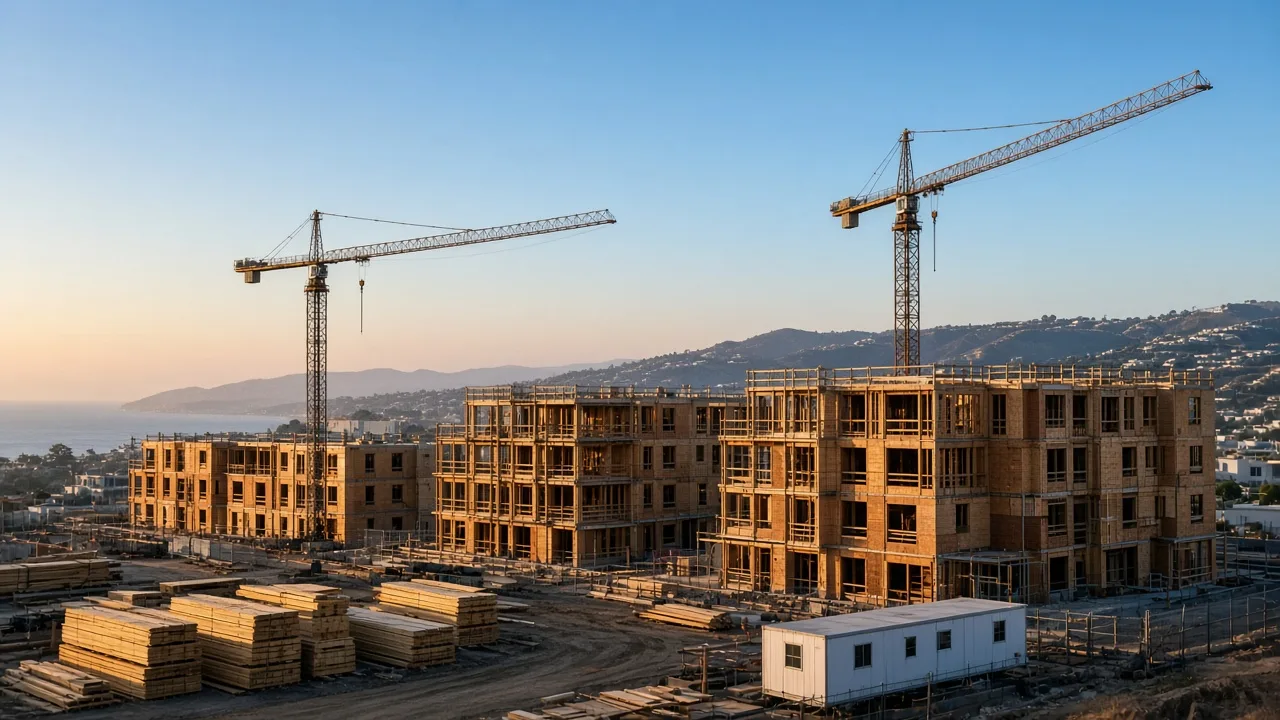
Prop 1 funds the affordable housing pipeline over the next several years, while the Prop 45 defeat keeps the approvals clock exactly where it is.
What the results mean for your portfolio.
No single outcome rewrites the San Diego market overnight. Together they set the long-run supply, demand, financing, and tax variables investors underwrite against. Here is the practical read.
The supply pipeline is now funded, slowly
Prop 1 puts roughly $10 billion in general obligation capital behind rental housing, supportive housing, and homeownership programs, drawn down over years. Multifamily and land investors should watch where subsidized projects are proposed and underwrite around growing future competition rather than this year’s delivery count.
Approvals stay on the old clock
With Prop 45 defeated, the CEQA review timeline is unchanged. Entitlement risk and review time remain real costs in every development underwriting, and nobody gets the promised fast-track shot clocks for housing projects.
New-home demand gets a second mortgage
Prop 37 adds buying power only for newly built homes, once CalHFA stands the program up in 2027. New-home communities, infill townhome projects, and condo conversions could see stronger traffic, while the resale market competes for the same buyers without the subsidy.
A wealth-tax firewall for portfolios, locked in
Prop 42 shields investment accounts, notes, retirement funds, and business interests from a new state wealth or asset tax and protects against retroactive tax increases. Prop 40’s billionaires’ tax was also defeated, and Prop 42 outpolled it, so its protections control. Real property taxation is untouched, preserving the Prop 13 framework investors underwrite against.
Local special taxes stay a simple-majority game
With Prop 43 defeated, cities and the county keep the ability to pass dedicated special taxes by simple majority. Combined with the June vacancy tax defeat, the message from voters is mixed, and underwriting should treat new local revenue measures as a live possibility rather than a foregone conclusion.
A direct hit on SDUSD property owners
Measure M is the one measure on this ballot with a direct property tax levy attached, and it passed. Owners inside San Diego Unified should model the $32 per $100,000 of assessed value, about $320 per year on a $1 million assessment, into 2027 underwriting, even though proponents describe it as extending an existing rate rather than raising it.
Two cliffhangers left to watch
Measure B and Measure A both hold narrow leads at roughly 51.6% to 51.7% yes with mail ballots outstanding. County certification in the coming weeks settles whether the half-cent sales tax and the charter reform take effect. Both change local costs or governance, not the tax bill on a specific property.
Bottom line for investors: treat the results as a risk-and-opportunity map, not a catalyst. The supply measures are multi-year, the demand measure is confined to new construction and still being stood up, the tax measures protect or shape the perimeter of the portfolio, and the only direct property tax levy is Measure M in San Diego Unified. Underwrite San Diego Unified properties for the $32 per $100,000 levy, file Prop 8 appeals by November 30, watch the December 9 FOMC meeting before locking, and follow the certification of Measures A and B.
The dates that matter between now and the new year.
The ballot is one item on a dense year-end calendar. These are the dates San Diego investors should have pinned before the holidays.
Proposition 8 decline-in-value appeal deadline
The deadline to apply for a Prop 8 assessment review with the San Diego County Assessor. Entirely independent of the election, this remains the most valuable year-end property tax action for owners whose market value sits below assessed value.
County certification of Measure A and Measure B
San Diego County will certify the results of the two close races, settling whether the half-cent sales tax and the charter reform take effect. The school bond, Measure M, already cleared its threshold.
Final FOMC meeting of 2026
The last rate decision of the year, with the 30-year fixed at 7.32% and the federal funds range at 3.75% to 4.00%. Lock strategy and refinance windows hinge on the bond market reaction through year-end.
New California landlord-tenant laws arrive
AB 2025 digital rental ad image disclosures, the SPARE Act service rules, the new SUM-130 summons, and SB 594 for short-term rental platforms all take effect alongside whatever certified local measures dictate.
CalHFA and Prop 1 rollouts begin
CalHFA designs and begins issuing Prop 37 down payment assistance bonds for newly built homes, and state agencies begin drawing down the Prop 1 housing bond for rental and homeownership programs across the state.
Related reading: our November 2026 ballot guide explains every measure in full detail, our year-end 2026 investor playbook covers the rate and calendar math, and our California property tax guide walks through the Prop 8 appeal process in detail.
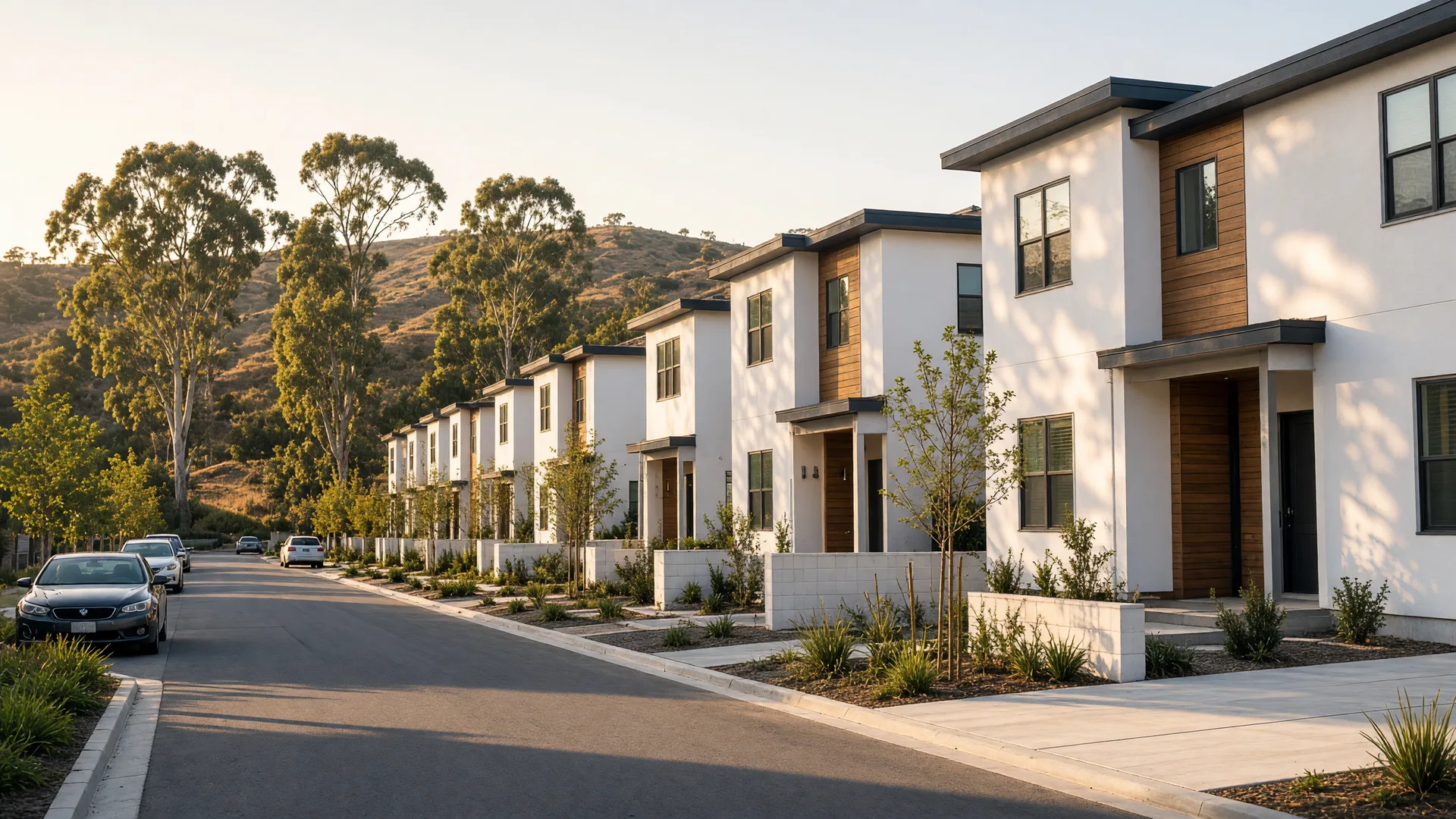
Prop 37 points down payment assistance at newly built homes like these, while the resale market competes for the same buyers without the subsidy.
Frequently asked questions.
Which statewide measures passed on November 3?
Which statewide measures passed on November 3?
When can buyers actually use the Prop 37 assistance?
When can buyers actually use the Prop 37 assistance?
What does Prop 1 passing mean for San Diego supply?
What does Prop 1 passing mean for San Diego supply?
Does the Prop 45 defeat change current development projects?
Does the Prop 45 defeat change current development projects?
What happens to local special taxes now that Prop 43 failed?
What happens to local special taxes now that Prop 43 failed?
How much does Measure M cost a San Diego Unified property owner?
How much does Measure M cost a San Diego Unified property owner?
Are Measures A and B final yet?
Are Measures A and B final yet?
What should investors do now that the election is over?
What should investors do now that the election is over?
Plan around the results
and the year-end calendar.
Whether you are underwriting a San Diego Unified property, planning a Prop 8 appeal, or weighing how the new bond funding and buyer assistance change a deal, our team can help you make a data-driven decision before year-end.