
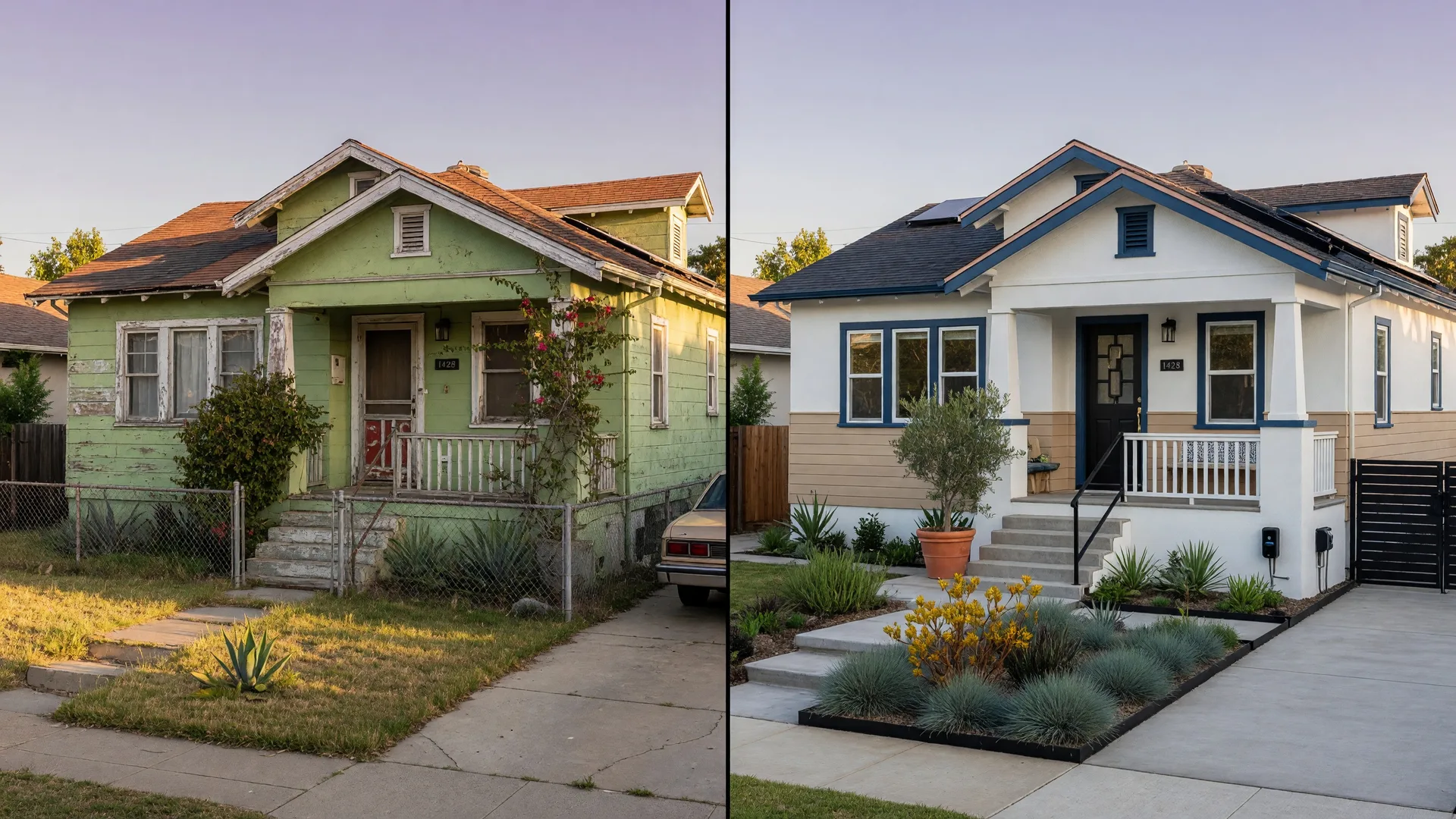
The BRRRR real estate method in San Diego.
A complete guide to using the Buy, Rehab, Rent, Refinance, Repeat method for real estate investing in San Diego County — with actionable strategies for 2026 market conditions.
Maximum purchase price as a percentage of After Repair Value (ARV) minus renovation costs — the BRRRR method's core underwriting rule.
Typical timeline for a full BRRRR cycle in San Diego, from acquisition through refinance.
Current refinance interest rates for stabilized BRRRR properties in San Diego's 2026 market.
Entry price range for BRRRR-ready properties in San Diego's inland value-add neighborhoods.
The BRRRR method — Buy, Rehab, Rent, Refinance, Repeat — is one of the most powerful strategies for building a real estate portfolio with recycled capital. Instead of saving for a 20% down payment on each new property, BRRRR investors let the same capital work across multiple deals by creating equity through renovation and extracting it through refinance.
In San Diego's high-price market, the BRRRR method offers a path to portfolio growth that is otherwise difficult with conventional buy-and-hold strategies. A typical BRRRR cycle in the county requires $450,000–$650,000 in total capital (buy + rehab), but if executed correctly, the refinance step recovers 90%–100% of that capital — allowing the investor to acquire the next property with the same funds.
The method is not without challenges in San Diego. High acquisition costs, stringent California building codes, elevated labor costs, and a 6.5%–8.5% refinance rate environment all demand disciplined underwriting and conservative projections. But for investors who source the right deals and execute renovations effectively, BRRRR remains one of the most capital-efficient strategies available.
This guide covers every step of the BRRRR method as it applies to San Diego's 2026 market: how to find and underwrite off-market deals, what renovations deliver the highest return on investment, how to structure the refinance for maximum capital recovery, and which neighborhoods offer the best BRRRR opportunities right now.
We also address the specific challenges of using BRRRR in California — from Title 24 energy compliance to appraisal risk and higher renovation costs — and provide practical strategies to overcome each one. Whether you are executing your first BRRRR or looking to refine an existing strategy, this guide is designed to help you deploy capital efficiently and responsibly in the San Diego market.
How does the BRRRR method work?
The BRRRR method consists of five sequential steps. Each step builds on the previous one, and the entire cycle depends on executing each phase correctly — from the initial underwriting to the final refinance.
Buy
Purchase a distressed or undervalued property at no more than 70% of the estimated After Repair Value (ARV), subtracting renovation costs. The 70% rule ensures enough equity to recover your capital at refinance. In San Diego, off-market deals through probate, pre-foreclosure, and expired listings are the primary source of BRRRR-ready inventory.
Key detail: Target 70% of ARV minus repairs. Example: ARV of $700,000 minus $50,000 in repairs equals $440,000 max purchase price. Use hard money or bridge loans for speed.
Rehab
Renovate strategically to maximize the post-rehab appraisal. Focus on kitchen and bathroom updates, fresh paint, flooring, landscaping, and curb appeal. In San Diego, energy-efficient upgrades (solar, dual-pane windows, tankless water heaters) can qualify for state and federal incentives while boosting rental desirability.
Key detail: Kitchen and bath renovations deliver 70%–100% ROI. California energy-efficiency incentives can offset upgrade costs by 15%–30%. Budget 15% contingency for unexpected findings.
Rent
Place a reliable tenant and establish consistent rental income. Thorough tenant screening — credit check, income verification, rental history, and California-compliant background screening — is essential. A stabilized lease history of 3–6 months strengthens the refinance application and demonstrates the property's income-generating capacity to the lender.
Key detail: Target 1 month of vacancy during lease-up. Screen tenants with credit score 650+, income 3x rent, and positive rental references. California AB 1482 compliance is essential.
Refinance
After the property is stabilized with a tenant, perform a cash-out refinance based on the new, higher appraised value (ARV). The goal is to pull out enough capital to repay the initial acquisition and renovation costs — ideally 100% or more. A DSCR or conventional investment loan is typically used for the refinance. The refinance is not a taxable event.
Key detail: Target 70%–75% LTV on ARV. At $700,000 ARV and 70% LTV, the new loan is $490,000. If your total buy + rehab = $490,000, all capital is recycled. Expect 6.5%–8.5% refinance rates in 2026.
Repeat
Use the recovered capital — plus any appreciation equity — to acquire the next BRRRR property. Each cycle compounds your portfolio growth without requiring new out-of-pocket capital. Investors with a successful first BRRRR can scale to 3–5 properties within 12–24 months using the same recycled capital.
Key detail: Successful BRRRR investors target 3–5 properties in the first 24 months. Each cycle compounds returns. Build your deal-finding pipeline while the current property is under renovation.
Is San Diego a good market for the BRRRR method?
San Diego presents both opportunities and challenges for BRRRR investors. The market's structural undersupply, strong employment base, and steady appreciation support the long-term value creation that BRRRR depends on. But the county's high baseline prices and construction costs require more disciplined sourcing and underwriting than in lower-cost markets.
San Diego Advantages
- Structural supply deficit: Chronic housing undersupply supports long-term appreciation and value growth through renovation.
- Strong tenant demand: Military, biotech, tourism, and education employment anchors create consistent rental demand across price points.
- Value-add inventory: Older housing stock in inland neighborhoods provides ample opportunities for forced appreciation through renovation.
- Proposition 13 tax protection: Property taxes are locked in at purchase and capped at 2% annual increases, protecting long-term returns.
San Diego Challenges
- High baseline prices: Finding deals at 70% of ARV requires off-market sourcing and disciplined underwriting. MLS listings rarely pencil.
- Stringent building codes: Title 24 energy standards, seismic requirements, and local permitting add 10%–15% to renovation costs.
- Elevated labor costs: Skilled trades in San Diego cost 20%–35% above national averages, and contractor availability is tight.
- Higher interest rates: 2026 refinance rates of 6.5%–8.5% make full capital recovery more challenging than in the low-rate era.
How do you execute each BRRRR step in San Diego?
Each step of the BRRRR method requires specific knowledge and execution to succeed in San Diego's unique market conditions.
Step 1: Buy — Sourcing Off-Market Deals
The single most important factor in BRRRR success is the acquisition price. San Diego deals that satisfy the 70% rule are almost never found on the MLS. Focus your sourcing efforts on: probate and trust sales (San Diego County probate court filings), pre-foreclosure and notice of default listings, expired and withdrawn MLS listings (sellers may consider below-market offers), direct-to-seller marketing (bandit signs, door knocking, direct mail to absentee owners), wholesalers and fix-and-flip investors looking to exit quickly, and FSBO (for sale by owner) properties. Build relationships with probate attorneys, estate administrators, and real estate agents who specialize in distressed properties. A consistent deal-flow pipeline is the difference between executing one BRRRR and building a portfolio.
Step 2: Rehab — Value-Add Renovation Strategy
Renovation is where you create the equity that makes BRRRR work. In San Diego, the highest ROI renovations include: kitchen updates (minor remodels recoup 70%–80% at resale), bathroom renovations (recoup 60%–70%), fresh interior and exterior paint (highest ROI of any improvement), flooring replacement (hardwood or LVP over carpet), curb appeal landscaping (drought-tolerant California native plants), and energy-efficiency upgrades (solar, dual-pane windows, tankless water heaters — often with state incentives). California requires permits for structural work, electrical, plumbing, HVAC, and additions. Unpermitted work discovered during appraisal can prevent refinancing. Always budget a 15%–20% contingency for unexpected findings — common in older San Diego homes.
Step 3: Rent — Tenant Placement Strategy
With the renovation complete, the property must demonstrate stabilized rental income to qualify for refinancing. Key steps: price the unit based on comparable San Diego rentals (not your personal target), conduct thorough tenant screening (credit score 650+, income at least 3x rent, positive landlord references, no eviction history), use the California Association of Realtors lease agreement with all required disclosures (AB 1482, lead-based paint, mold, military ordnance), and collect a security deposit capped at one month's rent (as of July 2024 California law). A 3–6 month lease history is typically required before refinance lenders will consider the property stabilized. During this period, keep meticulous rent rolls and expense records.
Step 4: Refinance — Capital Recovery Strategy
The refinance is where you recover the capital you deployed in Steps 1 and 2. The goal is to cash out at 70%–75% loan-to-value (LTV) based on the new appraised value (ARV). At a $700,000 ARV with 70% LTV, the new loan is $490,000. If your total acquisition cost (purchase + rehab + carrying costs) is $490,000 or less, all your capital is recycled. DSCR loans are the most popular BRRRR refinance product — they qualify based on the property's rental income rather than personal income. Conventional investment loans are an option for borrowers who meet debt-to-income requirements. The refinance itself is not a taxable event, so the cash-out proceeds are tax-free. Expect 4–6 weeks for the refinance closing process.
Step 5: Repeat — Scaling Your Portfolio
With your capital recovered and a stabilized rental property in your portfolio, you repeat the cycle. Each BRRRR cycle grows your portfolio by one property without requiring new out-of-pocket capital. Successful San Diego BRRRR investors typically scale from 1 to 3–5 properties within 12–24 months. Key considerations for scaling: maintain adequate cash reserves across your portfolio (6+ months of operating expenses per property), build systems for property management before you have more units than you can manage personally, keep a pipeline of potential deals flowing even while executing the current cycle, and monitor refinance rates to time your cash-outs advantageously. The compounding effect of BRRRR is powerful — each recycled dollar works across multiple deals over time.
Which San Diego neighborhoods are best for BRRRR in 2026?
Not every San Diego neighborhood is suitable for the BRRRR method. The best targets combine below-median entry prices, room for forced appreciation through renovation, strong rental demand, and realistic refinance values. These four inland neighborhoods offer the most consistent BRRRR opportunity in 2026.
| Neighborhood | Entry Price | ARV Range | Typical Rehab | Cap Rate | Outlook |
|---|---|---|---|---|---|
| City Heights | $550K–$700K | $650K–$800K | $40K–$70K | 5%–6.3% | Strong — El Cajon Blvd redevelopment driving values |
| National City | $450K–$600K | $550K–$700K | $35K–$60K | 6%–7% | High — lowest entry point in the county |
| El Cajon | $500K–$650K | $600K–$750K | $40K–$65K | 5.5%–6.5% | Solid — growing demand from first-time buyers and families |
| Chula Vista | $600K–$750K | $700K–$850K | $45K–$75K | 5%–6% | Good — Bayfront redevelopment driving long-term appreciation |
For a broader view of investment neighborhoods across San Diego, including cash flow and appreciation strategies, see our Neighborhood Investment Spotlights guide and First-Time Investor Tips for neighborhood tier analysis.
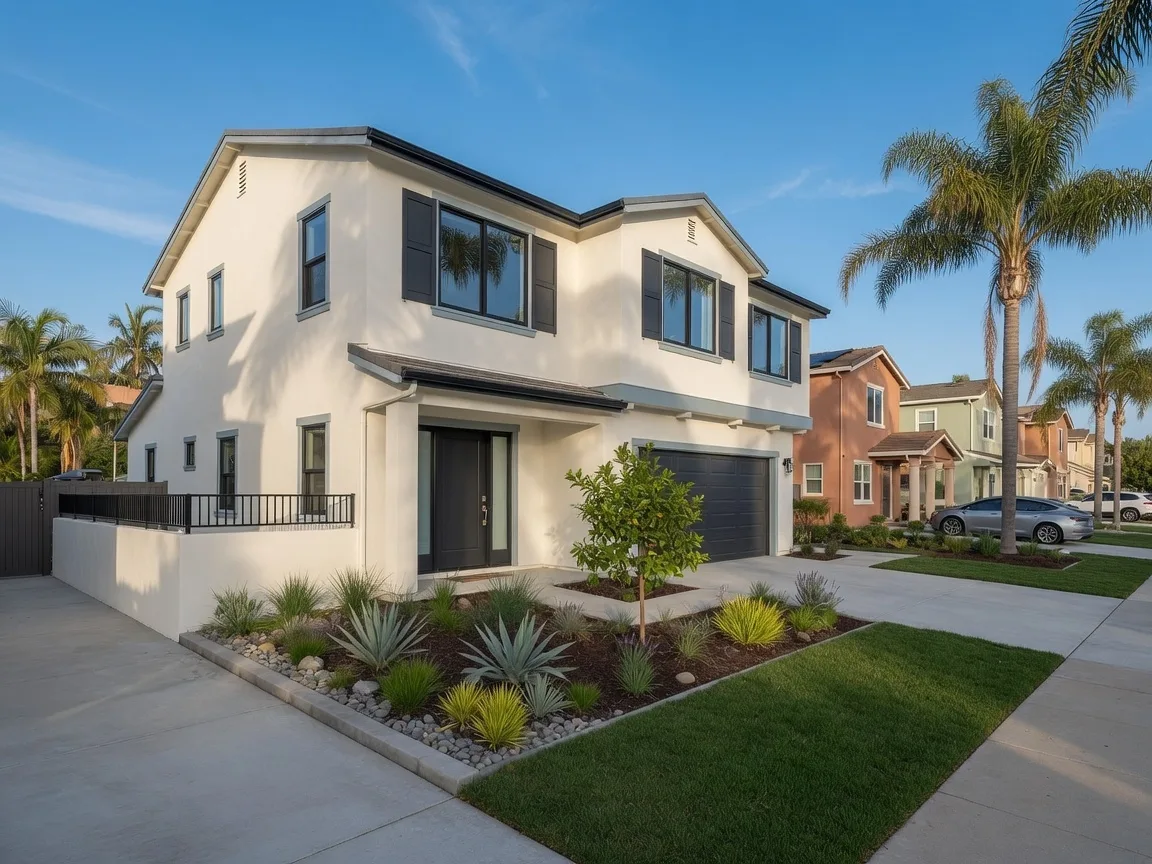
A successfully renovated BRRRR property in a San Diego inland neighborhood, showing the value-add potential of strategic rehabilitation.
What challenges do BRRRR investors face in San Diego and how do you overcome them?
California's regulatory environment, elevated costs, and market dynamics create specific challenges for BRRRR investors. Here is how to address each one.
High Acquisition Costs
San Diego's median home price above $950,000 makes finding deals that satisfy the 70% rule difficult. Off-market sourcing through probate, pre-foreclosure, trust sales, and expired listings is essential. Investors who rely solely on MLS listings will struggle to find BRRRR-ready deals.
Strategy: Build relationships with probate attorneys, trust administrators, and wholesalers. Target C-class neighborhoods in inland submarkets where value-add opportunities are more common.
Stringent Building Codes
California's Title 24 energy code, seismic retrofit requirements, and local San Diego permitting standards add complexity and cost to renovations. Unpermitted work discovered during appraisal can kill the refinance — all renovations must be properly permitted and inspected.
Strategy: Work with licensed contractors who know San Diego permitting requirements. Factor 10%–15% premium for California code compliance into renovation budgets. Never skip permits.
Higher Renovation Costs
Labor and material costs in San Diego are 20%–35% above national averages. Skilled trades are in high demand, and supply chain disruptions can extend renovation timelines. A 3-month rehab in other markets may take 4–6 months in San Diego.
Strategy: Build relationships with 2–3 reliable crews before acquiring a property. Add a 15%–20% contingency to renovation budgets. Phase renovations to prioritize income-producing improvements first.
Interest Rate Environment
With 2026 refinance rates at 6.5%–8.5%, the cost of carry is higher than during the 2020–2022 low-rate era. At these rates, pulling out 100% of capital is more difficult — investors may need to leave some equity in the deal or target higher-ARV properties.
Strategy: Conservative underwriting at 70% LTV. Target properties with higher ARV-to-purchase-price spreads. Consider DSCR loans that may offer more favorable terms for stabilized rentals.
What does a typical San Diego BRRRR deal look like?
Here is a realistic BRRRR scenario in City Heights, one of San Diego's most active value-add neighborhoods. All figures are based on 2026 market conditions.
Equity remaining in property after refinance. This equity grows with market appreciation.
Estimated annual rent at $3,500/month. Net operating income after expenses: approximately $1,800–$2,400/month.
Capital available for the next BRRRR deal. Approximately 90% of initial capital is recycled.
This example assumes a City Heights property acquired off-market at $420,000 with $55,500 in renovations, appraising at $630,000 ARV. At 70% LTV refinance ($441,000), the investor recovers approximately 90% of the $488,100 total capital deployed. The remaining $47,100 stays as equity in a now-performing rental asset. Results vary by property condition, renovation scope, and appraiser judgment. Always use conservative projections and stress-test your numbers.
What are the tax advantages of the BRRRR method?
The BRRRR method offers several tax advantages that make it more efficient than traditional buy-and-hold investing. Understanding these benefits is essential for accurate return projections.
Tax-Free Refinance
The cash-out refinance is not a taxable event. Because you are borrowing against equity rather than selling the property, the proceeds are tax-free. This is a core advantage of the BRRRR method — you can recover most or all of your invested capital without triggering a tax liability.
Depreciation Deductions
Residential rental properties depreciate over 27.5 years. On a $630,000 ARV property, the depreciable basis (excluding land value) is approximately $470,000, yielding roughly $17,100 in annual depreciation deductions. This offsets rental income and reduces your taxable income by $4,000–$6,000 per year depending on your tax bracket.
Cost Segregation
A cost segregation study can reclassify 25%–40% of renovation costs into 5- and 15-year property categories eligible for accelerated depreciation (including bonus depreciation). On a $55,500 renovation, that could mean $14,000–$22,000 in accelerated first-year deductions — significantly reducing taxable income in the first year of ownership.
Mortgage Interest Deduction
Mortgage interest on both the acquisition loan (hard money or bridge) and the permanent refinance loan (DSCR or conventional) is fully deductible against rental income. At 7% on a $441,000 loan, that is approximately $30,800 in annual interest deductions — significantly reducing taxable rental income in the early years of the loan.
Important: Tax laws are complex and subject to change. The tax advantages described here are based on current IRS and California tax code as of mid-2026. Bonus depreciation percentages phase down through 2027 under current law. Consult a CPA or tax professional who specializes in California real estate investing before making investment decisions based on tax projections.
Frequently asked questions about BRRRR in San Diego.
Does the BRRRR method still work in San Diego with current interest rates?
Does the BRRRR method still work in San Diego with current interest rates?
What is the 70% rule in the BRRRR method?
What is the 70% rule in the BRRRR method?
What loan types work best for the BRRRR method in California?
What loan types work best for the BRRRR method in California?
How long does a typical BRRRR cycle take in San Diego?
How long does a typical BRRRR cycle take in San Diego?
What types of properties work best for the BRRRR method in San Diego?
What types of properties work best for the BRRRR method in San Diego?
What are the tax implications of the BRRRR method?
What are the tax implications of the BRRRR method?
What is the biggest risk of the BRRRR method?
What is the biggest risk of the BRRRR method?
Let's evaluate your
BRRRR strategy.
Our team has experience with the BRRRR method in San Diego's inland neighborhoods. We can help you identify off-market opportunities, evaluate deal economics, and connect you with renovation, lending, and property management resources.