
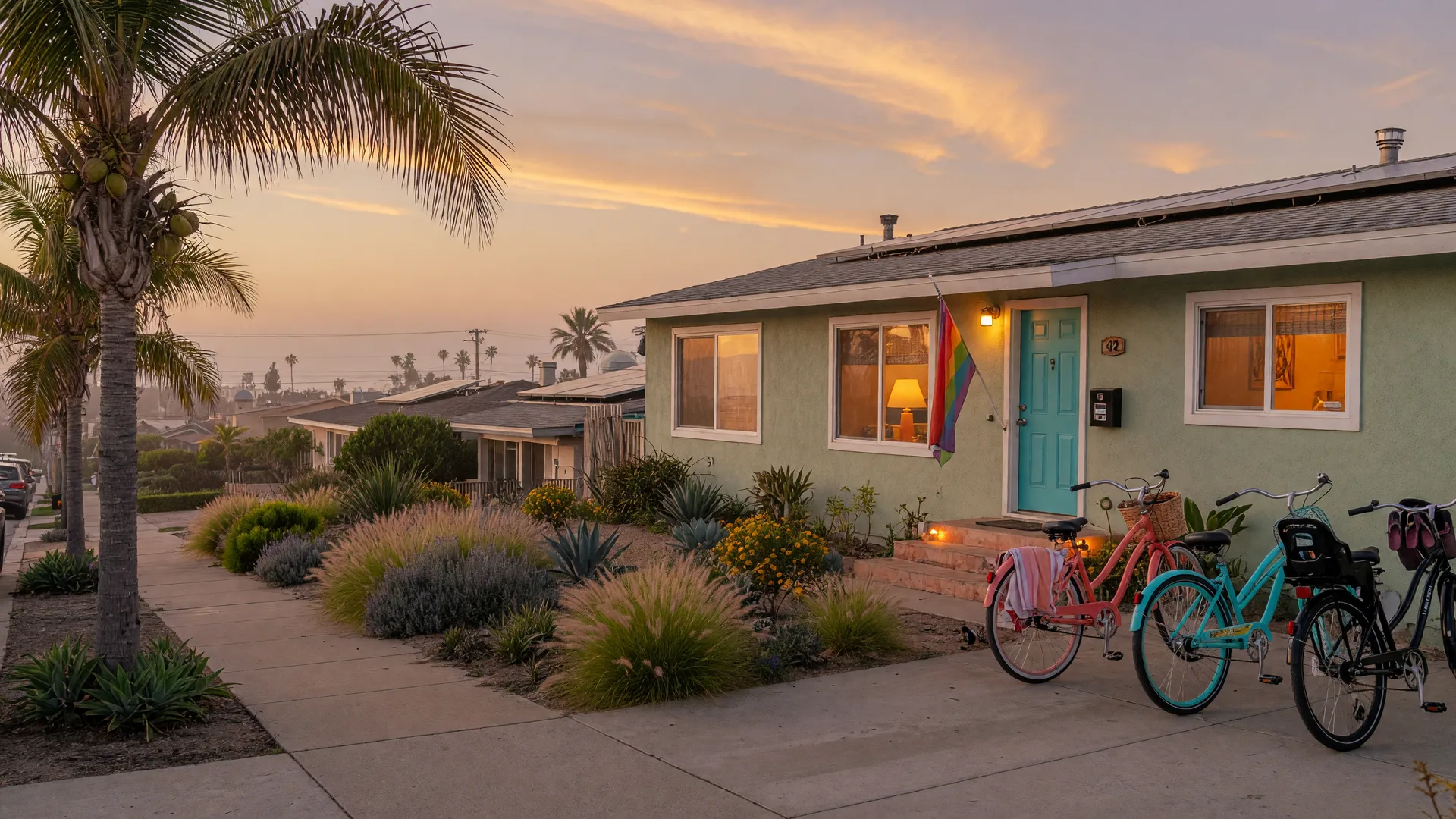
Short-term rentals in Q4 2026: the license cap nears, and what it means for investors.
San Diego's Tier 3 whole-home license cap is nearly reached, demand is holding at 65% occupancy, and a new state law lands January 1, 2027. This guide covers the numbers, the regulatory changes, and the year-end checklist for hosts and investors.
The City Treasurer reported 4,859 Tier 3 licenses issued against a cap of roughly 5,419, about 1% of housing stock. Trackers show the count shrinking through 2026, and once the cap is reached new applications move to a lottery.
AirDNA counted 18,824 active Airbnb, Vrbo, and Booking.com listings as of September 29, 2026, with a $318 average daily rate and 65% occupancy.
AirDNA's estimate for the trailing year, up from the $47K to $58K citywide range this guide reported earlier in 2026 as top coastal properties continued to outperform.
Chaptered September 25, 2026, the Short-Term Rental Facilitator Act of 2026 refines the platform data-sharing framework San Diego already uses to enforce its STRO ordinance.
The defining story of San Diego's short-term rental market in Q4 2026 is scarcity: the Tier 3 whole-home license cap is nearly reached, and every remaining permit is now a scarce asset.
The City Treasurer reported 4,859 Tier 3 licenses issued as of October 8, 2026, leaving 802 of roughly 5,419 available. Trackers following the count show it falling through the year, and once the cap is reached new applications move to a lottery. For an investor, that changes the question from "can I get a license?" to "what is a property worth with or without one?"
The demand side is holding but not booming. AirDNA counted 18,824 active listings as of September 29, 2026 with a $318 average daily rate and 65% occupancy, while hotels closed 2025 at 72.3% occupancy and the Tourism Authority forecasts about 71% for 2026. Tourism dollars are near records, but growth is flat.
Regulation keeps tightening. SB 346 platform data sharing, in effect since January 1, 2026, has already driven 16,500+ unlicensed listings off the platforms, and the city secured a $1.25 million judgment against an illegal six-property operation in June. On January 1, 2027, SB 594 refines the state's facilitator reporting framework, and AB 2025 adds disclosure rules for digitally altered rental ads.
This guide updates the flagship short-term rental playbook for the current quarter: the market numbers, the license cap math, the 2027 law changes, what to underwrite before buying, and the year-end checklist every host and investor should run.
What do the latest numbers say about San Diego short-term rentals?
Four signals frame the market entering Q4 2026: occupancy holding near 65%, hotel demand flat, tourism dollars near records, and a license cap that is nearly exhausted.
Demand is holding at 65% occupancy
AirDNA reported 65% average occupancy across 18,824 active listings as of September 29, 2026, with a $318 average daily rate and roughly $66,800 in average annual revenue per listing. Occupancy held steady through the summer peak, and the citywide average daily rate remains well above the $252 to $336 range reported by other trackers earlier in the year depending on listing counts and measurement windows.
Hotel demand is flat, which matters for STR pricing
San Diego hotels closed 2025 at 72.3% occupancy with a $213 average daily rate, down about two points, the first decline since 2018 outside the pandemic. The San Diego Tourism Authority forecasts occupancy slipping a few more points to roughly 71% in 2026, pressured by new supply including the 1,600-room Gaylord resort. When hotel occupancy softens, STR operators feel it in shoulder-season pricing, even if summer holds.
Tourism dollars are still near records
San Diego hosted about 32.5 million visitors in 2024 with $14.8 billion in spending, and 2025 was tracking near 32.8 million visits and $15 billion. Heading into 2027, hotel revenue is at records and international arrivals are back to pre-pandemic levels, with the 2026-27 cruise season underway since September. The demand base for short-term rentals remains large, but it is growing slowly rather than surging.
The Tier 3 license cap is the real constraint
The City Treasurer reported 4,859 Tier 3 licenses issued as of October 8, 2026, leaving 802 of roughly 5,419 available. Tracker sources show the remaining count falling from about 829 in mid-2026 to 816 in September and 799 in late September. When demand exceeds availability, Tier 3 licenses are issued by lottery. Tier 4 (Mission Beach) is fully closed, and Tier 1 and Tier 2 remain uncapped.
The data-summary math: 18,824 active listings at a $318 average daily rate and 65% occupancy produce roughly $66,800 in average annual revenue per listing, but the distribution is steep. Coastal whole-home product in La Jolla and Mission Beach earns multiples of inland and downtown listings, and the license cap means the most profitable coastal niches are also the hardest to enter.
How close is San Diego to exhausting the Tier 3 cap?
With 802 of roughly 5,419 Tier 3 licenses left as of October 8, 2026, the whole-home license is becoming the scarcest input in San Diego's STR investment math.
The cap is roughly 1% of housing stock
Tier 3 whole-home licenses are capped at about 5,419 citywide, approximately 1% of the city's housing stock. The City Treasurer reported 4,859 issued as of October 8, 2026, leaving 802 available. Trackers following the count show it falling through 2026: about 829 in mid-2026, 816 in September, and 799 in late September.
Exhaustion triggers a lottery
Once the cap is reached, new Tier 3 applications go into a lottery rather than a first-come queue, per the city's published rules. That changes the economics of entry: an investor who buys a property today without a license is buying a chance in a lottery, not a guaranteed permit.
Licenses attach to the operator, not the property
STRO licenses are issued to the host or operator, and the Good Neighbor Policy obligations follow the license. When a property with an active license changes hands, the buyer cannot simply inherit the license; the transfer rules and the current operator's compliance history matter. Verify before you underwrite.
Enforcement keeps tightening
SB 346 platform data sharing, effective January 1, 2026, lets the city cross-reference listings automatically. Over 16,500 unlicensed listings have been removed since the STRO program launched, and the city secured a $1.25 million judgment in June 2026 against a six-property illegal operation. Unlicensed operation is no longer a viable strategy.
A balanced view: license scarcity cuts both ways. It raises the value of properties that already hold an active license and reduces new competition for licensed operators, but it also means a buyer without a license is purchasing lottery odds, not a permit. Tier 1 and Tier 2 remain uncapped for owner-occupants and part-time hosts, and the 30-night mid-term rule remains the most reliable path for investors who cannot secure a Tier 3 license.
Where does the STR market sit against the wider backdrop?
4,859 issued against a roughly 5,419 cap; trackers show the count falling from about 829 in mid-2026. Exhaustion triggers a lottery.
AirDNA: 18,824 active listings, $318 average daily rate, 65% occupancy, about $66,800 average annual revenue per listing.
2025 hotel occupancy closed at 72.3% with a $213 ADR; SDTA forecasts about 71% for 2026 with new supply including the 1,600-room Gaylord.
30-year fixed for the week ending October 1, 2026, the highest since November 2023; FOMC meetings October 28 and December 9.
What new rules apply to short-term rentals in 2027?
One state law directly targets the STR facilitator framework, one touches how every rental is advertised, and local rules continue to set the day-to-day constraints.
SB 594: Short-Term Rental Facilitator Act of 2026
Chaptered September 25, 2026 (Chapter 456, Statutes of 2026), SB 594 amends the state's short-term rental facilitator reporting framework. It refines how cities can require platforms like Airbnb and Vrbo to share host and booking data, building on the SB 346 framework that took effect January 1, 2026. For licensed San Diego hosts the practical effect is modest: the city already receives platform data and cross-references it against the STRO database. For unlicensed operators, the data pipeline gets more complete, not less.
AB 2025: Digitally altered rental ad disclosures
Signed in September 2026, AB 2025 requires housing providers and advertisers to disclose clearly when a rental listing uses a digitally altered image, including AI-generated images and virtual staging. Short-term rental listings are rental housing advertising, so hosts who use enhanced photos should plan to label them and, where the image is based on a real photo, link the unaltered original. Licensed agents already carry a similar duty under AB 723, in effect since January 1, 2026.
Local rules still set the day-to-day
No other statewide STR law with a confirmed 2027 effective date surfaced in the legislative record, which means local rules continue to dominate. San Diego's STRO tiers, the Mission Beach closure, coastal city caps in Encinitas, Carlsbad, and Del Mar, and Coronado's prohibition on rentals under 26 nights in residential zones all remain the operative constraints. Know the jurisdiction before you buy.
What do the economics look like at 7.28% money?
The revenue story is unchanged, but the cost side is heavier: TOT is higher, financing is more expensive, and management and insurance costs keep rising.
Revenue still concentrates in coastal product
AirDNA's citywide average of roughly $66,800 per listing hides a wide spread. The site's neighborhood benchmarks from earlier in 2026 still hold as directional ranges: La Jolla listings run $88,000 to $171,000+ annually with ADRs up to $733, Mission Beach runs $72,000 to $102,000 at 68% to 73% occupancy, and Pacific Beach runs $55,000 to $80,000. Inland and downtown product earns less but carries lower acquisition costs.
TOT now runs 13.75% to 15.75% all-in
Measure C raised Transient Occupancy Tax rates effective May 1, 2026 to tiered levels of 11.75%, 12.75%, or 13.75% depending on zone, and some zones add a Tourism Marketing District assessment. Combined obligations typically land between 13.75% and 15.75% of gross revenue. Underwrite TOT as a first-dollar cost, not an afterthought.
Financing at 7.28% changes the deal math
The 30-year fixed averaged 7.28% for the week ending October 1, 2026, the highest since November 2023, after six straight weekly increases. DSCR and other non-QM programs still lend on STR properties, underwriting on revenue history or stabilized projections, but at rates in the 6.5% to 8.75% range with tighter stabilized-asset ratios. Re-run every deal at current money, not last year's rate.
The 30-night mid-term escape valve still works
Stays of 30 or more consecutive nights fall outside the STRO ordinance entirely: no license, no TOT. Travel nurses, military relocations, and the biotech corridor keep mid-term demand strong, and the hybrid model, short-term in peak season and mid-term in winter, remains the most flexible structure for a capped market.
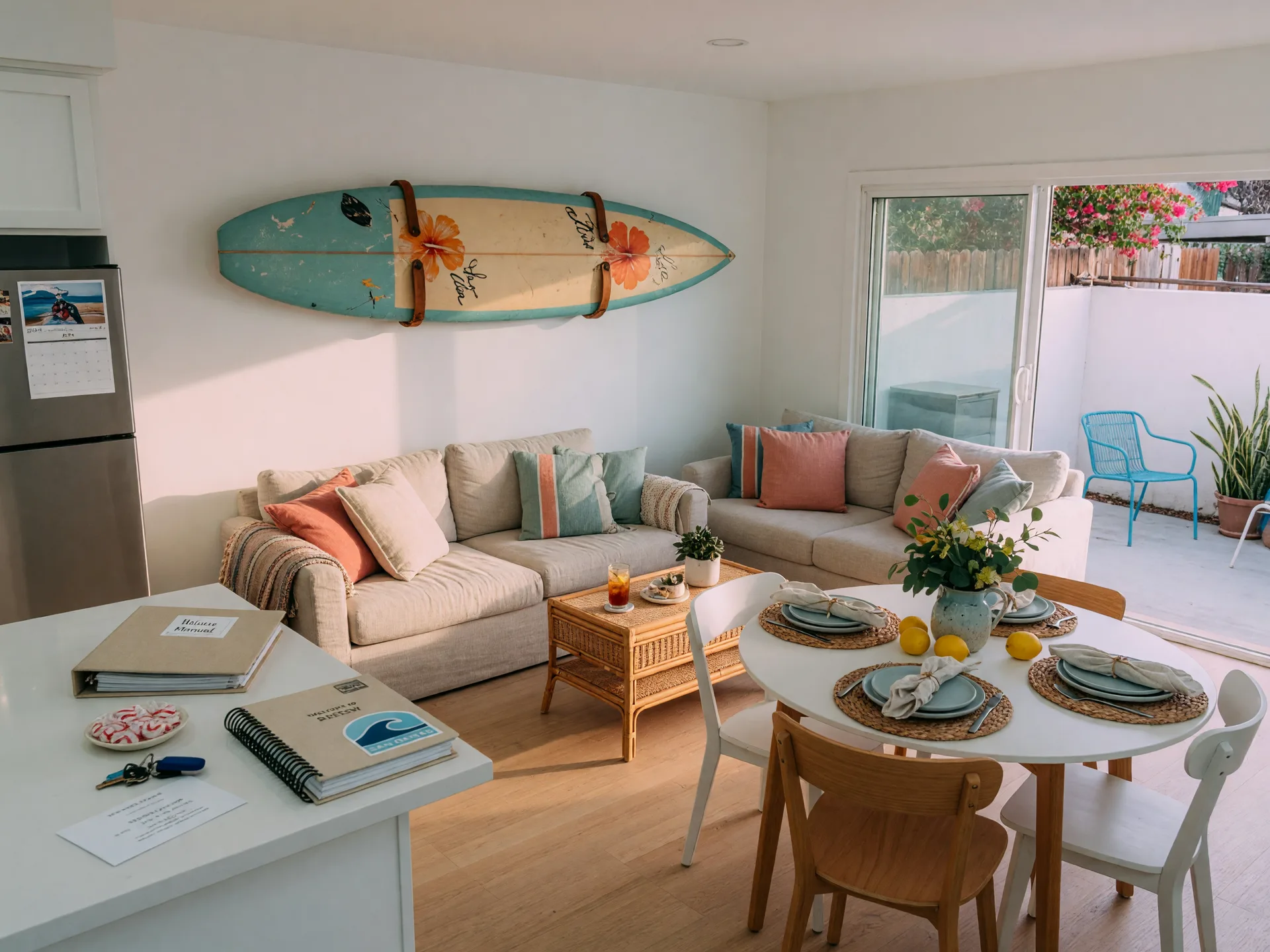
A professionally presented interior supports the nightly rate and the review score, which is why presentation and operations matter as much as the license itself.
What should investors check before buying an STR property in 2026-27?
In a capped market, the license question comes first. Run every prospective deal through these six checks before any offer.
Verify Tier 3 availability before you underwrite
The City Treasurer reported 802 Tier 3 licenses remaining as of October 8, 2026. Check the current count with the Treasurer's office before making any purchase decision that assumes a whole-home STR license. If the cap has closed, the property's STR value depends on an existing license, a lottery entry, or a mid-term strategy.
Confirm the property is actually eligible
Zoning, HOA rules, coastal zone restrictions, and local jurisdiction caps all gate whether a property can host short-term guests at all. Encinitas caps STR permits at 2.5% of eligible units, Carlsbad allows STRs only in the Coastal Zone and the La Costa Resort master plan area, Del Mar caps at 129 permits with a primary-residence requirement, and Coronado prohibits rentals under 26 nights in residential zones. Verify at the parcel level.
Underwrite at 7.28% money with realistic occupancy
Model debt service at current rates, not last year's. Use conservative occupancy: 60% to 65% for coastal product and lower for inland, with a seasonal ramp and shoulder-season dips. Add TOT at 13.75% to 15.75% and professional management at 20% to 30% of gross, or your own time cost if self-managing.
Stress-test the license and enforcement risk
If you are buying a property with an active license, confirm the license's compliance history and the transfer mechanics with the city. If you are buying without a license, price in the lottery risk and the $1,000-per-day fine exposure for any unlicensed operation. Enforcement is automated under SB 346 and active: 16,500+ listings removed and a $1.25 million judgment in June 2026.
Model the mid-term fallback
The 30-night rule is the escape valve: stays of 30+ nights need no STRO license and pay no TOT. Run the property's numbers as a furnished mid-term rental in the off-season and as a hybrid in peak season. A property that works as a mid-term rental even without an STR license is a safer buy in a capped market.
Review insurance and coastal exposure
California carriers keep tightening coastal and wildfire exposure, and STR use changes the policy. Confirm the policy covers short-term rental use, guest liability, and the structure's actual replacement cost. Start the renewal conversation 90 days out and compare quotes rather than accepting a non-renewal notice.
The year-end checklist for short-term rental hosts and investors.
File or review your Prop 8 appeal by November 30
The deadline to apply for a Proposition 8 decline-in-value assessment review with the San Diego County Assessor is November 30, 2026. If your property's market value is below its assessed value, an appeal can cut property taxes for 2026-27. See our California property tax guide for the full process.
Reconfirm license and TOT compliance before January 1
SB 594 takes effect January 1, 2027, refining the state's short-term rental facilitator reporting framework. Confirm your STRO license is current, your TOT returns are filed, and your listings display the required license number before the new year. AB 2025 also takes effect January 1, 2027, requiring disclosure of digitally altered images in rental ads.
Review insurance renewals early
STR properties need coverage that reflects short-term guest use, and coastal San Diego properties face tightening carrier appetite. Start the renewal conversation at least 90 days before expiry, confirm dwelling coverage tracks rebuild cost, and address any non-renewal notice immediately.
Re-run your underwriting at 2026 rates
With the 30-year fixed above 7% and hotel occupancy flat, re-test every STR deal: gross revenue at realistic occupancy, TOT at 13.75% to 15.75%, management at 20% to 30%, and debt service at current rates. The model that worked at 6% money can look different at 7.28%.
Plan 1099 and year-end reporting
STR income, platform payouts, and any contractor payments for the 2026 tax year hit their reporting window at the end of January 2027. Under the One Big Beautiful Bill Act the 1099 threshold rises from $600 to $2,000 for tax year 2026. Discuss depreciation, cost segregation, and platform fee treatment with a tax professional now.
Calendar anchors: October 28 and December 9, 2026 FOMC meetings; the November 30, 2026 Prop 8 appeal deadline; January 1, 2027 SB 594 and AB 2025 effective dates; and the late-January 2027 1099 filing window. Our year-end investor playbook covers the full calendar and rate math.
Go deeper on the short-term rental playbook.
The Flagship STR Guide
The four STRO tiers, TOT rates, the Good Neighbor Policy, and neighborhood revenue benchmarks in full detail.
The 30-Night Mid-Term Strategy
How stays of 30+ nights avoid STRO and TOT entirely, with furnished monthly rate benchmarks and a due diligence checklist.
Self-Managing an STR
Guest communication, turnover, multi-platform marketing, and knowing when to hand off to a professional manager.
Frequently asked questions.
How many Tier 3 licenses are left in San Diego as of Q4 2026?
How many Tier 3 licenses are left in San Diego as of Q4 2026?
What does SB 594 change for short-term rental hosts in 2027?
What does SB 594 change for short-term rental hosts in 2027?
Is the San Diego short-term rental market still profitable in late 2026?
Is the San Diego short-term rental market still profitable in late 2026?
How do 7%+ mortgage rates affect STR investing in San Diego?
How do 7%+ mortgage rates affect STR investing in San Diego?
Can I convert a short-term rental to a mid-term rental to avoid the cap?
Can I convert a short-term rental to a mid-term rental to avoid the cap?
What are the key year-end 2026 deadlines for STR hosts?
What are the key year-end 2026 deadlines for STR hosts?
Where can investors learn more about San Diego short-term rentals?
Where can investors learn more about San Diego short-term rentals?
Navigate the capped STR market
with a data-driven team.
Whether you own a property suited to short-term rental use, want to evaluate license availability, or need help structuring a mid-term strategy that protects your income, our team can help you make a data-driven decision.